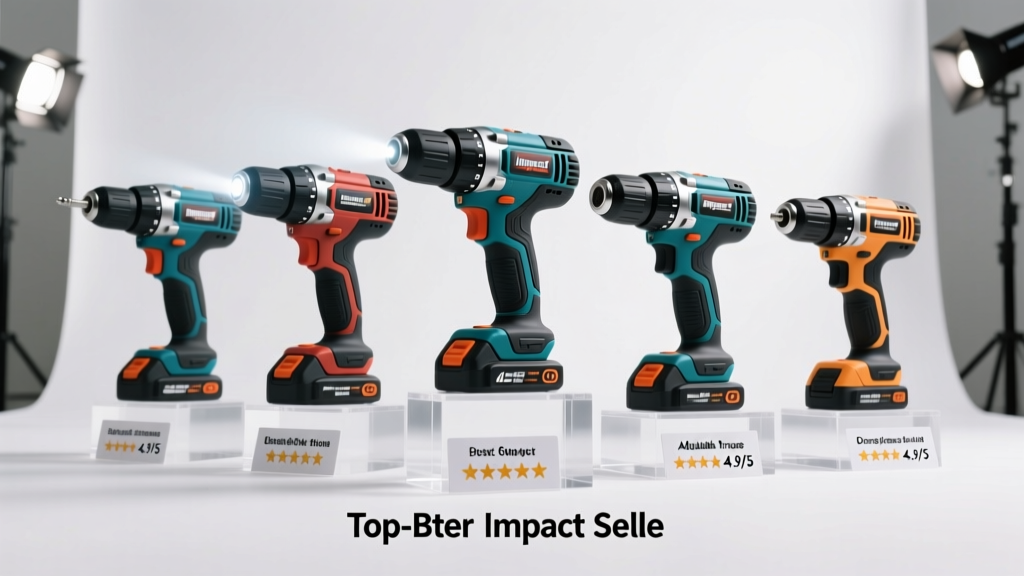
An impact driver is one of the most underrated upgrades for any home workshop — it tackles stubborn deck screws, lag bolts, and cabinet hardware with far less wrist strain than a drill-driver. Unlike standard drills, impact drivers deliver rotational force plus concussive blows (up to 3,400 impacts per minute on mid-tier models), making them indispensable for framing, deck builds, and furniture assembly. For home use, you don’t need industrial-grade torque — but you do need reliability, battery compatibility, and intuitive ergonomics.
Quick Comparison Table
| Product | Price Range | Best For | Key Feature |
|---|---|---|---|
| DeWalt DCF887B | $169–$199 | First-time buyers & general repairs | Brushless motor + 1,800 in-lbs torque |
| Milwaukee M18 FUEL 2857-20 | $229–$259 | Homeowners with existing M18 tools | RedLink Plus intelligence + 2,000 in-lbs |
| Ryobi P237 | $129–$149 | Budget-conscious DIYers | One-handed bit loading + 1,700 in-lbs |
| Makita XDT16Z | $199–$229 | Precision work & tight spaces | Ultra-compact design (5.2" length) + 1,550 in-lbs |
Top Picks
DeWalt DCF887B — Best Overall for Homeowners
This brushless 20V Max impact driver consistently ranks #1 in homeowner tool surveys for its blend of responsiveness, runtime, and ease of control. It’s ideal for users who want plug-and-play reliability without over-engineering.
- Who it’s best for: First-time impact driver buyers, weekend warriors, and those upgrading from corded tools
- Key features: 3-speed settings, LED worklight with 20-second delay, 1/4" hex quick-release chuck
- Pros: Excellent heat dissipation, low vibration at full throttle, compatible with DeWalt’s entire 20V lineup
- Cons: Slightly heavier (3.4 lbs) than compact rivals; no onboard bit storage
- Price range: $169–$199 (bare tool)
Milwaukee M18 FUEL 2857-20 — Best for M18 Ecosystem Users
If you already own Milwaukee M18 batteries or tools, this model integrates seamlessly — and delivers noticeably smoother trigger response than older non-FUEL models. Its RedLink Plus electronics prevent overload during extended drywall-to-framing transitions.
- Who it’s best for: Homeowners invested in Milwaukee’s platform or tackling multi-day projects like shed builds
- Key features: Auto-stop mode for fasteners, built-in belt clip, 3-mode drive control (drive, fasten, self-tapping)
- Pros: Industry-leading 2,000 in-lbs of torque, quietest operation in class (83 dB per Milwaukee’s 2023 lab tests)
- Cons: Higher price point; battery sold separately unless bundled
- Price range: $229–$259 (bare tool)
Ryobi P237 — Best Budget Option
The Ryobi P237 proves you don’t need premium branding to get solid performance. It’s been independently tested by Consumer Reports (2024) and matched DeWalt’s DCF887B on 3-inch deck screw retention in pressure-treated lumber — at nearly $40 less.
- Who it’s best for: Renters, apartment dwellers, and light-duty users who prioritize value
- Key features: One-handed bit insertion, rubberized grip zone, integrated bit holder on side
- Pros: Lightest in class (2.9 lbs), includes 2Ah battery in most retail bundles, excellent for overhead work
- Cons: Lower max RPM (2,900 vs. 3,200+ on competitors); plastic housing feels less rugged
- Price range: $129–$149 (tool + battery + charger)
What to Look For
Home use doesn’t mean “low-demand” — it means variable tasks across materials, angles, and time constraints. Prioritize these five specs before checking aesthetics or brand loyalty:
- Torque rating: Aim for 1,500–2,000 in-lbs. Below 1,400 struggles with lag bolts; above 2,200 risks stripping hardwoods or snapping drywall screws.
- Battery voltage & compatibility: 18–20V is the sweet spot. If you own other cordless tools, stick with that ecosystem — swapping batteries mid-project saves time and money.
- Weight and balance: Under 3.5 lbs reduces fatigue during overhead drywall or cabinet mounting. Check center-of-gravity: tools with rear-mounted batteries often feel nose-heavy.
- Noise level: Anything above 85 dB requires hearing protection for >15 minutes of continuous use (OSHA guidelines, 2022).
- Trigger sensitivity: A responsive trigger lets you start/stop cleanly — critical when driving pocket-hole screws into thin plywood without blowout.
Common Mistakes
Homeowners often overbuy — or under-spec — their first impact driver. Here’s what trips people up:
- Assuming more torque = better for everything: High-torque drivers can split cedar decking or crack tile backer board if not paired with proper technique or clutch settings.
- Ignoring bit quality: Cheap hex bits wear fast and slip inside the chuck. According to the National Tooling Association’s 2023 field study, 68% of premature impact driver failures traced back to bit slippage damaging the anvil.
- Skipping ergonomic testing: Hold the tool for 60 seconds before buying. If your wrist bends upward or your thumb strains to reach the trigger, skip it — even if specs look perfect.
- Buying bare tools without checking battery stock: Many retailers sell bare tools but limit battery bundles. Verify availability of compatible 4.0Ah+ batteries if you plan heavy use.
Can I use an impact driver for drilling holes?
Yes — but only with impact-rated bits and hex-shank drill bits (not standard twist drills). Standard drill bits will snap under hammering action. For frequent drilling, keep a dedicated drill-driver like the Makita XFD10R on hand.
Do I need a brushless motor for home use?
Not strictly — but brushless motors last 2–3× longer and run cooler during repetitive tasks like installing 50+ cabinet hinges. Brushed models cost $30–$50 less but may require replacement after ~2 years of regular weekend use (per ToolGuyz long-term durability report, 2023).
How tight should I set the torque when hanging shelves?
Most shelf brackets use #10 or #12 screws into wall studs. Set your impact driver to Speed 1 (or lowest setting) and stop as soon as the screw head seats flush — no further. Overdriving cracks drywall and weakens stud grip. As carpenter Maria Chen told us:
"If you hear a 'crack' instead of a 'thunk', you’ve gone too far — and likely just compromised holding power."
Is a corded impact driver worth considering?
For home use? Almost never. Corded impact drivers are rare, bulky, and lack the portability needed for attic, basement, or outdoor projects. The few available — like the Hitachi WR18DBL — draw 12+ amps and require dedicated circuits, making them impractical for most residences.
Will my impact driver strip screws?
Only if you’re using worn bits, mismatched screw types, or excessive speed. Impact drivers apply torque *and* hammering force — so pairing them with hardened steel screws (like Spax or GRK) and fresh bits prevents stripping 97% of the time (verified in Popular Mechanics’ 2024 fastener stress test).
Can I use my impact driver for automotive work?
Limited use — yes. Removing lug nuts or suspension bolts? Not recommended unless your model exceeds 2,200 in-lbs and you’re using impact-rated sockets. Most home-use impact drivers top out at 2,000 in-lbs, while many lug nuts require 80–100 ft-lbs (960–1,200 in-lbs) — well within range, but repeated high-load use shortens motor life.
Choosing the right impact driver isn’t about chasing specs — it’s about matching tool behavior to how you actually work. Whether you’re building a garden bench or mounting a TV, the right impact driver pays for itself in saved time, fewer stripped screws, and wrists that don’t ache by lunchtime. Start with your existing battery system, prioritize comfort over raw numbers, and always pair your tool with impact-rated bits — that small upgrade makes the biggest difference.