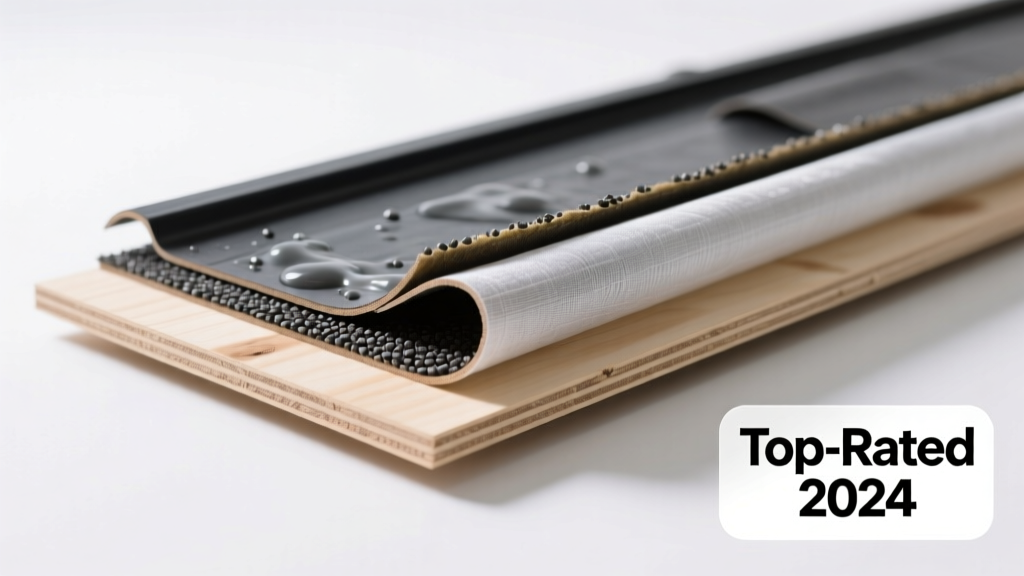
Ice and water shield is your roof’s first line of defense against winter leaks—especially in valleys, eaves, and around chimneys. A single poorly sealed section can lead to $5,000+ in attic mold remediation or ceiling drywall replacement, according to the Insurance Institute for Business & Home Safety's 2023 report on residential water damage.
Quick Comparison Table
| Product | Price Range | Best For | Key Feature |
|---|---|---|---|
| GAF StormGuard | $75–$95 per roll (108 ft²) | New construction in cold climates | Self-sealing polymer layer with 40-mil thickness |
| Owens Corning WeatherLock | $68–$82 per roll (108 ft²) | Reroofing over existing shingles | Aggressive acrylic adhesive; works at 25°F |
| Grace Ice & Water Shield | $88–$105 per roll (108 ft²) | High-wind coastal areas | UL Class A fire rating + 120-mph wind uplift certification |
| Carlisle Syn-Tec SBS Ultra | $92–$110 per roll (108 ft²) | Flat or low-slope roof sections | SBS-modified bitumen with 60-mil thickness and peel-and-stick reliability |
Top Picks
GAF StormGuard Ice & Water Shield
Best for new builds in USDA Hardiness Zones 4–7, where ice dams form regularly. Its 40-mil SBS-modified asphalt backing resists punctures during underlayment installation, and its self-sealing layer bonds tightly over nail shanks—even after thermal cycling.
- Pros: UL 2178 certified for 12-month UV exposure; compatible with GAF shingle warranties
- Cons: Stiffer than competitors—harder to conform to complex flashing details
- Price range: $75–$95 per 108 ft² roll
Owens Corning WeatherLock Flex
Ideal for re-roofing jobs where temperature swings are common during installation. It adheres reliably down to 25°F, so you won’t need heat guns or primer in early spring or late fall—unlike Grace or Carlisle, which recommend minimums of 40°F.
- Pros: Flexible enough to wrap around pipe boots and dormer corners without cracking
- Cons: Lower UV resistance—must be covered within 30 days per manufacturer specs
- Price range: $68–$82 per 108 ft² roll
Grace Ice & Water Shield Plus
Top choice for homes near Lake Erie or the Gulf Coast, where wind-driven rain combines with freeze-thaw cycles. It’s the only widely available shield with both UL Class A fire rating and ASTM D1970 compliance for 120-mph wind uplift resistance.
- Pros: Proven performance in IBHS-certified wind/rain testing (2022 FORTIFIED Home lab trials)
- Cons: Premium price point; requires careful surface prep—dust or chalk lines reduce adhesion
- Price range: $88–$105 per 108 ft² roll
What to Look For
Not all ice and water shields perform equally—even if they meet ASTM D1970. Thickness (measured in mils), UV tolerance, low-temp adhesion specs, and compatibility with your shingle warranty matter more than brand name alone.
- Thickness: 40–60 mil is ideal—thinner versions (<30 mil) tear easily during nailing; thicker ones (>70 mil) resist conforming to ridges
- UV exposure limit: Check how many days it can sit exposed before shingling—GAF allows 12 months; Owens Corning says 30 days
- Temperature range: If installing November–March, verify low-temp adhesion rating—not just 'cold weather' marketing copy
- Warranty alignment: Some shingle warranties (e.g., CertainTeed Landmark) require specific underlayments to remain valid
Common Mistakes
Homeowners and even some contractors skip critical prep steps—or misapply the product entirely. Overlapping errors, improper fastening, and ignoring substrate conditions cause most field failures.
"We see more leaks from 2-inch overlaps than from material failure. Minimum overlap must be 6 inches—and that’s measured *after* stretching, not before," says roofing consultant Maria Lin, RRO, with over 20 years inspecting failed installations across New England.
- Using staples instead of cap nails—staples pull out under thermal expansion
- Installing over damp or dusty OSB—adhesive won’t bond, leading to edge lifting
- Skipping drip edge integration—water gets trapped behind the shield at eaves
- Assuming one layer covers all flashings—valleys and penetrations need double layers or specialty membranes like valley flashing
How much ice and water shield do I really need?
Measure your eave overhang (typically 24"–36") plus 24" up the roof slope—that’s your minimum coverage width. Then add valley coverage (36" wide, doubled), chimney/wall intersections (24" beyond each side), and skylights (12" beyond frame). Most homes need 2–4 rolls for full protection—not just the eaves. Use our roof measurement calculator to estimate precisely.
Can I install ice and water shield myself?
Yes—if you’re comfortable working on steep roofs and have a helper to unroll and align. But mistakes are costly: a single lifted seam at the rake edge can channel water into sheathing. We recommend professional installation for roofs over 6:12 pitch or homes with complex geometry—like those with intersecting gables or multiple dormers.
Does ice and water shield replace felt paper everywhere?
No. It’s only required (and code-mandated) in vulnerable zones: eaves, valleys, rakes, and around penetrations. The rest of the roof still needs synthetic underlayment or #30 felt. Using ice and water shield across the entire deck adds cost without meaningful benefit—and may trap moisture if ventilation is inadequate.
How long does it last if left uncovered?
It depends on UV stability. GAF StormGuard lasts up to 12 months uncovered; Owens Corning WeatherLock lasts 30 days; Grace recommends covering within 14 days. Prolonged exposure degrades the adhesive and makes the membrane brittle—especially in high-altitude or southern exposures.
Is there a difference between "ice and water shield" and "peel-and-stick"?
Technically, all ice and water shields are peel-and-stick—but not all peel-and-stick membranes are rated for ice dam protection. Only products meeting ASTM D1970 (with hydrostatic head test and nail sealability verification) qualify as true ice and water shield. Generic peel-and-stick underlayments often lack the polymer-modified bitumen needed for self-sealing.
Do I need it if I live in a warm climate?
Probably not for ice dams—but yes for wind-driven rain. Florida, Texas, and Southern California building codes now require it in high-wind zones (per ASCE 7-22), especially within 30 feet of the perimeter. It’s less about freezing and more about preventing water intrusion during tropical storms.
If your home sits in a snowbelt or high-wind zone, skipping ice and water shield isn’t cutting corners—it’s rolling dice with your attic insulation, drywall, and air quality. Choose based on your climate, roof complexity, and warranty requirements—not just the lowest sticker price. For related guidance, see our guides on synthetic roof underlayment and flashing installation best practices.