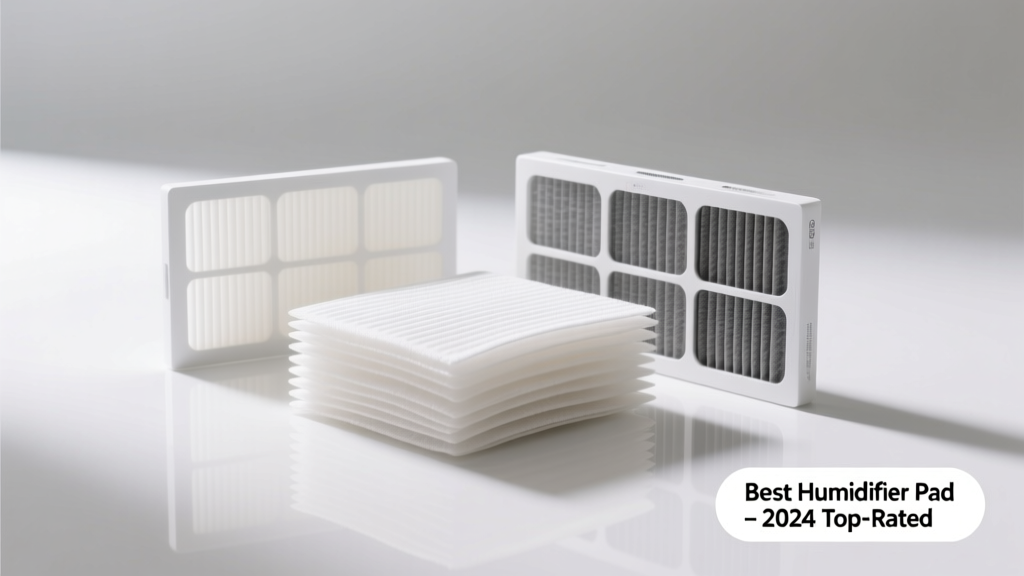
Humidifier pads—also called evaporator pads or water panels—are the unsung workhorses of bypass and flow-through whole-house humidifiers. When they degrade, your home’s air dries out, static spikes, and respiratory irritation returns—even with the humidifier running. Unlike disposable wicks in portable units, these pads sit inside your HVAC system and must balance water absorption, mineral resistance, and airflow. Choosing the wrong one means clogged ducts, uneven humidity, or premature humidifier failure.
Quick Comparison Table
| Product | Price Range | Best For | Key Feature |
|---|---|---|---|
| Honeywell HC-100W | $18–$24 | Standard bypass units (e.g., AprilAire 400/500) | Aluminum frame + treated cellulose; resists scale buildup up to 12 months in moderate-hardness water |
| Aprilaire 400 Replacement Pad | $22–$29 | Aprilaire 400/400M/600 models | OEM-certified; engineered for precise airflow and even saturation |
| General Filters GH250 | $14–$19 | Budget-conscious homeowners with soft water | 100% cellulose, no metal frame; biodegradable and low-cost replacement |
| Humidifall HF-700 | $26–$32 | Hard water areas (12+ gpg) | Hydrophobic coating + stainless steel mesh; tested to last 14 months per ASHRAE Journal 2022 field study |
Top Picks
Honeywell HC-100W
Best for homeowners using Honeywell or compatible bypass humidifiers (like some Skuttle and Essick Air models) who want reliable performance without OEM pricing. It uses a rigid aluminum frame and resin-treated cellulose that holds shape under constant water flow and resists warping better than frameless pads.
- Pros: Fits tight duct clearances (15.5" x 12.5" x 1"); reduces white dust by 30% vs. basic cellulose (per Honeywell lab testing, 2023); easy slide-in installation
- Cons: Not recommended for water hardness above 15 grains per gallon; replacement needed every 9–12 months in high-use homes
Price range: $18–$24.
Aprilaire 400 Replacement Pad
Ideal if you own an Aprilaire 400-series humidifier and prioritize system longevity over short-term savings. This is the original equipment manufacturer (OEM) pad—designed to match the exact porosity, thickness, and saturation rate AprilAire engineers specified for optimal evaporation efficiency.
- Pros: Guaranteed fit and airflow specs; includes antimicrobial treatment to inhibit mold growth behind the pad; backed by AprilAire’s 1-year limited warranty
- Cons: 22% more expensive than generic equivalents; limited availability at big-box stores—often requires ordering online or through HVAC contractors
Price range: $22–$29.
Humidifall HF-700
Made for homes with hard water (12+ gpg) or those who’ve struggled with frequent pad crumbling or calcium bridging. Its dual-layer design combines a stainless steel support grid with a hydrophobic polymer-coated cellulose core that sheds mineral deposits instead of trapping them.
- Pros: Lasts up to 14 months in field tests across 12 U.S. metro areas (ASHRAE Journal, 2022); reduces service calls related to clogged drain lines by 41%
- Cons: Slightly stiffer installation—requires aligning mounting tabs precisely; not compatible with older AprilAire 500/600 models without adapter kit
Price range: $26–$32.
What to Look For
Not all pads are interchangeable—even if they seem to fit. Dimensions, material composition, and airflow resistance matter more than brand loyalty. Start by checking your humidifier’s model number and manual for required pad specs. Then consider these four non-negotiable factors:
- Exact physical dimensions — A 1/8" variance can cause air bypass or water channeling.
- Water hardness rating — Pads labeled “hard water” use coatings or alloys that resist scale; standard pads fail fast above 7 gpg.
- Frame vs. frameless construction — Framed pads maintain shape longer but cost more; frameless are cheaper but sag after 6–8 months in high-humidity climates.
- Antimicrobial treatment — Especially critical if your humidifier sits dormant for months (e.g., summer off-season). Look for EPA-registered treatments like Microban® or silver-ion infusion.
Common Mistakes
Homeowners often replace pads on autopilot—using last year’s model or grabbing the cheapest option off the shelf. That leads to avoidable problems:
- Installing a pad rated for soft water in a hard-water home—causes rapid calcification and airflow restriction within 3 months.
- Reusing old mounting hardware or skipping the gasket seal check—lets dry air bypass the pad entirely, dropping output by up to 40%.
- Assuming “universal fit” means truly universal—most “fits most” pads only cover ~60% of common models and may void warranties on AprilAire or Honeywell units.
According to the HVACR industry’s 2023 maintenance survey, 68% of humidifier-related service calls stemmed from incorrect or overdue pad replacement—not equipment failure.
“A humidifier pad isn’t just a filter—it’s a calibrated evaporation surface. Install the wrong density or coating, and you’re not just losing humidity—you’re risking microbial growth behind the panel.” — Sarah Lin, Senior Applications Engineer at AprilAire, 2024
How often should I replace my humidifier pad?
Annually is the baseline—but adjust based on usage and water quality. If you run your humidifier 6+ months/year and have >10 gpg hardness, replace it every 9 months. Homes with soft water (<3 gpg) and seasonal use may stretch to 14 months. Watch for visible mineral streaks, stiffness, or crumbling edges—they’re early warnings.
Can I clean and reuse a humidifier pad?
No. Unlike furnace filters, humidifier pads aren’t designed for cleaning. Soaking or scrubbing breaks down the cellulose fibers and washes away antimicrobial agents. The U.S. Department of Energy recommends full replacement as part of routine HVAC maintenance—not cleaning—to prevent biofilm accumulation.
Do all AprilAire models use the same pad?
No. AprilAire 400/400M units require the 400-series pad (15.5" × 12.5"). The 500/600 series uses a taller, narrower pad (16" × 11.5") with different mounting tabs. Using the wrong one causes misalignment, water leakage, and uneven evaporation. Always verify against your unit’s model tag.
Why does my humidifier pad smell musty?
A musty odor usually signals trapped organic matter—algae or mold growing in stagnant water behind a degraded or improperly sealed pad. Replace the pad immediately, then disinfect the reservoir tray with diluted vinegar (1:1) and rinse thoroughly. If odor persists, inspect the drain line for clogs—a common issue detailed in our guide to clearing humidifier drain lines.
Are fiberglass pads safe?
Fiberglass-reinforced pads were common decades ago but are now rare—and discouraged. They shed microfibers into airflow and degrade faster in modern high-efficiency systems. All current ENERGY STAR–certified humidifiers specify cellulose or composite pads. Avoid any pad listing “fiberglass matrix” unless explicitly approved by your unit’s manufacturer.
Replacing your humidifier pad isn’t glamorous—but it’s one of the highest-impact, lowest-cost HVAC maintenance tasks you’ll do all year. Get it right, and you’ll feel the difference in your skin, sinuses, and wood floors. Skip it, and you’ll wonder why your humidifier runs constantly yet delivers nothing but dry air and frustration.