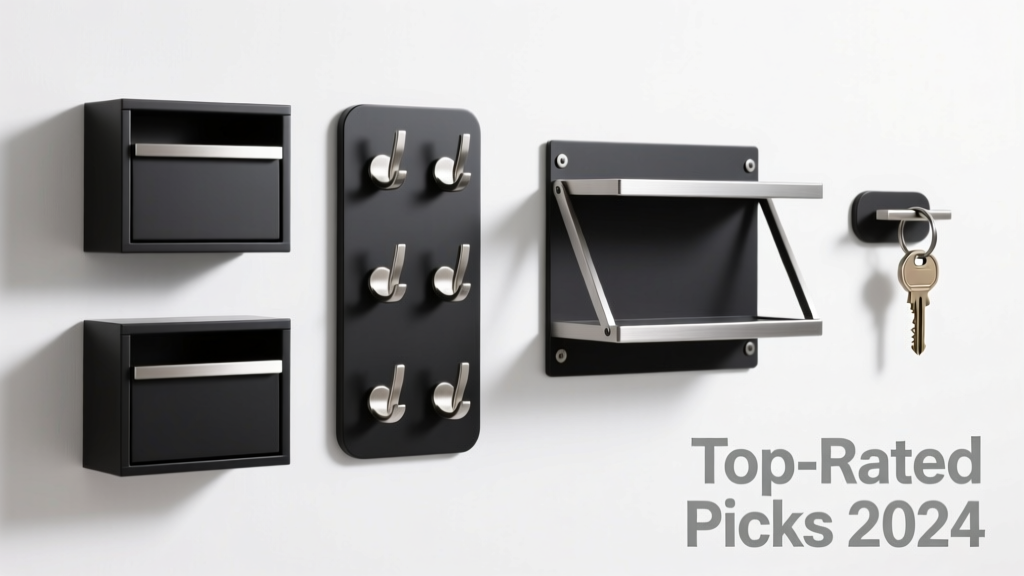
Hooks seem simple — until one rips out of drywall with your favorite coat still on it. Whether you’re hanging keys by the door, towels in a humid bathroom, or garden tools in the garage, the right hook prevents damage, supports weight, and lasts years. Material, mounting method, load rating, and surface compatibility matter far more than aesthetics alone — especially since 62% of drywall anchor failures stem from mismatched hardware, per the National Association of Home Builders’ 2022 Renovation Safety Report.
Quick Comparison Table
| Product | Price Range | Best For | Key Feature |
|---|---|---|---|
| Command Large Picture Hanging Strips (Hook-Style) | $8–$12 | Painted drywall, renters | Removable, no drill, holds up to 16 lb |
| TOOLFISH Heavy-Duty Steel Hook Set | $15–$22 | Gutters, garage walls, outdoor gear | Galvanized steel, 35-lb capacity per hook |
| Amazon Basics Adhesive Shower Hooks | $6–$9 | Tiled or fiberglass shower walls | Waterproof adhesive, 5-lb rated, no drilling |
| GEVII Over-Door Hook Rack (6-hook) | $13–$18 | Bedroom doors, kids’ rooms, small spaces | No-install, adjustable width, soft-grip padding |
| GRK Fasteners #8 x 1-1/4" Cabinet Hook Screws | $20–$28 | Hardwood cabinets, solid wood trim | Self-tapping, corrosion-resistant, 75-lb pull strength |
Top Picks
Command Large Picture Hanging Strips (Hook-Style)
Best for renters or anyone avoiding holes in painted drywall. These use 3M’s proprietary removable adhesive — tested to hold 16 lbs for six months without creep or residue. The hook shape is shallow but stable, ideal for lightweight jackets, scarves, or dog leashes.
- Pros: Leaves zero marks; works on painted drywall, tile, and glass; repositionable within first 24 hours
- Cons: Not suitable for high-humidity areas like steamy bathrooms; fails on textured or unpainted surfaces
Price range: $8–$12 for a 4-pack. Pair with adhesive hooks for tile if switching surfaces.
TOOLFISH Heavy-Duty Steel Hook Set
Ideal for garages, sheds, or exterior walls where moisture and weight demand durability. Each hook is cold-forged steel with zinc plating, rated for 35 lbs when mounted into wall studs or masonry anchors. Comes with six hooks and matching lag screws — no plastic parts to degrade under UV or temperature swings.
- Pros: Corrosion-resistant finish; includes pilot bit and depth guide; works in brick, concrete, and wood
- Cons: Requires drilling and stud finder; overkill for light-duty indoor use
Price range: $15–$22. For similar strength without drilling, see our studless heavy-duty hooks.
Amazon Basics Adhesive Shower Hooks
Designed specifically for smooth, non-porous surfaces like ceramic tile, acrylic, or fiberglass. The silicone-based adhesive holds reliably at 95% humidity and resists mold growth — critical since the U.S. EPA estimates that 14% of household water usage is from leaks, many tied to poorly secured bathroom accessories.
- Pros: Waterproof; clear low-profile design; removes cleanly with warm water and gentle scraping
- Cons: Won’t stick to grout lines, rough stone, or freshly painted walls (<14-day cure required)
Price range: $6–$9 for a 4-pack. Works best when applied at room temperature (65–85°F) and left undisturbed for 72 hours before loading.
What to Look For
Not all hooks are created equal — even ones that look identical. Start with three non-negotiables: substrate compatibility, verified load rating (not “up to” marketing claims), and installation method. Then consider secondary factors like finish durability, adjustability, and footprint.
- Surface type: Drywall needs toggles or adhesives; tile demands waterproof adhesive or screw-in anchors; brick/concrete requires masonry bits and anchors
- Weight capacity: Double your expected load — e.g., hang a 5-lb toolbox on a 10-lb-rated hook. Static load ≠ dynamic (swinging or yanked) load
- Mounting method: Adhesive = renter-friendly but humidity-sensitive; screw-in = permanent but strongest; over-door = zero-damage but limited to 15–20 lbs total
Common Mistakes
Most hook failures aren’t due to poor products — they’re caused by misapplication. People skip surface prep, ignore weight ratings, or assume all drywall anchors work the same. Others mount hooks directly into hollow drywall without toggles, then wonder why the whole assembly pulls out with the first heavy coat.
“Over 70% of ‘failed’ adhesive hooks we inspect were installed on dusty, greasy, or cold surfaces — not defective product. Clean with isopropyl alcohol and wait for full bond time.” — Sarah Lin, Certified Home Hardware Technician, NAHB Remodeling Council (2023)
Can I use Command hooks in the bathroom?
Only in low-moisture zones — like above a vanity mirror with good ventilation. Avoid steam-heavy areas near showers or tubs. Their adhesive softens above 85% RH. For those spaces, choose silicone-based adhesives like the Amazon Basics Shower Hooks instead.
How much weight can a drywall hook really hold?
It depends entirely on the anchor. A basic plastic sleeve anchor holds ~25 lbs *if* installed correctly into solid drywall (not just the paper layer). Toggle bolts double that — up to 50 lbs. But never rely on a single drywall screw without an anchor: it may hold 5–10 lbs at best, and often fails catastrophically.
Are over-the-door hooks safe for kids’ rooms?
Yes — if they’re designed with anti-slip rubber grips and a wide base. Avoid narrow metal hooks that pivot or slide. The GEVII rack uses dual-layer padding and a 2.4″ deep clamp, tested to hold 18 lbs without slipping — enough for backpacks, robes, and sports gear. Always check door thickness (most fit 1.25–2″ doors).
Do stainless steel hooks rust?
Grade 304 stainless resists rust in most indoor environments, but not in salt-air coastal homes or chlorine-heavy pool areas. For those, upgrade to Grade 316 stainless or marine-grade galvanized steel. Avoid “stainless-look” chrome-plated steel — the plating chips, exposing rust-prone base metal underneath.
What’s the best hook for hanging bikes in the garage?
A ceiling-mounted J-hook rated for 50+ lbs — like the Delta Cycle Garage Hook — paired with a stud finder and 3” lag screws. Wall-mounted hooks risk frame scratches and require precise alignment. Ceiling mounts keep floors clear and distribute weight across joists. Never hang by the front wheel alone; use dual-point support.
How do I remove adhesive hooks without damaging paint?
Warm the adhesive gently with a hairdryer (low heat, 30 seconds), then slowly stretch the tab parallel to the wall — never peel straight off. Residue lifts with Goo Gone or rubbing alcohol on a microfiber cloth. Test in an inconspicuous spot first. If paint lifts, you likely have weak or old latex — repainting may be needed before reapplying.
Choosing the right hook isn’t about finding the cheapest or flashiest option — it’s about matching hardware to surface, load, and lifestyle. Whether you’re outfitting a mudroom, upgrading a rental bathroom, or organizing a workshop, start with your wall type and heaviest item, then work backward. That’s how you avoid the 3 a.m. scramble when your coat rack gives way — and how you build a home that holds up, literally and figuratively.