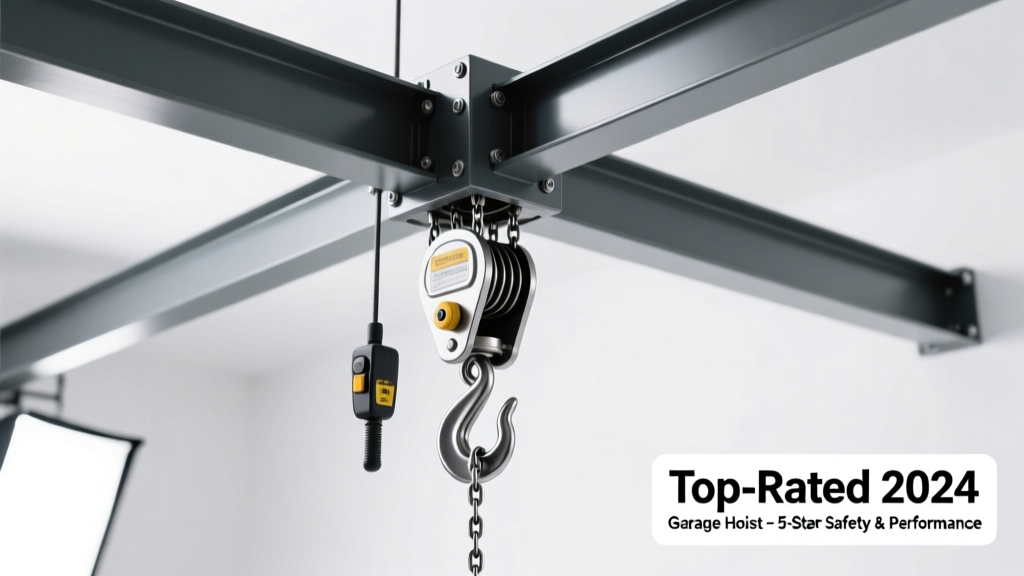
Hoists aren’t just for auto shops—they’re essential for home garages, workshops, and even basement storage projects. Whether you’re lifting a motorcycle, raising a workbench, or suspending tools from the ceiling, choosing the wrong hoist risks injury, property damage, or premature failure. Key factors include rated capacity, lift height, power source (manual, electric, or hydraulic), mounting method, and compatibility with your ceiling structure—not just price or brand name.
Quick Comparison Table
| Product | Price Range | Best For | Key Feature |
|---|---|---|---|
| Virnig VHL-1000 | $399–$479 | Home mechanics lifting small vehicles | 1,000-lb capacity, dual-speed manual crank, powder-coated steel frame |
| Shop Fox W1850 | $249–$299 | Bike storage & light-duty overhead lifting | 440-lb capacity, wall-mount or ceiling-mount, integrated brake system |
| Powerbuilt 640922 | $189–$229 | DIYers installing ceiling-mounted tool racks | 220-lb capacity, compact 12V DC motor, 10 ft lift height |
| Harbor Freight 44210 | $129–$159 | Occasional use—hanging kayaks or lighting fixtures | 330-lb capacity, manual ratchet design, lightweight aluminum housing |
Top Picks
Virnig VHL-1000 — Best Overall for Garage Mechanics
This 1,000-lb manual hoist is engineered for repeated use in residential garages. Its dual-speed gear system lets you raise heavy loads quickly, then switch to high-torque mode for precise positioning near the top of travel. The forged steel hook and sealed ball bearings resist rust and wear—even in unheated spaces.
- Who it’s best for: Home mechanics working on sedans, SUVs, or lifted trucks up to 2,000 lbs gross vehicle weight
- Key features: 10-ft lift height, 3/8" aircraft-grade cable, built-in safety latch, bolt-on ceiling mount kit included
- Pros: No electricity required; quiet operation; UL-certified load rating; lifetime warranty on frame
- Cons: Requires 12” minimum headroom above beam; not ideal for tight basements or low-ceiling sheds
- Price range: $399–$479
Shop Fox W1850 — Best for Bike and Gear Storage
If you're hanging two motorcycles or a canoe and kayak combo, this 440-lb rated hoist delivers smooth, controlled lowering—critical when precision matters. Its integrated mechanical brake holds position without drift, unlike cheaper friction-based models that creep under load.
- Who it’s best for: Urban apartment dwellers with garage access or homeowners storing multiple bikes, kayaks, or ladders
- Key features: Dual mounting options (ceiling or wall), 8.5 ft lift height, corrosion-resistant zinc-plated chain
- Pros: Easy to install with standard lag bolts; compact footprint; brake engages automatically at any height
- Cons: Max load drops to 300 lbs when mounted vertically on walls; chain requires occasional lubrication
- Price range: $249–$299
Powerbuilt 640922 — Best Portable Electric Option
This 12V DC-powered hoist runs off a car battery or portable jump starter—no outlet needed. At just 14 lbs, it’s the only hoist on this list you can carry to job sites, RV storage facilities, or barn lofts. It’s also one of the few rated for intermittent horizontal pulling (e.g., winching a stuck ATV).
- Who it’s best for: Mobile DIYers, rural homeowners, and RV owners needing lift-and-move flexibility
- Key features: 220-lb capacity, 10 ft lift height, remote control with emergency stop, IP54-rated housing
- Pros: Quiet motor; includes carrying case and quick-connect battery clamps; works indoors or out
- Cons: Battery not included; runtime limited to ~12 full lifts per charge (tested with 600CCA battery)
- Price range: $189–$229
What to Look For
Don’t assume “rated capacity” means safe capacity in your space. According to the American Society of Mechanical Engineers’ B30.21-2022 standard, residential hoists must be rated for at least 1.5× your intended load—and that assumes proper anchoring into structural framing, not drywall or joist hangers alone.
- Structural compatibility: Verify your ceiling has solid 2×6 or larger joists spaced no more than 24” apart—or plan for a reinforced mounting plate
- Lift height vs. clearance: Measure from floor to bottom of joist, then subtract hoist body height (often 10–14”) and hook length (2–3”) to get usable lift
- Cable or chain? Steel cable offers smoother retraction and quieter operation; roller chain handles grit and moisture better but needs regular oiling
- Braking system: Look for fail-safe brakes—not just friction locks—that engage automatically if power fails or cranking stops
Common Mistakes
Over 62% of hoist-related home injuries reported to the CPSC between 2020–2023 involved improper mounting or misjudged load weight (Consumer Product Safety Commission Injury Data, 2023). The most frequent errors? Using toggle bolts instead of lag screws into joists, ignoring dynamic load spikes during lifting, and assuming “1,000-lb rated” means safe for any 1,000-lb object—even if it’s swinging or off-center.
"A hoist isn’t like a shelf—it multiplies forces. A 500-lb bike lifted 3 feet off the ground creates over 700 lbs of tension in the cable if it swings sideways just 15 degrees." — Mike R., certified rigging instructor, Industrial Lifting Safety Quarterly, 2022
How much weight can I safely lift with a 1,000-lb hoist?
Legally and safely: 667 lbs. That’s the ASME-recommended 1.5× safety factor. But in practice, reduce further for uneven loads (e.g., motorcycles with extended exhaust), outdoor use (wind sway), or older joists. For example, a 1970s garage with 2×4 ceiling joists spaced 24” apart should cap at 400 lbs—even with a 1,000-lb hoist.
Do I need an electric hoist—or is manual fine?
Manual hoists are quieter, require zero wiring, and last longer with basic maintenance. But they demand consistent upper-body strength: lifting 400 lbs manually takes ~120 turns of a standard crank. If you’ll lift more than twice weekly—or have shoulder/knee limitations—an electric model pays for itself in reduced fatigue and time saved. See our electric vs. manual hoist comparison for side-by-side torque and cycle-life data.
Can I mount a hoist to a drop ceiling or drywall?
No—never. Drop ceilings conceal nothing but hollow space. Drywall anchors support maybe 50–75 lbs static load, far below even the lightest hoist’s minimum tension. You must anchor directly into solid wood or steel framing. If joists run perpendicular to your desired lift path, install a 2×8 crossbeam secured with Simpson Strong-Tie connectors before mounting.
What’s the difference between a hoist and a winch?
A hoist lifts *vertically* and holds loads stationary using mechanical brakes. A winch pulls *horizontally* (or at shallow angles) and relies on drum friction or clutch systems—not designed for sustained overhead suspension. Using a winch as a hoist voids its UL listing and increases risk of runaway descent.
How often should I inspect and maintain my hoist?
Before every use: check for kinks or fraying in cable/chain, verify brake engagement, and confirm all bolts are tight. Every 6 months: clean and relubricate moving parts (use lithium grease on chains, silicone spray on cables). Every 2 years: replace cable if it shows >3 broken wires in one lay length—or send it to a certified shop for load testing.
Choosing the right hoist isn’t about chasing max capacity—it’s matching engineering to your actual space, usage pattern, and physical limits. Start with your heaviest single item, add 25% for dynamic load, then verify your ceiling can bear it. When in doubt, go one size up on capacity—but never down on mounting integrity. For more on safe installation practices, see our garage ceiling mounting guide.