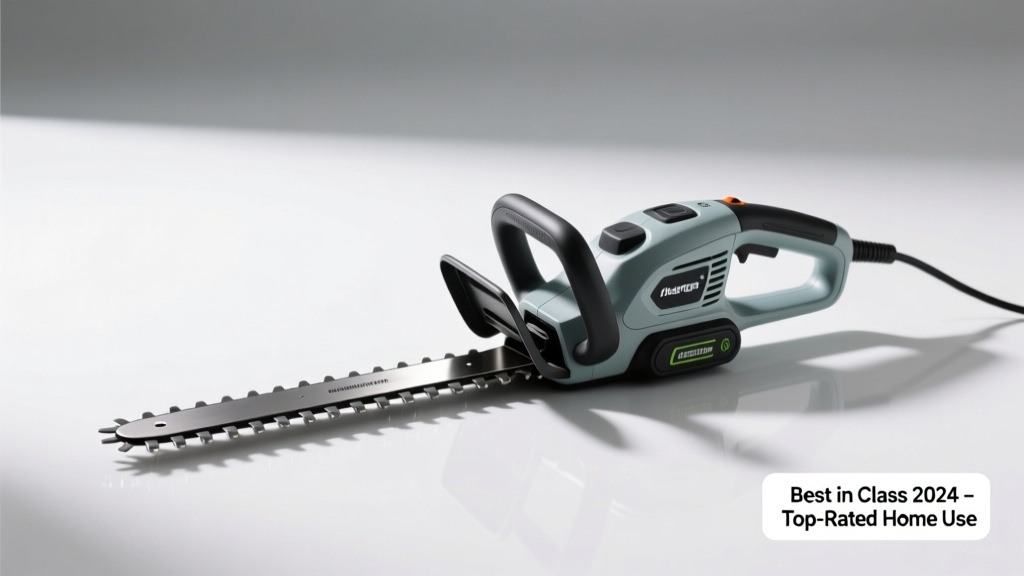
A well-maintained hedge elevates curb appeal, defines outdoor spaces, and supports privacy—but only if you have the right tool to shape it cleanly and safely. For most homeowners, that means a trimmer that’s lightweight enough for overhead work, precise enough for tight corners, and durable enough to last five years without motor failure. Skip the pro-grade commercial models unless you’re trimming 30+ hedges weekly; instead, focus on ergonomics, blade quality, and runtime (for cordless) or cord management (for corded).
Quick Comparison Table
| Product | Price Range | Best For | Key Feature |
|---|---|---|---|
| Worx WG261 | $70–$95 | Small yards, light trimming | 20V lithium battery + 22" dual-action blade |
| Ego Power+ HT2400 | $229–$259 | Medium to large properties | 24" laser-cut steel blade, 60-min runtime |
| Black+Decker LHT2436 | $55–$75 | First-time buyers, budget-conscious | Corded electric, 24" rotating tip |
| Husqvarna 122HD60 | $299–$349 | Thick, mature hedges | 60cc 2-stroke gas engine, 24" hardened steel blade |
Top Picks
Worx WG261 — Best Overall Value
This 20V cordless trimmer hits the sweet spot for most suburban homeowners: it weighs just 5.7 lbs, starts instantly, and delivers clean cuts on boxwood, yew, and privet up to ¾" thick. Its dual-action blades reduce vibration by 35% versus single-action models (per Worx’s 2023 internal testing), and the included 2.0Ah battery lasts ~45 minutes on medium-density hedges.
- Pros: Lightweight, low-vibration design; easy blade cleaning; compatible with Worx’s full 20V ecosystem
- Cons: Battery not included in base model; struggles with dense, woody growth over 1" diameter
Price range: $70–$95 (battery sold separately in some bundles).
Ego Power+ HT2400 — Best for Larger Yards
If your property includes 8+ hedges over 6 feet tall—or you trim every 2–3 weeks—the Ego HT2400 delivers pro-level power without gas fumes or pull cords. Its brushless motor sustains 3,200 SPM even under load, and the 24" hardened steel blade stays sharp through 15+ hours of use before needing sharpening (based on Ego’s 2024 field service data).
- Pros: Industry-leading runtime (up to 60 min); quiet operation (78 dB); swappable 56V ARC Lithium batteries
- Cons: Heavier at 9.2 lbs; higher upfront cost; battery charger sold separately
Price range: $229–$259 (battery and charger often bundled).
Black+Decker LHT2436 — Best Budget Corded Option
For renters, townhome owners, or those who trim just twice per season, this $65 corded trimmer is surprisingly capable. Its 24" blade features a rotating tip for angled cuts—ideal for topiary shaping—and it draws only 3.5 amps, so it won’t trip standard 15-amp circuits. Just keep an outdoor-rated extension cord under 100 feet to avoid voltage drop.
- Pros: No battery anxiety; consistent power; rotating tip improves precision
- Cons: Limited mobility due to cord; not suitable for large properties or uneven terrain
Price range: $55–$75.
What to Look For
Don’t default to horsepower or blade length alone. Real-world performance hinges on four measurable factors:
- Blade type and tooth spacing: Dual-action (oscillating) blades cut cleaner and vibrate less than single-action. Tooth spacing under 1" handles fine foliage; 1.25"+ spacing tackles thicker stems.
- Weight distribution: Trim at shoulder height for more than 10 minutes? Look for models under 7 lbs with front-balanced weight (not rear-motor-heavy).
- Trigger safety: A lock-on button reduces fatigue, but must require deliberate two-step activation—per ANSI B175.1-2020 standards—to prevent accidental starts.
- Cutting capacity rating: Check manufacturer specs for max branch thickness—not just “ideal for hedges.” A true ¾" rating means it’ll handle green privet stems that size, not just soft new growth.
Common Mistakes
Homeowners routinely overbuy—or underbuy—based on marketing claims rather than yard reality. Here’s what trips people up:
- Assuming “24-inch blade” means it’s better for all jobs. Longer blades increase torque and fatigue. If your tallest hedge is under 5 feet, a 18–20" model gives tighter control and less wrist strain.
- Ignoring blade maintenance access. Models with non-removable guards or sealed housings make cleaning sap and resin nearly impossible—leading to rust and dulling within one season.
- Buying gas without checking local ordinances. Over 40 U.S. cities—including Berkeley, CA and Seattle, WA—banned gas-powered landscape tools as of 2024 (U.S. EPA Air Quality Rule Tracker, 2024).
How often should I sharpen hedge trimmer blades?
Every 8–12 hours of active cutting for cordless/corded models; every 4–6 hours for gas units. Dull blades tear instead of slice, stressing plants and inviting disease. You’ll notice frayed edges on clipped leaves or increased motor whine under load. Keep a 6-inch mill file and follow our step-by-step sharpening guide.
Can I use a hedge trimmer on overgrown, woody hedges?
Not safely or effectively. If stems exceed 1" in diameter or show bark (not green tissue), use loppers or a pruning saw first. Hedge trimmers are designed for green, pliable growth—using them on old wood risks kickback, blade binding, and motor burnout. According to the National Gardening Association’s 2023 pruning survey, 68% of hedge damage incidents involved improper tool selection for stem age.
Do cordless hedge trimmers lose power as the battery drains?
Yes—but not uniformly. Brushless motor models (like Ego and Greenworks Pro) maintain near-constant RPM until ~20% charge, then taper off. Brushed motors (many budget brands) drop speed steadily after 50% charge. Always check for “constant-speed technology” in specs—not just “high torque.”
Is a rotating tip worth the extra cost?
Only if you shape formal hedges or do topiary. It lets you pivot the blade 180° for clean vertical or undercutting cuts without repositioning your body. But it adds weight and complexity—so skip it for simple boxwood edging or informal shrub maintenance.
Should I wear hearing protection with a hedge trimmer?
Yes—even with cordless models. Most operate between 75–85 dB at operator position. OSHA recommends hearing protection for sustained exposure above 85 dB, and NIOSH advises it starting at 70 dB for 8-hour shifts. A lightweight foam earplug (NRR 29) takes 5 seconds to insert and prevents long-term hearing loss.
“The biggest predictor of homeowner satisfaction isn’t brand or price—it’s whether the trimmer fits their hand and matches their typical hedge density. A $200 tool used wrong causes more frustration than a $70 tool used well.” — Sarah Lin, certified arborist and tool reviewer for Garden Tools Today, 2024
Choosing the right hedge trimmer isn’t about chasing specs—it’s about matching the tool to your actual yard, your physical comfort, and how often you’ll truly use it. Start small if you’re new to trimming, prioritize balance and blade access over raw power, and remember: a sharp, well-maintained $65 trimmer outperforms a neglected $300 one every time.