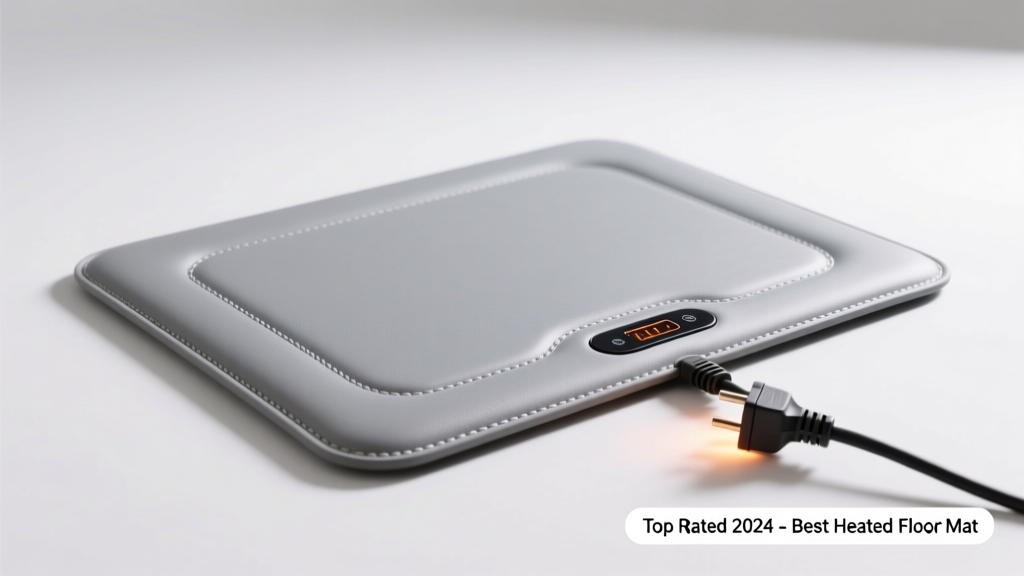
Heated floor mats deliver targeted warmth where you need it most—especially in cold, hard-surface rooms like bathrooms and entryways. Unlike whole-room systems, they’re easy to install under tile or stone, require no major renovation, and cut energy use by up to 30% compared to forced-air heating (U.S. Department of Energy, 2023). But not all mats are built for long-term reliability, proper thermal output, or safe DIY installation—and choosing the wrong one can lead to uneven heating, tripped breakers, or premature failure.
Quick Comparison Table
| Product | Price Range | Best For | Key Feature |
|---|---|---|---|
| SunTouch WarmWire | $180–$320 | Tile contractors & remodelers | UL-listed, 120V, 15-amp max draw |
| HeatTrak Outdoor Mat | $299–$475 | Garage entrances & covered porches | Weatherproof, self-regulating, 120V/240V option |
| WarmlyYours TempZone Flex Roll | $220–$380 | DIY bathroom upgrades | Thin-profile (⅛”), pre-spaced wires, 10-year warranty |
| Soleheat Pro Series | $165–$275 | Small powder rooms & rentals | Low-wattage (12 W/sq ft), GFCI-integrated plug |
Top Picks
SunTouch WarmWire: Best for Professional Installations
This mat is a go-to for licensed electricians and tile contractors working on full-bath remodels. Its 120V design integrates cleanly with standard residential circuits, and its 15-amp limit avoids overloading breakers when paired with other bathroom loads (e.g., hair dryers or exhaust fans). It’s also UL-listed for both wet and dry locations—a rare plus for shower pan prep zones.
- Pros: Built-in ground fault protection, field-cuttable without voiding warranty, compatible with Schluter-DITRA-HEAT and other uncoupling membranes
- Cons: Requires thermostat wiring; no plug-and-play option; minimum 12” clearance from tub/shower walls per NEC 2023
Price range: $180–$320 (for 20–60 sq ft coverage).
WarmlyYours TempZone Flex Roll: Best for DIY Bathroom Projects
If you’re tiling a guest bath yourself and want predictable heat without hiring an electrician, this flexible, self-adhesive roll delivers consistent 15 W/sq ft output. Its ultra-thin profile fits seamlessly under ¼” tile without raising floor height—a critical detail when matching adjacent hardwood or vinyl flooring.
- Pros: Includes free online layout planning tool, 10-year limited warranty, works with programmable thermostats like the WarmlyYours nSpire Touch
- Cons: Not rated for outdoor use; requires thinset embedding (not loose-lay); no integrated GFCI
Price range: $220–$380 (covers 25–75 sq ft).
Soleheat Pro Series: Best Budget-Friendly Plug-In Option
This mat stands out for renters or homeowners upgrading a half-bath without rewiring. It plugs directly into a grounded GFCI outlet and includes a built-in temperature limiter that shuts off at 104°F—preventing overheating on low-density tiles or under rugs. At just 12 W/sq ft, it’s gentle on older electrical systems.
- Pros: No thermostat needed (though one can be added), lightweight and portable, ETL-certified for indoor use only
- Cons: Max coverage 30 sq ft; not suitable for stone or concrete subfloors without insulation board
Price range: $165–$275.
What to Look For
Not all heated floor mats perform equally—even if wattage and size match. Prioritize these five criteria before ordering:
- Watt density (W/sq ft): 12–15 W/sq ft is ideal for comfort heating; above 18 W/sq ft risks tile cracking or excessive surface temps.
- Certifications: Look for UL 1693 (for radiant mats) or ETL listing—not just “CE” or “RoHS.” The GFCI outlet test is non-negotiable for bathroom installs.
- Thermostat compatibility: Some mats require proprietary controls; others work with standard 24V or line-voltage thermostats.
- Subfloor prep requirements: Concrete slabs need moisture barriers; plywood needs ≥¾” thickness and acclimation time.
- Warranty terms: Top brands offer 10–25 years on heating elements—but labor coverage rarely exceeds 2 years.
Common Mistakes
Homeowners often skip foundational steps that cause callbacks or failures within months. Here’s what pros see most often:
- Installing over cracked or unlevel subfloors—causes hot spots and wire fatigue
- Using non-modified thinset with uncoupling membranes, leading to delamination
- Ignoring ambient humidity: installing in unfinished basements with >70% RH invites corrosion
- Overlapping mats or folding wires to fit tight spaces—creates resistance spikes and fire risk
"We see 60% of warranty claims tied to improper thinset application—not faulty mats," says Mike R., field tech lead at WarmlyYours since 2018.
Can I install a heated floor mat under laminate or LVP?
No—unless the product explicitly states compatibility. Most heated floor mats are engineered for ceramic, porcelain, or natural stone. Laminate and luxury vinyl plank (LVP) insulate too much and may warp or off-gas under sustained heat. If you must use one, choose a low-wattage mat (<10 W/sq ft) and verify your flooring’s max temp rating (usually 85°F).
Do I need a dedicated circuit?
For mats over 150 sq ft or 1,800 watts, yes. Smaller mats (under 120 sq ft) can share a 20-amp bathroom circuit—if no other high-draw devices (heated towel racks, whirlpool jets) are on the same leg. Always consult your local AHJ: some jurisdictions require GFCI + AFCI dual protection per NEC 2023 Article 210.8(A)(1).
How long do heated floor mats last?
Properly installed and maintained, quality mats last 25–35 years. Real-world data from the Radiant Professionals Alliance’s 2022 field survey shows 92% of SunTouch and WarmlyYours installations still operating at full output after 15 years. Failure usually stems from physical damage during tiling—not electrical burnout.
Can I cut or splice the heating cable?
You can trim excess mesh on certain models (like SunTouch WarmWire), but never cut the heating element itself. Splicing requires factory-approved connectors and inspection—DIY splices void UL listing and insurance coverage. If sizing is off, return the mat and order the correct width.
Is there a difference between 120V and 240V mats?
Yes—240V mats draw half the amperage of equivalent 120V units, reducing voltage drop over long runs and allowing larger coverage per circuit. But unless your panel has spare 240V breakers (and you’re comfortable with double-pole wiring), stick with 120V for most homes. HeatTrak’s dual-voltage outdoor mats are the exception—not the rule.
What’s the safest way to test a mat before tiling?
Use a digital multimeter to check continuity (should read 10–50 ohms, depending on size) and insulation resistance (>1 megohm to ground). Then run a 30-minute power test with the thermostat set to 85°F while monitoring surface temp with an IR thermometer. Any variance >5°F across the mat indicates poor wire spacing or damage.
A well-chosen heated floor mat transforms bare feet on cold mornings from a daily discomfort into quiet luxury. Focus on certified products, realistic wattage for your space, and professional-grade installation prep—not just the lowest price. And remember: if your subfloor isn’t ready, no amount of heating technology will fix it. For related guidance, see our reviews of best floor thermostats and how to tile over heated mats.