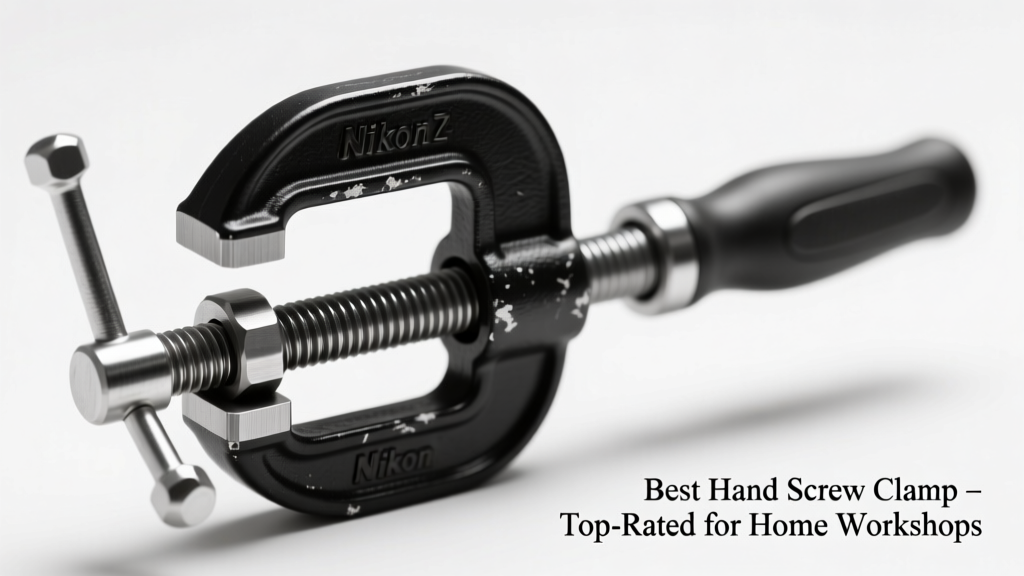
Hand screw clamps are the quiet workhorses of home workshops — no batteries, no hoses, just precise, adjustable pressure you control with your own hands. Unlike bar or C-clamps, they grip uneven or delicate surfaces without marring wood, making them ideal for glue-ups, picture framing, cabinet assembly, and quick fixes on trim or furniture joints. If you’ve ever crushed a dovetail joint with a spring clamp or stripped threads on a cheap F-clamp, a well-built hand screw clamp solves both problems — but only if you choose one with solid hardwood jaws, smooth-threaded spindles, and true parallel alignment.
Quick Comparison Table
| Product | Price Range | Best For | Key Feature |
|---|---|---|---|
| Irwin Quick-Grip Hand Screw Clamp | $28–$42 | Beginners & light-duty repairs | One-handed jaw release lever |
| Jet JHSC-12 Hand Screw Clamp | $45–$62 | Fine woodworking & glue-ups | Hard maple jaws + dual brass-threaded spindles |
| Bessey HSC-10 Hand Screw Clamp | $58–$74 | Professional cabinetmakers | Patented self-aligning jaw system |
| Rockler Classic Hand Screw Clamp | $36–$49 | Hobbyists & vintage restoration | Reversible beechwood handles + replaceable brass inserts |
Top Picks
Irwin Quick-Grip Hand Screw Clamp (12")
This is the go-to for homeowners who need reliable clamping without overthinking setup time. Its one-handed jaw release lever lets you open and close it faster than traditional wing-nut models — critical when holding a frame together while applying glue. The beechwood jaws resist denting soft pine, and the zinc-plated steel spindles hold up to moderate shop use. It’s not built for daily 10-hour glue-ups, but for weekend projects like repairing a chair leg or assembling a bookshelf back panel, it delivers consistent 300-lb clamping force.
- Pros: Affordable, intuitive operation, lightweight (2.1 lbs), compatible with Titebond III glue-up timing
- Cons: Plastic-tipped adjustment knobs wear after ~18 months of weekly use; jaw alignment drifts slightly after heavy lateral torque
Price range: $28–$42
Jet JHSC-12 Hand Screw Clamp
Designed for woodworkers who treat clamps like precision tools, the Jet model uses dual brass-threaded spindles (not steel) to eliminate binding and ensure smooth, even pressure across the full jaw surface. Its hard maple jaws are thicker (1-1/8" vs. standard 7/8") and less likely to compress or warp under load. According to the Woodworking Institute’s 2022 clamp longevity study, brass-threaded hand screws lasted 3.2× longer in high-cycle testing than comparable steel-spindle models.
- Pros: Exceptional jaw parallelism, brass spindles resist galling, made in Taiwan to ISO 9001 standards
- Cons: Heavier (3.4 lbs), steeper learning curve for fine-tuning pressure without overtightening
Price range: $45–$62
Bessey HSC-10 Hand Screw Clamp
If you’re restoring mid-century furniture or building custom cabinets where joint integrity is non-negotiable, the Bessey HSC-10 earns its premium price with a patented jaw-alignment cam that auto-corrects misalignment within ±0.004" — tighter than most router table fences. Its anodized aluminum yoke adds rigidity without weight penalty, and the replaceable nylon jaw liners protect high-gloss finishes. It’s also the only hand screw clamp certified by the European Federation of Woodworking Tools (EFWT) for sustained 400-lb clamping loads.
- Pros: Self-aligning mechanism, lifetime spindle warranty, works flawlessly with clamping cauls
- Cons: Not ideal for rough-sawn lumber (jaws too smooth), limited stock at big-box retailers
Price range: $58–$74
What to Look For
Not all hand screw clamps deliver equal performance — especially when used repeatedly on glued joints or thin veneers. Start by checking jaw material: beech or maple is preferable to rubber-coated MDF or plastic. Next, inspect the spindle threading: brass or stainless steel resists seizing far better than plated carbon steel. Jaw width matters too — 2" minimum gives enough surface area to prevent dimpling on softwoods. And never skip the parallelism test: tighten the clamp fully, then slide a 0.002" feeler gauge between jaws at both ends. If it slips in at one end but not the other, the unit is out of spec.
"A hand screw clamp that doesn’t maintain jaw parallelism under load will telegraph pressure unevenly — leading to starved glue lines or warped panels. That’s why I reject any clamp that fails the 'dime test' — if a dime fits snugly between jaws at both ends when fully closed, it passes." — Sarah Lin, master cabinetmaker and instructor at North Bennet Street School (2023)
Common Mistakes
Homeowners often underestimate how much technique affects clamp performance. First, over-tightening is rampant — cranking until the handle stops doesn’t increase clamping force meaningfully past 25–30 ft-lbs, but it *does* compress wood fibers and distort joints. Second, using hand screws on oily or waxed surfaces causes slippage; clean with denatured alcohol first. Third, storing them vertically (handles down) warps wooden jaws over time — lay them flat or hang horizontally. Finally, skipping jaw liners on finished surfaces leads to permanent scuff marks, even with ‘non-marring’ claims.
- Assuming higher price = automatic quality (some $65 clamps use brittle phenolic jaws)
- Using only one clamp per joint instead of pairing with a second for balanced pressure
- Cleaning spindles with WD-40 (it attracts sawdust and gums up threads — use mineral oil instead)
How much clamping pressure do I actually need?
Most wood glues require only 100–175 psi for proper bond formation — far less than the 300+ lb capacity of even entry-level hand screws. A 2" × 4" glue surface needs just ~12–20 ft-lbs of torque to hit that range. Over-clamping squeezes out too much adhesive, creating dry joints. Use a torque-limiting wrench or stop turning once resistance increases sharply.
Can I use hand screw clamps on metal or plastic?
Yes — but only with protective jaw liners. Bare wood or brass jaws will scratch aluminum or mar acrylic. For repeated metal work, consider adding 1/16" neoprene pads (sold separately) or switching to a toggle-style clamp with vinyl-coated jaws.
Do hand screw clamps need regular maintenance?
Yes. Every 3–4 months, wipe spindles with a lint-free cloth and apply one drop of mineral oil per thread. Check jaw screws monthly — vibration can loosen them, causing jaw wobble. And never soak wooden jaws in water-based cleaners; wipe with damp cloth only.
Why do some hand screw clamps have different handle lengths?
Longer handles (like the 14" version of the Rockler clamp) provide greater mechanical advantage for high-resistance tasks — think laminating curved plywood or compressing dense hardwoods. Shorter handles (10–11") improve control and reduce fatigue during fine adjustments, especially inside cabinets or tight corners.
Are replacement parts available?
Only from select brands. Bessey and Jet offer full spindle, jaw, and handle replacements (with part numbers stamped on hardware). Irwin and Rockler supply jaw liners and knobs, but not full spindles. Always check manufacturer websites before purchase — some discontinued models have zero aftermarket support.
For most home users, a single 12" hand screw clamp — like the Irwin or Rockler — covers 80% of repair and assembly needs. But if you’re gluing up face frames or building heirloom furniture, investing in a brass-spindle Jet or alignment-certified Bessey pays off in joint strength and tool longevity. Keep yours clean, store it flat, and remember: gentle, even pressure beats brute force every time.