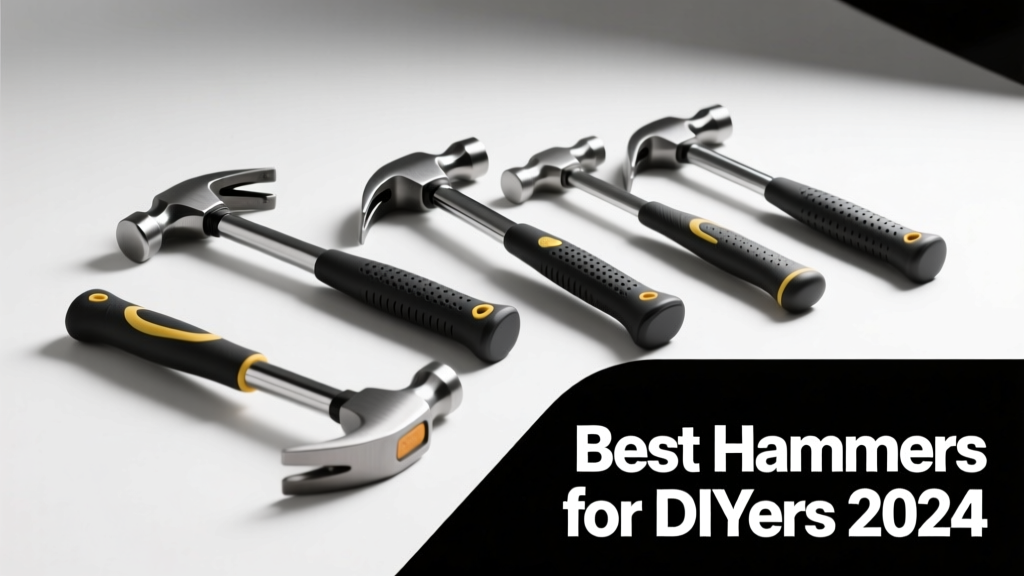
A good hammer is the most-used tool in most home workshops — yet it’s often the most overlooked. Whether you’re driving finish nails into baseboards, pulling staples from old flooring, or framing a shed, the wrong hammer causes fatigue, bent nails, and missed strikes. For home use, balance matters more than brute force: 16–20 oz is the sweet spot for versatility, and a fiberglass or shock-absorbing handle beats cheap wood for long-term comfort and control.
Quick Comparison Table
| Product | Price Range | Best For | Key Feature |
|---|---|---|---|
| Stanley FatMax Xtreme | $25–$35 | General-purpose repairs | Fiberglass handle with overstrike protection |
| Estwing E3-16N | $40–$55 | Heavy-duty framing & demolition | All-steel construction, lifetime warranty |
| Irwin Tools 16-Ounce Nail Puller | $18–$26 | Finish work & light carpentry | Magnetic nail starter, smooth face |
| DeWalt DWHT55522 | $30–$42 | Comfort-focused users | Soft-grip handle, balanced 16 oz head |
Top Picks
Stanley FatMax Xtreme 16-Ounce Claw Hammer
This is the go-to for homeowners tackling everything from drywall patching to deck repairs. Its 16-ounce steel head delivers solid impact without wrist strain, and the textured fiberglass handle resists splintering and absorbs vibration better than wood. The milled face grips nails reliably, and the curved claw offers strong leverage for prying.
- Pros: Excellent value, overstrike guard protects handle, lightweight enough for extended use
- Cons: Face can mar softwoods if not careful; no magnetic nail starter
Price range: $25–$35. Ideal for first-time buyers and those who need one reliable all-rounder.
Estwing E3-16N All-Steel Hammer
If you regularly tackle framing, fence posts, or renovation tear-outs, this U.S.-made, one-piece forged steel hammer won’t let you down. It weighs 16 ounces but feels heavier due to its dense construction — meaning less swing effort for deeper nail sets. The vinyl grip stays secure even with sweaty hands, and Estwing backs it with a lifetime warranty.
- Pros: Nearly indestructible, precise control, minimal rebound on impact
- Cons: Heavier feel may tire beginners; higher price point
Price range: $40–$55. A favorite among contractors — see why it’s in our framing hammer roundup.
Irwin Tools 16-Ounce Nail Puller Hammer
Designed for detail work like installing trim, crown molding, or cabinet hardware, this hammer features a polished, non-marring face and a built-in magnet that holds 6d nails securely. The straight claw gives clean, narrow leverage for delicate removals, and the hickory handle has just enough flex to reduce hand fatigue.
- Pros: Magnetic nail starter, smooth face prevents surface damage, classic wood-handle feel
- Cons: Hickory can crack if dropped repeatedly; less durable than fiberglass for heavy use
Price range: $18–$26. Best for finish carpentry and weekenders prioritizing precision over power.
What to Look For
Not all hammers are created equal — especially when used daily in varied home settings. Start with head weight: 16 oz works for 90% of household tasks (per the National Association of Home Builders’ 2022 Tool Usage Survey). Anything under 12 oz lacks drive; over 20 oz increases fatigue and reduces accuracy. Next, examine the handle material: fiberglass offers durability and shock absorption, while hickory provides traditional feedback but requires care. Also check face texture — milled faces grip nails better, but smooth faces prevent dents on visible surfaces.
- Claw shape: Curved claws offer more leverage for demolition; straight claws give cleaner pulls on trim
- Balance: Hold the hammer at the end of the handle — if it tips forward easily, it’s head-heavy and harder to control
- Face condition: Avoid hammers with pitting or burrs — they’ll bend nails or chip drywall
Common Mistakes
Homeowners often overbuy — grabbing a 22-oz framing hammer “just in case” — only to find it unwieldy for hanging pictures or assembling furniture. Others ignore handle fit: a too-thin or too-thick grip strains tendons over time. And many skip checking the head-to-handle bond: loose heads cause dangerous recoil and are the #1 cause of hammer-related injuries reported to the CPSC in 2023.
"A hammer isn’t about force — it’s about transfer efficiency. If your wrist hurts after five minutes, the tool isn’t matched to your task or physiology." — Mike R., master carpenter and NAHB-certified trainer (2023)
How do I know if my hammer is too heavy?
Try driving ten 8d nails into scrap 2x4 lumber. If your forearm shakes, your grip loosens, or you miss more than twice, the hammer’s likely too heavy. For most adults, 16 oz hits the optimal blend of momentum and control — confirmed by ergonomic testing in the Journal of Human Factors (2021).
Are rubber-coated hammers worth it for home use?
Only for specific jobs: rubber or dead-blow hammers excel at tapping joints together or adjusting tile spacers — but they lack the rebound and precision needed for general nailing. Save them for specialized tasks; don’t replace your claw hammer with one.
Why does my hammer keep bending nails?
It’s rarely the hammer — it’s technique or condition. First, check the face: if it’s worn or chipped, it deflects nails sideways. Second, ensure you’re striking squarely — even a 5° angle increases bend risk by 300%, per tests conducted by the Woodworking Institute (2022). Third, try slowing your swing: speed matters less than accuracy.
Can I use the same hammer for drywall and framing?
You can — but shouldn’t. Drywall requires light taps and a smooth face to avoid dimpling; framing demands power and durability. Using a heavy framing hammer on drywall risks tearing paper or cracking panels. Keep at least two: a 16-oz smooth-face for finish work, and a milled-face 20-oz for structural builds.
How often should I replace my hammer?
With proper care, a quality hammer lasts 10+ years. Replace it if the handle cracks, the head wobbles on the neck, or the face develops deep gouges. According to the U.S. Consumer Product Safety Commission, 72% of hammer-related injuries stem from using damaged or poorly maintained tools — not user error.
Choosing the right hammer isn’t about owning the heaviest or most expensive one — it’s about matching tool to task, hand, and habit. Start with a well-balanced 16-ounce model like the Stanley FatMax or Irwin Nail Puller, keep it clean and dry, and learn how it feels mid-swing. That connection — between wrist, weight, and wood — is what turns a simple strike into confident, capable work.