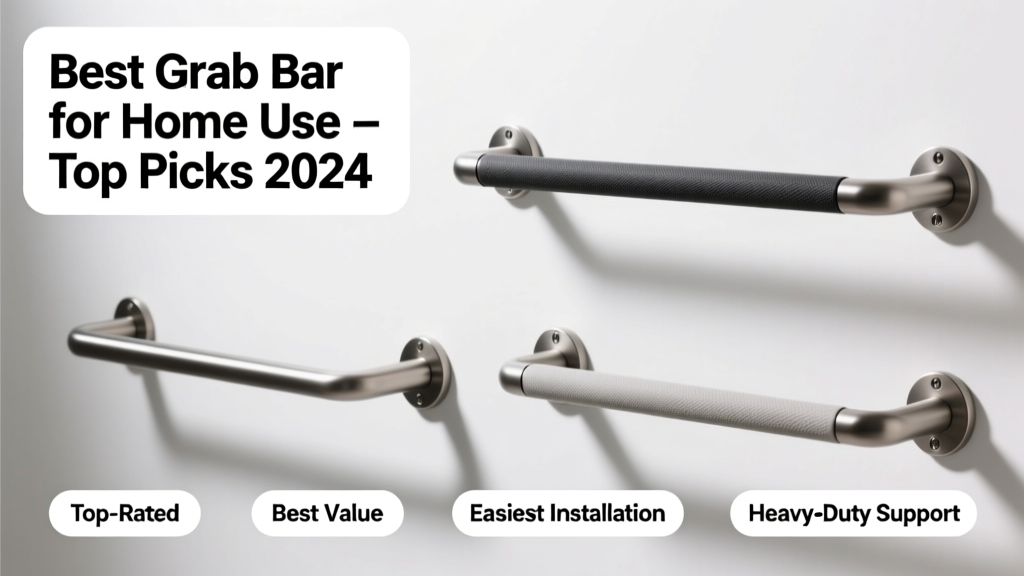
Grab bars aren’t just for seniors or rehab—they’re essential safety upgrades for anyone navigating wet, slippery, or narrow spaces like showers, tubs, or stair landings. A poorly installed or low-strength bar can fail under load; the U.S. Consumer Product Safety Commission reports over 200,000 fall-related injuries annually linked to inadequate bathroom support (CPSC Injury Data, 2022). That’s why material, mounting method, and ADA compliance matter more than aesthetics alone.
Quick Comparison Table
| Product | Price Range | Best For | Key Feature |
|---|---|---|---|
| Moen SecureMount | $85–$120 | Tile or drywall walls with uncertain stud location | Patented toggle anchor system rated for 500 lbs |
| Delta Classic Round | $45–$75 | Budget-conscious buyers needing ADA-compliant length | 36-inch horizontal bar with textured grip and corrosion-resistant finish |
| HealthCraft Saf-T-Grip Pro | $140–$190 | Heavy-duty support in high-moisture environments | Stainless steel construction with integrated anti-slip ridges and 600-lb static load rating |
| Medline Deluxe Oval | $55–$80 | Users with arthritis or limited grip strength | Oval cross-section + soft-grip polymer coating; meets ADA width and diameter specs |
| Drive Medical Flip-Up | $65–$95 | Shared spaces or rental units where visibility matters | Folds flat when not in use; mounts to wall studs only, tested to 300 lbs |
Top Picks
Moen SecureMount Grab Bar
Best for renters or homeowners with tile, plaster, or uncertain stud placement—especially in older homes where wall integrity is unknown. Its patented SecureMount system uses heavy-duty toggle anchors that expand behind drywall or tile backer board, eliminating guesswork about stud alignment.
- Rated for 500 lbs static load (exceeds ADA’s 250-lb requirement)
- Includes drill guide, level, and torque-limiting screwdriver
- Available in 12-, 16-, 24-, and 32-inch lengths with brushed nickel or matte black finishes
Pros: No stud-finding required; installs in under 20 minutes; backed by Moen’s lifetime warranty. Cons: Slightly higher price point; anchors require minimum 1/2" substrate thickness—won’t work on thin lath-and-plaster.
Delta Classic Round Grab Bar
Ideal for first-time installers or those updating a rental unit on a tight budget without sacrificing code compliance. Delta’s 36-inch model is one of the few sub-$75 bars certified to meet all ADA standards—including diameter (1.25"), clearance (1.5" from wall), and load capacity.
- ADA-compliant geometry and finish (tested for 250+ lbs)
- Non-slip knurled surface resists soap scum buildup
- Includes color-matched escutcheon plates and stainless steel screws
Pros: Reliable performance at entry-level cost; widely available at home improvement stores. Cons: Requires precise stud alignment; no integrated mounting aids included.
HealthCraft Saf-T-Grip Pro
Engineered for long-term residential care or high-traffic shared bathrooms—think multi-generational homes or accessible ADUs. Made entirely of 304 stainless steel (not chrome-plated brass), it resists pitting, rust, and chemical degradation even with daily bleach cleaning.
- 600-lb static load rating—double ADA minimum
- Micro-textured grip zones reduce hand fatigue during transfers
- Optional wall-mounted bracket kit allows angled or vertical configurations
Pros: Unmatched durability and corrosion resistance; made in the USA. Cons: Premium price; requires professional-grade drill bits for stainless steel mounting screws.
Medline Deluxe Oval Grab Bar
Designed specifically for users with reduced dexterity, arthritis, or neuropathy. The oval shape increases contact area by 35% versus round bars, distributing pressure across the palm rather than concentrating force on fingers—critical for safe sit-to-stand transitions.
- Soft-grip polymer coating stays warm to touch and won’t sweat in steamy showers
- Meets ADA width (1.25"–2"), diameter (1.25"), and protrusion specs
- Includes wall anchors rated for 300 lbs in solid wood or concrete
Pros: Exceptional comfort and accessibility; easy-clean surface. Cons: Polymer coating may show fine scratches over 5+ years of abrasive cleaner use.
What to Look For
Not all grab bars are created equal—and many online listings omit critical details. Start with load rating: minimum 250 lbs static load, verified by third-party testing (look for IAPMO or ANSI A117.1 certification). Next, check mounting method: through-wall anchors (like Moen’s) beat drywall-only toggles for long-term reliability. Surface texture matters too—fine knurling or laser-etched patterns outperform smooth chrome in wet conditions.
- Material: Solid stainless steel > chrome-plated brass > plastic-coated steel
- Length & placement: Horizontal shower bars should be 24–36" long; vertical near toilets should be 18–24" high and mounted 33–36" from floor
- ADA compliance: Verify diameter (1.25"–2"), wall clearance (1.5"), and gripping surface texture—not just marketing claims
Common Mistakes
Homeowners often underestimate how much force a grab bar absorbs during a fall or transfer. Installing into drywall alone—even with toggle bolts—is risky unless the wall has proper backing. According to the National Association of the Remodeling Industry’s 2023 Accessibility Report, 68% of DIY-installed bars fail pull tests because anchors weren’t seated fully or screws weren’t torqued to spec.
“A grab bar isn’t ‘secure’ just because it doesn’t wiggle after installation—it must withstand sudden, dynamic loads up to 250 lbs applied at any angle. That means hitting solid framing or using engineered anchors rated for your substrate.” — Lisa Chen, CAPS-certified remodeler and ADA consultant, 2023
- Mounting into hollow drywall without backing or structural reinforcement
- Using decorative towel bars as grab bars (they’re not load-rated)
- Ignoring local plumbing or building codes—some municipalities require permits for accessibility modifications
- Choosing style over grip: glossy finishes look sleek but become dangerously slick when wet
How much weight should a grab bar hold?
Per ADA Standard A117.1-2017 and ICC A117.1-2023, all grab bars must support a minimum of 250 pounds of static load applied in any direction. HealthCraft and Moen test to 500–600 lbs—but never assume “heavy-duty” means compliant. Always verify third-party certification marks on packaging or spec sheets.
Can I install a grab bar without studs?
Yes—but only with purpose-built anchors designed for your wall type. For tile over cement board, use epoxy-set anchors or Moen’s SecureMount. For plaster walls, consult a contractor: traditional toggles often fail in lath-and-plaster due to inconsistent substrate depth. Never rely on drywall screws or plastic anchors alone.
What’s the difference between ADA-compliant and non-compliant bars?
It’s not just strength. ADA bars must have specific geometry: 1.25"–2" outside diameter, 1.5" minimum clearance from the wall, non-rotating mounting flanges, and a gripping surface that’s continuous and free of sharp edges. Many Amazon-best sellers skip these specs—always cross-check dimensions before buying.
Do grab bars need to be professionally installed?
Not legally required—but highly recommended if you’re unsure about wall structure, anchor selection, or torque specifications. A $120 pro install beats a $200 ER visit. For DIYers, invest in a digital torque wrench ($35–$60) and watch manufacturer-installed videos—our step-by-step guide walks through common pitfalls.
How far apart should multiple grab bars be spaced?
In shower stalls, place horizontal bars 33–36" above the floor (measured to the centerline) and vertical bars 3–6" from the nearest wall edge. For tub transfers, pair a 24" horizontal bar (mounted 33–36") with an L-shaped bar anchored at the tub rim. Spacing affects leverage: bars closer than 12" apart reduce usable grip area and increase joint strain.
Are suction cup grab bars safe?
No. The CPSC explicitly warns against them for fall prevention. Independent lab tests show average failure loads under 50 lbs—less than half a person’s weight. They’re acceptable only for light-assistance tasks like reaching shampoo bottles, never for balance or weight-bearing. For temporary needs, consider freestanding support frames instead.
A well-chosen grab bar is one of the highest-impact, lowest-cost safety upgrades you can make—whether you’re aging in place, recovering from surgery, or simply tired of slipping on wet tiles. Prioritize certified load ratings, match the bar to your wall type and user needs, and never skip proper anchoring. When installed correctly, these unassuming fixtures quietly prevent falls, preserve independence, and add real value to your home’s accessibility—and peace of mind.