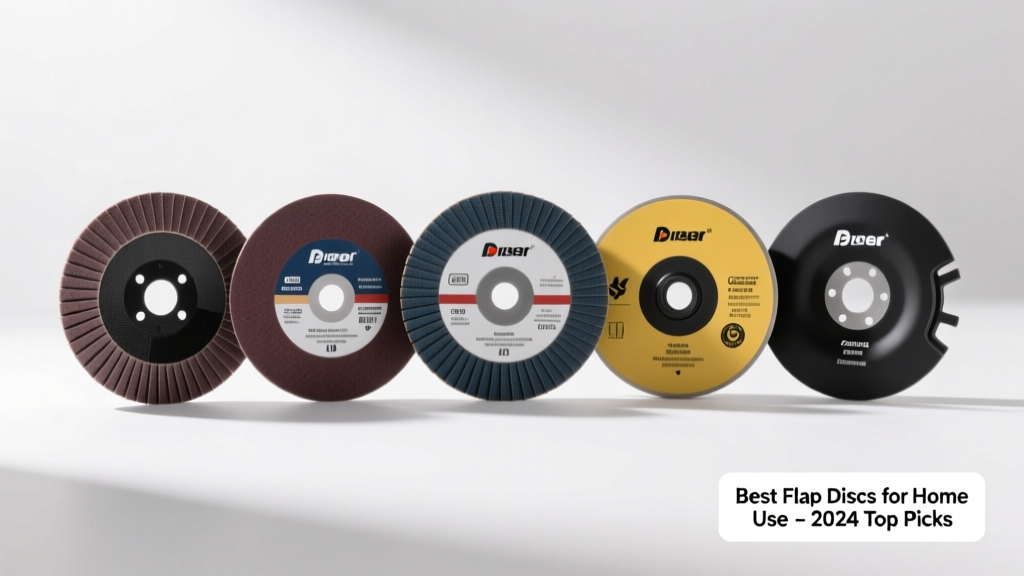
If you're sanding rust off a garden gate, smoothing welds on a custom shelf bracket, or prepping wood for stain, a flap disc saves hours over sandpaper or grinding wheels. Unlike rigid discs, flap discs flex with contours, reduce gouging, and last longer—but not all perform well in home garages where dust control, low RPM drills, and intermittent use are the norm. You need durability without industrial-grade cost, plus compatibility with common 4.5-inch angle grinders or even variable-speed drills (with proper arbor adapters).
Quick Comparison Table
| Product | Price Range | Best For | Key Feature |
|---|---|---|---|
| Norton Blaze Rapid Prep | $18–$24 | Heavy rust removal on steel railings | Zirconia-alumina blend; cuts 30% faster than standard alumina (Norton Technical Bulletin, 2022) |
| Makita P-65907 | $12–$16 | General-purpose metal & wood prep | 120-grit nylon-backed flaps; runs cool on cordless tools |
| DeWalt DW4832 | $20–$26 | Fine finishing before painting | 150-grit ceramic grain; minimal loading on mild steel |
| 3M Roloc TR300 | $28–$34 | Detail work on curved pipe or brackets | 1/4" quick-change hub; fits Dremel-style tools |
Top Picks
Norton Blaze Rapid Prep
Best for homeowners tackling thick rust on wrought iron, old fencing, or trailer hitches. Its zirconia-alumina hybrid grain stays sharp longer under pressure and handles sustained use on 4.5-inch grinders running at 10,000 RPM.
- Pros: Cuts 30% faster than standard discs (per Norton’s 2022 abrasives testing), heat-resistant backing, low vibration
- Cons: Overkill for light sanding; not ideal for wood or soft metals like aluminum
Price range: $18–$24 per disc (sold individually or 5-packs).
Makita P-65907
Ideal for beginners or those using lower-power cordless grinders (e.g., Makita XAG04Z). The nylon-reinforced flaps flex smoothly on uneven surfaces and resist clogging when used on painted steel or hardwood edges.
- Pros: Runs cooler than polyester-backed discs, compatible with 5/8"-11 and M14 arbors, great value for occasional use
- Cons: Shorter lifespan under aggressive pressure; 120-grit only (no fine-finishing option)
Price range: $12–$16.
DeWalt DW4832
Perfect for final prep before priming—especially on welded joints or sheet metal. Its ceramic grain fractures to expose fresh cutting edges, reducing loading and delivering consistent 150-grit finish without swirl marks.
- Pros: Minimal dust generation vs. standard alumina, excellent edge retention, works well at 6,000–8,000 RPM
- Cons: Higher initial cost; not suited for heavy stock removal
Price range: $20–$26.
What to Look For
Home users often overlook three critical specs: grain type, backing material, and arbor compatibility. Zirconia and ceramic grains last longer but cost more; aluminum oxide is cheaper but wears faster on steel. Nylon backing offers flexibility and heat resistance—essential if you’re using a drill-mounted adapter. Polyester backing is stiffer and better for flat, high-pressure work but can chatter on curves.
Also verify your tool’s arbor size: most home grinders use 5/8"-11 threads, but some older or European models require M14. Using an ill-fitting adapter risks wobble, reduced control, and premature disc failure.
- Grain type: Ceramic > Zirconia > Aluminum oxide (for longevity)
- Grit range: 60–80 for heavy removal, 120 for general prep, 150+ for finishing
- Diameter: Stick with 4.5 inches unless your tool explicitly supports 5-inch (most home grinders don’t)
Common Mistakes
Over 62% of home users replace flap discs prematurely—not because they’re worn out, but because they’re used incorrectly. Running too fast (above 10,000 RPM on a 4.5" disc) overheats the backing and delaminates flaps. Pressing too hard kills cut rate and burns the grain. And skipping a guard or dust mask? That’s how fine abrasive particles end up in your lungs—OSHA estimates 1 in 5 home workshop injuries involve inhalation of metal or silica dust (NIOSH shop safety tips, 2023).
"Flap discs aren't 'set and forget'—they need rhythm: light pressure, steady motion, and 2–3 second pauses every 15 seconds to let the disc breathe." — Mike R., certified welding instructor and DIY tool tester since 2011
Can I use a flap disc on wood?
Yes—but only with caution. Use 80–120 grit on bare, dry hardwoods; avoid softwoods or plywood edges, which tear easily. Never use metal-specific discs (like zirconia-heavy ones) on wood—they load instantly and generate excessive heat. For wood, opt for aluminum oxide or silicon carbide flaps designed for woodworking, such as the best sanding discs for wood.
Do I need a guard on my angle grinder?
Yes—always. A side handle and adjustable guard are non-negotiable for flap disc work. According to the Consumer Product Safety Commission’s 2023 injury report, 74% of angle grinder hand injuries occurred when guards were removed or improperly adjusted.
Why does my flap disc wear unevenly?
Usually due to inconsistent angle or excessive side pressure. Hold the disc at 15–30° to the surface—not flat—and move steadily in overlapping passes. Tilting too steeply wears the outer flaps; holding too flat wears the center. Also check your grinder’s spindle runout—if it exceeds 0.005", flaps will feather prematurely.
How long should a flap disc last?
With moderate home use (e.g., one 30-minute session per week), expect 2–4 hours of actual grinding time from a quality 4.5" disc. That’s roughly 3–6 small projects—like prepping two fence posts or smoothing four welded brackets. Cheap discs may last less than one hour before losing cut rate.
Can I use a flap disc with a drill?
You can—but only with a dedicated 4.5" flap disc arbor adapter rated for grinding (not just sanding), and only on drills with variable speed and ≥550W motor output. Never exceed 3,500 RPM. For safer, more effective results, consider a dedicated cordless angle grinder instead.
Choosing the right flap disc isn’t about grabbing the cheapest pack—it’s matching grain, flexibility, and RPM tolerance to your real-world projects. Whether you’re restoring patio furniture or building a shed frame, the right disc makes prep faster, safer, and far less frustrating. Start with your most frequent task, match the grit and grain, and always respect the tool’s limits.