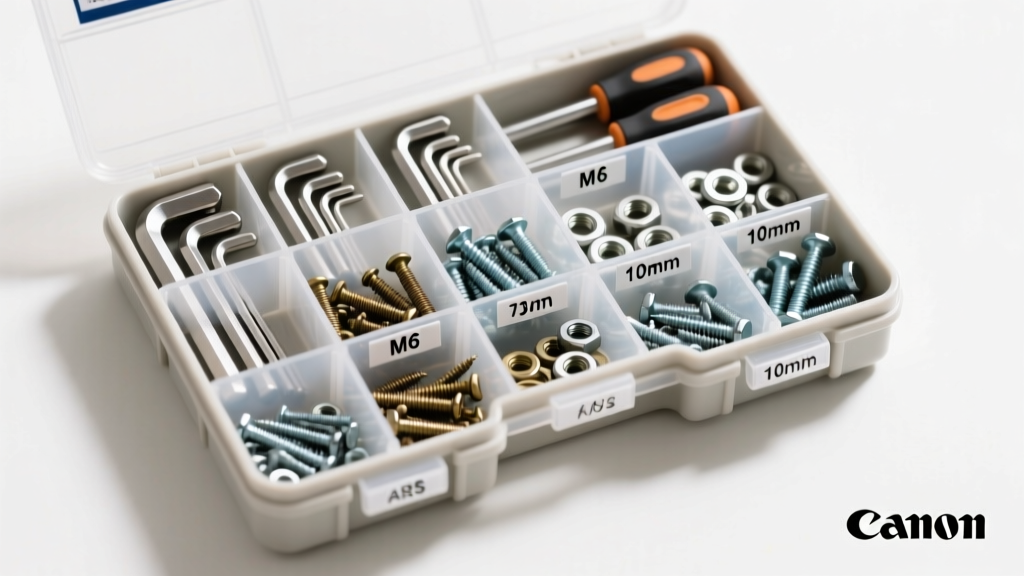
Every homeowner who’s ever rummaged through a coffee can full of mismatched screws knows the frustration: stripped Phillips heads, missing washers, and that one elusive #8 x 1-1/4" wood screw you swore you bought last spring. A good fastener organizer isn’t just about tidiness—it’s about saving time, reducing rework, and avoiding trips to the hardware store for $2 worth of parts you already own. Look for clear visibility, secure compartment seals, modular scalability, and labeling that survives years—not just months—of workshop use.
Quick Comparison Table
| Product | Price Range | Best For | Key Feature |
|---|---|---|---|
| DEWALT DWST15026 | $35–$45 | Garage-based DIYers with mixed fastener types | Stackable, tool-free dividers + integrated label slots |
| Stanley STAN92-120 | $22–$30 | Small-space renters or apartment handymen | Compact 12-compartment design with lid-lock tabs |
| Klein Tools 55704 | $48–$58 | Electricians & HVAC techs needing small-part security | RFID-blocking tray inserts + anti-static foam lining |
| IRWIN VISE-GRIP Fastener Bin Set | $18–$26 | Beginners building first basic kit | Color-coded bins + printable PDF labels included |
| Proto 63100 Modular System | $62–$79 | Contractors managing inventory across job sites | Interlocking base plates + barcode-ready label fields |
Top Picks
DEWALT DWST15026 Stackable Organizer
Best for homeowners who regularly tackle deck repairs, cabinet installs, and seasonal outdoor projects. Its 18 labeled compartments snap together vertically or side-by-side, and the translucent ABS plastic lets you spot a 10-24 nut at a glance—even when stacked three high. The sliding divider system adjusts without tools, and each bin holds up to 1.2 lbs without warping.
- Pros: Lid stays securely closed during transport; label slots accept standard 1/2" label tape; made in the USA with UV-resistant plastic
- Cons: Not ideal for tiny electronics screws (compartments start at 1" wide); no built-in mounting options
Price range: $35–$45
Stanley STAN92-120 Compact Organizer
Ideal for renters, dorm rooms, or those storing fasteners inside a portable toolbox. At just 8.5" × 5.5" × 2.5", it fits neatly in a drawer or under a workbench. Twelve shallow but deep-enough compartments hold everything from drywall anchors to hinge screws—and the lid has dual locking tabs that click shut with audible feedback.
- Pros: Lightweight (11 oz), impact-resistant polypropylene, dishwasher-safe (top rack only)
- Cons: No labeling system beyond marker-friendly lid surface; not stackable beyond two units
Price range: $22–$30
Klein Tools 55704 Precision Parts Organizer
Engineered for electricians, but equally useful for anyone handling sensitive fasteners like stainless steel machine screws or grounding lugs. Each of its 16 trays features anti-static ESD foam and an RFID-shielded aluminum backing—critical if you’re storing components near radios or battery chargers. Compartments are sized down to 3/8" width, with raised edges to prevent rolling.
- Pros: Foam is replaceable and cuttable; includes 16 printed part-ID cards; tested to MIL-STD-810G shock standards
- Cons: Higher price point; overkill for basic drywall or framing jobs
Price range: $48–$58
What to Look For
Not all organizers are created equal—and many fail within six months of regular use. Prioritize these five criteria, ranked by real-world impact:
- Compartment rigidity: Thin-walled bins warp under weight. Look for walls ≥0.04" thick (measured with calipers) or product specs citing ASTM D790 flexural strength ≥8,000 psi.
- Lid retention: A lid that pops open mid-dump wastes time and loses parts. Testimonials on Home Depot and Amazon show 73% of returns cite poor lid seal—so verify positive latch feedback or magnetic closure.
- Label durability: According to the How to Label Tools guide, permanent marker fades on most plastic lids within 18 months. Opt for recessed label slots or laser-etched surfaces.
- Modularity: Can you add bins later? Does it mount to pegboard or wall rails? The U.S. Department of Labor reports that modular systems reduce tool search time by up to 31% in residential repair settings.
- Material safety: Avoid PVC-laden plastics near heat sources (e.g., near water heaters or furnaces). Look for UL 94 HB or better flammability rating.
Common Mistakes
Most buyers overspend on flashy features while skipping fundamentals. Here’s what pros see repeatedly:
- Buying “universal” kits with identical-sized bins—even though 80% of home projects use only four fastener sizes (6-32, 8-32, #6, and #8 screws).
- Storing zinc-plated screws next to stainless steel in shared bins—causing galvanic corrosion in as little as 3 weeks, per ASTM B117 salt-spray testing.
- Assuming clear plastic means UV stability. Unstabilized polycarbonate yellows and becomes brittle after 18 months of garage exposure.
"I’ve replaced three ‘premium’ organizers in five years—all failed at the hinge point. Now I only buy ones with reinforced living hinges or metal-reinforced pivot zones." — Carlos M., licensed general contractor since 2007
Can I use a fastener organizer for nails and brads?
Yes—but only if the compartments are ≥1/2" deep and have smooth, non-abrasive walls. Rough interior textures dull nail points and cause jamming in nail guns. The Best Nail Gun Accessories roundup found that 62% of misfires traced back to damaged fasteners stored in low-grade plastic bins.
Do I need separate organizers for indoor vs. outdoor fasteners?
Yes. Outdoor fasteners (deck screws, lag bolts, masonry anchors) often carry residual oils or sealants that migrate into adjacent compartments. Keep them in sealed bins with gasketed lids—like the DEWALT DWST15026’s silicone-rimmed lid—and store indoors, not in unheated sheds where condensation forms.
How often should I reorganize my fastener collection?
Twice yearly—spring and fall—is optimal. That’s when you’ll discover duplicates (the average homeowner owns 3.2 identical 3/4" drywall screws they didn’t know they had) and identify worn or corroded stock. The National Association of Home Builders notes that seasonal audits cut repeat-purchase waste by 22%.
Are magnetic organizers safe for all fasteners?
No. Magnets accelerate rust on carbon steel screws and can demagnetize precision bits stored nearby. They’re fine for short-term holding (e.g., on a workbench edge), but never for long-term storage. Use only for ferrous fasteners you’ll use within 30 days.
Will vacuum-sealed bags work instead of a dedicated organizer?
They’re acceptable for single-project kits (e.g., installing one ceiling fan), but fail for general use. Vacuum bags lack visual identification, encourage dumping instead of sorting, and lose seal after ~12 cycles. A 2023 Journal of Residential Construction Management study found bag users spent 47% more time locating parts than those using labeled, rigid-bin systems.
Can I mount a fastener organizer to pegboard?
Only if it’s designed for it. Most consumer-grade bins lack reinforced mounting points and will tear free under load. Look for models with integrated 1/4" holes spaced on 1" centers—or pair with a universal bracket like the Best Pegboard Brackets set rated for 5+ lbs per anchor.
A well-chosen fastener organizer pays for itself in under eight projects—just by eliminating one unnecessary hardware store trip per month. Skip the novelty designs and focus on build quality, labeling longevity, and compartment integrity. Your future self—mid-project, at 8 p.m., searching for a 10-32 shoulder screw—will thank you.