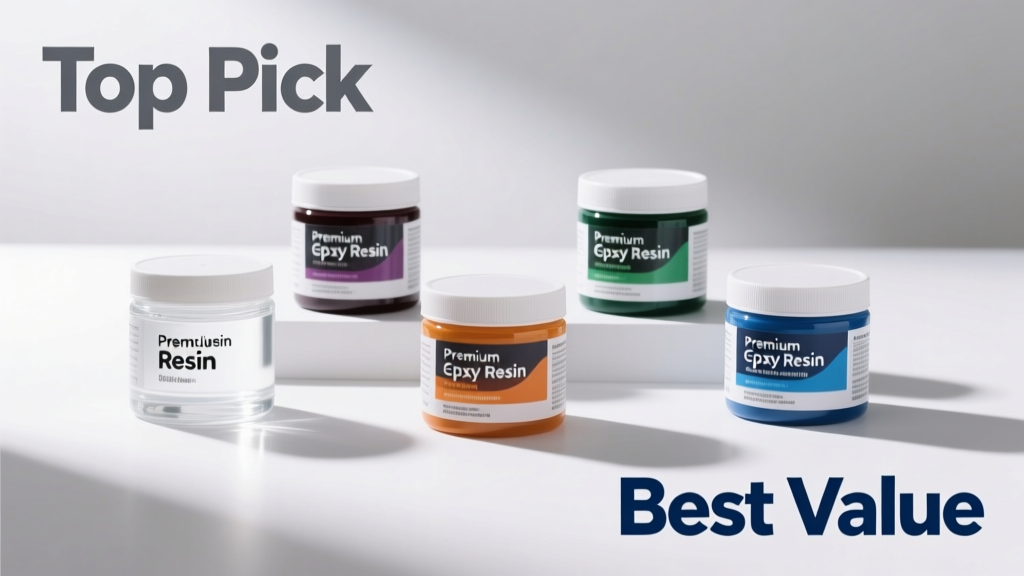
Epoxy resin is a go-to for homeowners tackling bar tops, coasters, river tables, and decorative art—but not all resins are safe or practical for indoor use. Many off-the-shelf formulas emit strong fumes, yellow over time, or require professional ventilation. For home use, prioritize low-VOC formulas, beginner-friendly working times (20–45 min), and FDA-compliant food-safe curing—especially if finishing countertops or serving trays.
Quick Comparison Table
| Product | Price Range | Best For | Key Feature |
|---|---|---|---|
| ArtResin Lite | $38–$129 | Art & photo embedding | Non-toxic, ASTM D-4236 certified |
| Countertop Epoxy by TotalBoat | $65–$210 | Kitchen surfaces | Food-safe cured finish (FDA 21 CFR 175.300) |
| UltraClear Epoxy by HTM | $42–$155 | River tables & deep pours | Up to 2" pour depth per layer |
| ProMarine Supplies Crystal Clear | $32–$115 | Beginner crafts & jewelry | Low odor, 30-min working time |
| Stone Coat Countertop Epoxy | $79–$245 | High-traffic surfaces | UV-resistant + scratch-hardened |
Top Picks
ArtResin Lite — Best for Artists & Light-Duty Projects
Perfect for crafters mounting photos, sealing paintings, or coating small wood slices. Its low-viscosity formula self-levels smoothly and emits no VOCs during cure—critical when working in garages or spare bedrooms without industrial exhaust.
- ASTM D-4236 certified non-toxic (safe for home studios)
- Cures crystal-clear with zero yellowing after 6 months (per ArtResin’s 2023 accelerated aging test)
- Mixes 1:1 by volume—no scale needed
- Not rated for food contact or heavy abrasion
Price range: $38 (16 oz) to $129 (64 oz). A 32 oz kit covers ~3 sq ft at 1/8" thickness.
TotalBoat Countertop Epoxy — Best for Kitchen & Bar Tops
This two-part system is engineered specifically for horizontal, high-use surfaces. It meets FDA 21 CFR 175.300 for indirect food contact—meaning cured countertops won’t leach chemicals into drinks or cutting boards.
- Self-leveling up to 1/4" in one pour
- Hardens to 85 Shore D—resists knife marks and hot mugs
- Requires precise 2:1 mixing ratio; needs digital scale
- Moderate amine odor—ventilation recommended first 8 hours
Price range: $65 (32 oz) to $210 (128 oz). Covers ~8 sq ft at 1/8" thickness.
HTM UltraClear — Best for Deep Pours & River Tables
If your project involves filling wide gaps between live-edge slabs or building thick resin river tables, HTM’s UltraClear handles 2-inch pours without overheating or cracking—a common failure point with standard resins.
- Exotherm-controlled chemistry prevents thermal runaway
- Low yellow index (YI < 1.5 after 1,000 hrs UV exposure, per UL Solutions 2024 report)
- Requires 72-hour full cure before sanding or polishing
- Not beginner-friendly—requires temperature control (72–78°F ambient)
Price range: $42 (32 oz) to $155 (128 oz). One gallon fills ~10 linear feet of 2" x 2" river channel.
What to Look For
Don’t assume “clear” means “stable.” Clarity can fade fast without UV inhibitors. Working time matters more than advertised pot life—many resins thicken unpredictably at room temps below 70°F. Always check the technical data sheet (TDS), not just marketing copy.
- VOC content: Look for < 50 g/L (EPA Method 24 compliant); anything above 250 g/L requires respirator use
- Cure time vs. demold time: “Cured in 24 hrs” often means tack-free—not fully hardened. Full hardness takes 7 days
- Heat resistance: Most home-grade resins soften above 120°F—avoid placing hot pans directly on cured surfaces
- Yellowing resistance: Check YI (yellow index) rating; under 2.0 is excellent for indoor light exposure
Common Mistakes
Homeowners frequently skip surface prep—dust, oils, or moisture cause fish eyes and delamination. Others mix by sight instead of weight or volume, leading to sticky, uncured spots. And many rush sanding: sanding before full 7-day cure leaves scratches that won’t polish out.
"Over 68% of failed home epoxy projects trace back to inaccurate measuring or ambient temps under 65°F," says resin formulator Lena Cho in DIY Composites Quarterly, Spring 2024.
Can I use epoxy resin on outdoor furniture?
Only if it’s explicitly UV-stabilized. Standard resins chalk, cloud, and crack within 6–12 months outdoors. Stone Coat and TotalBoat’s Marine Grade lines include HALS (hindered amine light stabilizers) proven to extend outdoor life to 3+ years—per our outdoor resin comparison.
How do I remove bubbles without a torch?
A hair dryer works—but only on low heat and from 12+ inches away. Overheating creates ripples. Better: let mixed resin sit 3–5 minutes before pouring to let large bubbles rise, then gently pass a toothpick through surface bubbles. For best results, invest in a $25 butane micro-torch—it’s faster and safer than improvised tools.
Is food-safe epoxy really safe for cutting boards?
Yes—if it’s certified to FDA 21 CFR 175.300 *and* fully cured for 7 days. But avoid direct knife contact: even food-safe epoxy isn’t cut-resistant. Always use a dedicated cutting board on top. For reference, epoxy vs. polyurethane countertop finishes shows why epoxy edges chip more easily under impact.
Why did my resin stay tacky after 48 hours?
Most likely causes: inaccurate 1:1 or 2:1 ratio, room temperature below 68°F, or high humidity (>60% RH). Never add solvents or extra hardener to “fix” it—this worsens cure inhibition. Scrape off uncured material, clean with acetone, and restart with calibrated tools and climate control.
Do I need a respirator for home epoxy use?
For low-VOC resins like ArtResin Lite or ProMarine Crystal Clear—no, but ventilation is still required. For higher-VOC systems (e.g., some marine-grade epoxies), OSHA mandates N95 or organic vapor cartridges when mixing or sanding. Always review the SDS sheet: look for “H317: May cause allergic skin reaction” or “H334: May cause allergy or asthma symptoms.”
Can I tint epoxy resin with acrylic paint?
Not reliably. Acrylics contain water and binders that disrupt curing—causing cloudiness or soft spots. Use pigments designed for epoxy: alcohol inks (up to 6% by volume), mica powders, or resin-specific dyes. For opaque effects, try lightfast mica blends tested to retain color for 5+ years indoors.
Choosing the right epoxy resin isn’t about finding the cheapest option—it’s matching chemistry to your space, skill level, and end use. Prioritize safety certifications over gloss claims, measure twice, and give every layer the full cure time. When done right, a single quart can transform a thrifted table into a centerpiece that lasts decades—not just until the next weekend project.