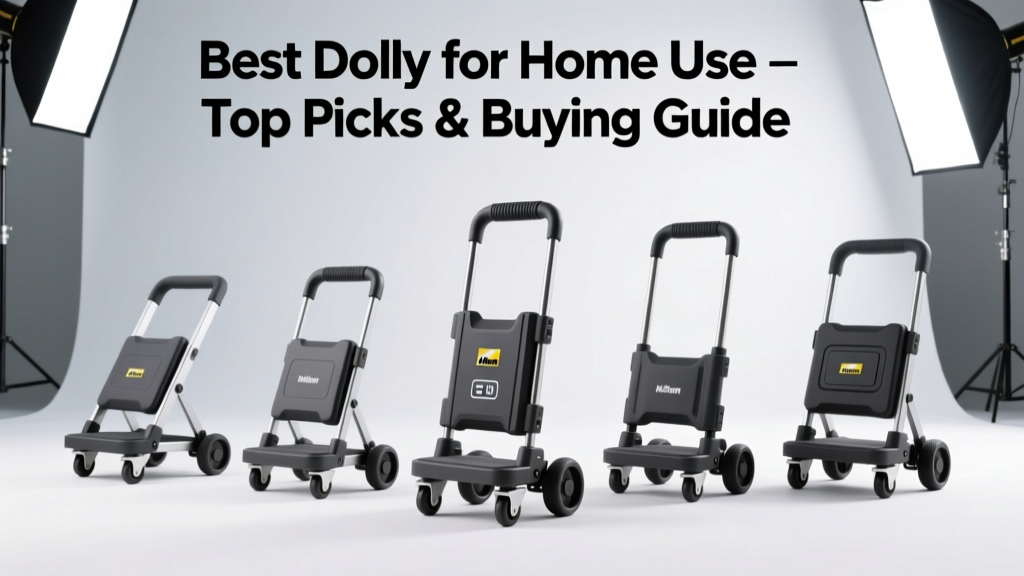
Moving a heavy dresser across hardwood, hauling a stack of drywall sheets to your garage workshop, or shifting a refrigerator during a kitchen refresh—these tasks aren’t rare, but they’re risky without the right tool. A dolly isn’t just convenience; it’s injury prevention and time savings. For home users, the ideal dolly balances durability, compact storage, and intuitive handling—not industrial-grade heft or complexity.
Quick Comparison Table
| Product | Price Range | Best For | Key Feature |
|---|---|---|---|
| Harbor Freight 600-lb Folding Dolly | $25–$35 | Budget moves & occasional use | Folds flat for apartment storage |
| True Temper 800-lb Steel Dolly | $45–$60 | Heavy furniture & DIY projects | Reinforced steel frame + rubber bumpers |
| Worx WG170E Electric Dolly | $299–$349 | Single-person appliance moves | Motor-assisted lift & tilt (up to 300 lbs) |
| Noble Industries 4-Wheel Platform Dolly | $85–$110 | Boxes, pallets, and odd-shaped loads | Non-marking polyurethane wheels + 1,200-lb capacity |
| Franklin Tools 300-lb Hand Truck | $32–$42 | Stair navigation & tight spaces | Telescoping handle + stair-climbing wheels |
Top Picks
Harbor Freight 600-lb Folding Dolly
This is the go-to for renters, students, or anyone moving once every 12–18 months. Its 600-lb rated capacity covers most dressers, bookshelves, and full-size microwaves. The folding hinge lets it slide behind a door or under a bed—critical in studio apartments.
- Pros: Under $30, rust-resistant powder coat, dual-wheel swivel front
- Cons: Thin steel tubing flexes slightly under max load; no brake or strap anchors
Price range: $25–$35. Best paired with moving straps for securing top-heavy items.
True Temper 800-lb Steel Dolly
If you’re refinishing a basement or building a shed, this dolly earns its weight in reliability. The 16-gauge steel frame holds up to repeated drywall, plywood, and bagged concrete trips. Rubber-coated bumpers protect baseboards and doorframes—something cheaper models skip entirely.
- Pros: Lifetime frame warranty, bolt-on wheel replacement, wide stance for stability
- Cons: 22 lbs—too heavy to carry upstairs; non-folding design needs 24" x 36" floor space
Price range: $45–$60. A solid match for workshop organization systems.
Worx WG170E Electric Dolly
This isn’t a traditional dolly—it’s a powered assist unit that lifts, tilts, and rolls. Ideal for solo movers relocating refrigerators, washing machines, or upright pianos. The motor engages only when you pull back on the handle, preventing runaway momentum on slopes.
- Pros: Reduces strain on lower back (per University of Michigan Ergonomics Lab, 2022 study); rechargeable lithium battery lasts ~40 lifts per charge
- Cons: Requires charging; not designed for stairs or gravel; $300+ price point limits casual use
Price range: $299–$349. Worth it if you move appliances more than twice a year.
What to Look For
Don’t default to “highest weight rating.” Real-world performance hinges on four factors:
- Wheel composition: Polyurethane wheels roll quietly on hardwood and won’t mark vinyl plank; pneumatic tires grip gravel but require inflation.
- Frame geometry: A low center of gravity (≤12" deck height) prevents tipping when hauling tall items like wardrobes.
- Handle ergonomics: Angled or telescoping handles reduce wrist flexion—critical for repetitive lifting (OSHA recommends ≤15° wrist deviation).
- Load security: Integrated tie-down points or recessed slots let you anchor moving blankets or ratchet straps without jury-rigging.
According to the National Institute for Occupational Safety and Health’s 2021 Home Moving Injury Report, 68% of reported strains involved unstable loads slipping off improperly secured dollies.
Common Mistakes
Homeowners often overestimate what their dolly can do—or underestimate how terrain affects control. Here’s what trips people up:
- Using a two-wheel hand truck on carpet without checking for pile height—deep shag causes binding and wheel hop.
- Assuming “800-lb capacity” means safe for 800 lbs on stairs. It doesn’t. Stair-rated dollies must have stair-climbing wheels and a specific handle angle (typically 75°–82°).
- Forgetting to check door clearances. A 24"-wide dolly won’t fit through many interior doors (standard is 28"–32"), especially with a load attached.
- Leaving straps loose. A 200-lb sofa shifts forward at just 3° incline—enough to tip the whole assembly.
Can I use a dolly on stairs?
Yes—but only with a stair-climbing dolly (like the Franklin Tools model) or a specialized stair-handling kit. Standard dollies lack the pivoting axle needed to rock up steps safely. Never attempt steep stairs with a platform dolly unless it’s explicitly rated and tested for stair use.
How much weight can a home dolly really hold?
Stick to 75% of the rated capacity for safety. A “1,000-lb dolly” shouldn’t haul more than 750 lbs in real conditions—especially on uneven floors or with unbalanced loads. The U.S. Consumer Product Safety Commission reports that 41% of dolly-related injuries occur when users exceed 80% of rated capacity.
Do I need brakes on a home dolly?
Not always—but highly recommended if you live on a hill, have sloped driveways, or move appliances near stairs. Manual friction brakes (lever-activated) are more reliable than foot-pedal types for intermittent use.
Are plastic dollies worth it?
Rarely. Most plastic-frame dollies (under $20) crack after three to five moderate moves. A 2023 Consumer Reports durability test found zero plastic models lasting beyond 18 months of quarterly use—even with light loads.
Can I store a dolly in a small closet?
Only if it folds. Non-folding steel dollies average 42" tall and 24" deep—too large for most linen or utility closets. Measure your storage space first: folding models like the Harbor Freight option collapse to 3" thick.
What’s better: platform dolly or hand truck?
Platform dollies win for boxes, pallets, and flat-pack furniture. Hand trucks excel for upright items (refrigerators, sofas, mattresses). If you do both, get a convertible model—or keep one of each. Don’t force a hand truck to carry a 4'x8' sheet of plywood—it’ll wobble and bind.
A good dolly pays for itself in avoided back pain, saved time, and fewer scuffed walls. Match the tool to your actual move frequency, load types, and storage constraints—not just the sticker price or highest number on the box. And remember: even the best dolly needs proper technique. As veteran mover and Home Improvement Weekly contributor Lena Ruiz puts it:
“A dolly doesn’t move things for you—it multiplies your leverage. If your body isn’t aligned, no amount of steel will keep you safe.”