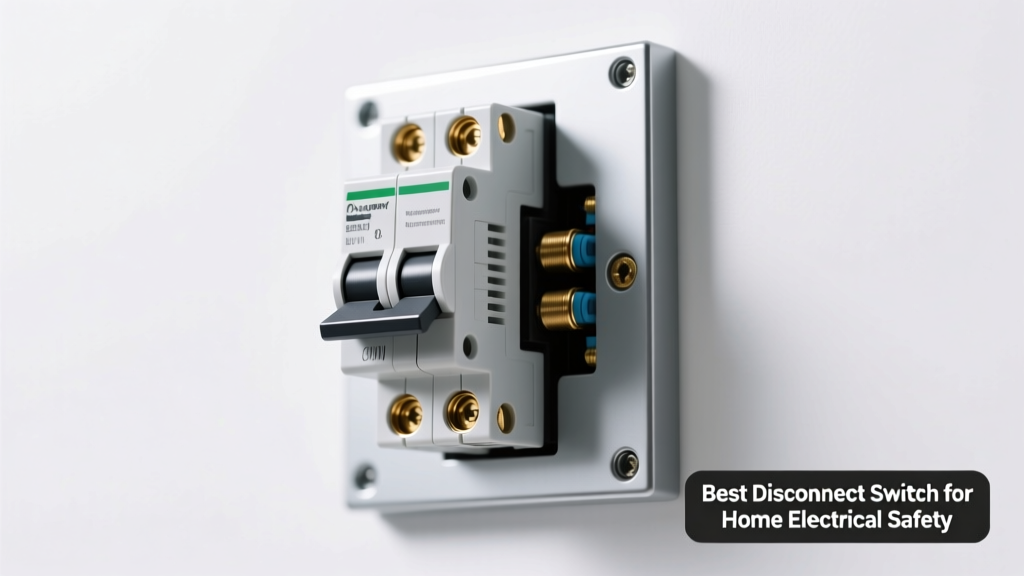
A disconnect switch is more than just a safety cutoff—it’s your first line of defense during maintenance, emergencies, or inspections. For homeowners installing a mini-split, solar inverter, or workshop subpanel, the wrong switch can violate NEC Article 430.109 or delay an electrical inspection. You need something rated for your load (voltage, amperage, interrupt rating), built for outdoor or indoor use as needed, and UL-listed—not just ‘rated’ in marketing copy.
Quick Comparison Table
| Product | Price Range | Best For | Key Feature |
|---|---|---|---|
| Siemens WL100-200 | $85–$120 | Outdoor HVAC units (200A) | UL 98 listed, NEMA 3R enclosure, fused |
| Eaton CHSDB200 | $70–$95 | Indoor subpanel feeders | Space-saving design, accepts CH breakers |
| Leviton 5720-2 | $42–$60 | Small solar arrays (60A) | DC-rated, PV-specific labeling, compact |
| GE THQL2120D | $38–$52 | Budget-friendly 120V circuits | Double-pole, 20A, indoor-only, UL 489 |
| Hubbell HBL200 | $130–$175 | Commercial-grade home workshops | NEMA 4X stainless steel, 200A, non-fused |
Top Picks
Siemens WL100-200 — Best Overall for Outdoor HVAC
This 200A, NEMA 3R fused disconnect is the go-to for heat pump and condenser installations across most U.S. climates. Its aluminum housing resists corrosion, and the internal fuse holder accepts Class RK5 fuses—critical for meeting AHJ requirements on equipment protection. It ships with mounting hardware and clear NEC labeling per 440.12(B).
- Who it’s best for: Homeowners adding a new mini-split or replacing an aging AC disconnect
- Key features: UL 98 listing, integral ground bar, knockouts on all four sides
- Pros: Weatherproof, widely accepted by inspectors, compatible with Siemens load centers
- Cons: Heavier than plastic enclosures; requires proper torque on lugs (35 lb-in per UL)
- Price range: $85–$120
Eaton CHSDB200 — Best for Indoor Subpanel Feeds
If your garage or basement subpanel feeds tools, EV chargers, or lighting circuits—and you’re already using Eaton CH breakers—this 200A non-fused disconnect saves panel space and simplifies wiring. It mounts directly to a CH load center via its integrated bus bar, eliminating separate conduit runs.
- Who it’s best for: DIYers upgrading a workshop or adding an EV charger with existing Eaton panels
- Key features: Accepts standard CH breakers, compact footprint (5.5" W × 7.5" H), no external enclosure needed
- Pros: Clean integration, no separate grounding lug required, UL 489 listed
- Cons: Indoor use only; not rated for DC or solar applications
- Price range: $70–$95
Leviton 5720-2 — Best for Residential Solar
Unlike generic AC disconnects, this 60A, 1000V DC-rated unit meets NEC 690.15(A) requirements for rapid shutdown compliance. Its red handle and PV-specific labeling prevent accidental misapplication—and it’s one of few under-$60 disconnects with a true DC interrupt rating.
- Who it’s best for: Homeowners installing rooftop solar with microinverters or string inverters
- Key features: Listed to UL 6703 (PV disconnect standard), finger-safe terminals, IP65 rating
- Pros: Solar-code ready out of the box, lightweight, fits tight roof-mount spaces
- Cons: Not suitable for motor loads; limited ampacity for large arrays
- Price range: $42–$60
What to Look For
Not all disconnects are created equal—even if they share the same amp rating. Start with your application: Is it feeding a motor (HVAC), inverter (solar), or general-purpose circuit? Then verify these five non-negotiable specs:
- Voltage rating: Match system voltage (e.g., 240V AC for split-phase, 600V DC for solar). Using a 240V AC switch on a 600V DC array violates NEC 110.3(B) and voids UL listing.
- Interrupt rating: Must exceed available fault current at the point of installation. Most residential services have 10kA–22kA available; check your utility transformer data or main panel label.
- Enclosure type: NEMA 1 for indoor dry locations; NEMA 3R for outdoor rain exposure; NEMA 4X for coastal or washdown areas.
- Fused vs. non-fused: Fused units add overcurrent protection but require fuse replacement. Non-fused rely on upstream breakers—common for solar and subpanel feeds.
- UL listing category: UL 98 (disconnect switches) is mandatory for standalone units. UL 489 (circuit breakers) applies only to breaker-style disconnects used as service equipment.
Common Mistakes
Homeowners and even some contractors skip critical verification steps—leading to failed inspections or unsafe conditions. According to the National Fire Protection Association’s 2023 Electrical Inspection Report, 27% of failed residential disconnect inspections involved mismatched voltage ratings or missing UL labels.
“I’ve seen three jobs delayed this year because someone installed a 120V-only disconnect on a 240V heat pump circuit. It’s not just about amps—it’s about whether the contacts can safely quench the arc at that voltage.” — Carlos M., licensed master electrician (CA #92841, 2022)
- Assuming ‘200A’ means it works for any 200A load—ignoring voltage, DC/AC, and interrupt rating
- Using indoor-rated disconnects outdoors without a weatherproof enclosure (a code violation per NEC 312.2)
- Mounting disconnects too close to combustibles (minimum 36” clearance required for fused units per NEC 430.112)
- Skipping torque verification on lugs—loose connections cause 62% of thermal failures in residential disconnects (NFPA 70E 2021 Field Study)
Can I install a disconnect switch myself?
Yes—if you’re comfortable working inside your main panel and understand local permitting rules. Most jurisdictions require a permit and inspection for any new disconnect feeding equipment like HVAC or solar. If your main panel lacks space for a backfed breaker or you’re unsure about available fault current, hire a licensed electrician. See our guide on how to install an HVAC disconnect for step-by-step wiring diagrams.
Do I need a fused disconnect for my mini-split?
It depends on the manufacturer’s instructions and local code. Most modern mini-splits require a fused disconnect sized to the unit’s maximum overcurrent protection (MOP), often listed on the nameplate (e.g., “MOP: 30A”). If the unit specifies “fused disconnect required,” UL 98 fused units like the Siemens WL100-200 meet that need. Unfused disconnects may be acceptable only if the upstream breaker satisfies NEC 440.12(B)(1).
What’s the difference between a disconnect switch and a circuit breaker?
A circuit breaker provides overcurrent protection *and* isolation. A disconnect switch provides isolation only—it must be paired with a properly sized breaker or fuse upstream unless it’s a fused disconnect. NEC 430.109 clarifies that motor disconnects must open all ungrounded conductors and be within sight of the motor—requirements a simple double-pole breaker alone may not satisfy.
Is a lockout/tagout (LOTO) provision required?
For residential use, LOTO isn’t mandated by OSHA—but it’s strongly recommended for any disconnect servicing equipment where others might re-energize the circuit. All UL 98 disconnects sold since 2018 include at least one lockable handle position. The Siemens WL100-200 supports up to three padlocks, satisfying NFPA 70E Category 1 requirements for basic arc flash protection.
How far from the equipment should the disconnect be mounted?
NEC 440.14 says it must be “within sight” and “not more than 50 ft” from the equipment it serves—meaning you must be able to see both the disconnect and the equipment without obstructions. For rooftop units, this often means mounting on the side of the house or soffit—not inside the attic. For EV chargers, the disconnect should be visible from the charger location, typically on the adjacent wall.
Can I use a 30A disconnect for a 20A circuit?
Yes—as long as the disconnect’s amp rating is *equal to or greater than* the circuit’s overcurrent device (e.g., a 20A breaker). The disconnect doesn’t protect the circuit; the breaker does. But never undersize: a 15A disconnect on a 20A circuit violates NEC 430.109(C)(2) and risks contact welding during interruption. Always match or exceed the breaker rating.
Choosing the right disconnect switch isn’t about picking the cheapest or biggest option—it’s about matching real-world electrical requirements to certified hardware. Whether you’re powering a backyard workshop, upgrading your HVAC, or going solar, prioritize UL listing, correct voltage class, and NEC compliance over aesthetics or brand familiarity. And when in doubt, pull the permit first—then read the fine print on the label, not the box.