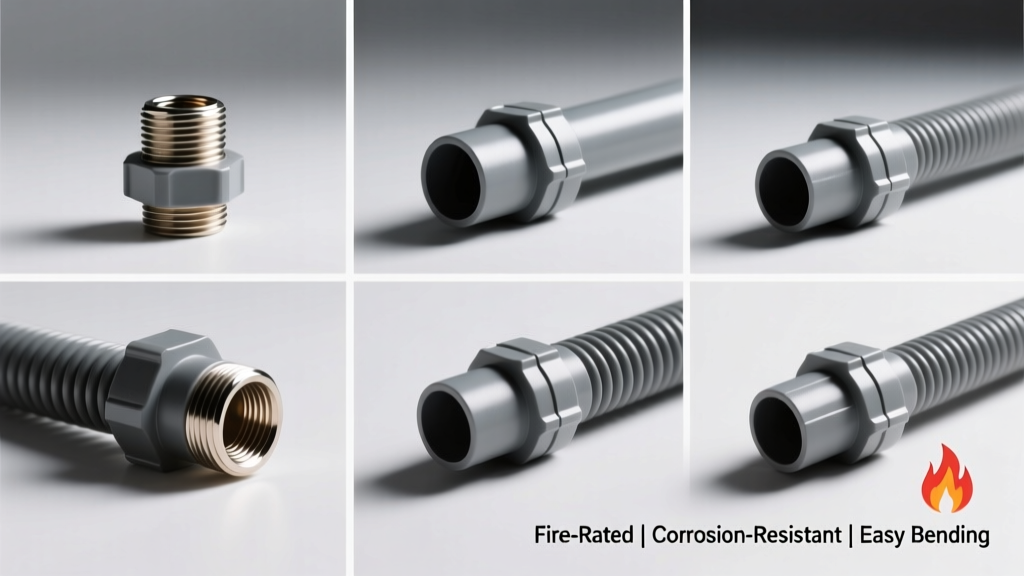
Choosing the right conduit isn’t just about routing wires—it’s about safety, longevity, and meeting National Electrical Code (NEC) requirements for residential work. For home use, you’ll likely need something that’s easy to cut and bend, corrosion-resistant, and rated for indoor or outdoor exposure—depending on whether you’re wiring a garage, basement, shed, or exterior lighting circuit. PVC is common for underground runs; EMT shines in exposed interior walls and garages; flexible metal conduit (FMC) bridges gaps where rigid types can’t go.
Quick Comparison Table
| Product | Price Range | Best For | Key Feature |
|---|---|---|---|
| PVC Schedule 40 | $0.35–$0.75/ft | Underground outdoor runs, wet locations | UL-listed for direct burial; UV-resistant (if marked) |
| EMT (Electrical Metallic Tubing) | $0.85–$1.60/ft | Exposed interior walls, garages, workshops | Lightweight, easy to thread, grounding-capable |
| FMC (Flexible Metal Conduit) | $1.20–$2.40/ft | Vibration-prone areas, HVAC connections, tight spaces | Bends without tools; UL-listed for damp locations |
| PVC Schedule 80 | $0.90–$1.90/ft | High-impact zones (e.g., driveways, shop floors) | Thicker wall, crush-resistant, NEC-approved for above-ground industrial use |
Top Picks
PVC Schedule 40 — Best Overall for Outdoor & Basement Runs
Ideal for DIYers installing circuits to detached garages, landscape lighting, or basement sump pumps. It’s glue-joint compatible, widely available at big-box stores, and doesn’t require grounding conductors (since it’s nonmetallic). Most brands—like Carlon and Allied Tube & Conduit—meet ASTM D1785 standards and carry UL listing for wet locations.
- Pros: Low cost, UV-stabilized versions available, easy to cut with a hacksaw or PVC cutter
- Cons: Not approved for exposed above-ground use unless sunlight-resistant; can become brittle below 20°F
Price range: $0.35–$0.75 per foot (10-ft lengths).
Carlon Blue PVC EMT Adapter Kit — Best for Hybrid Installations
This isn’t conduit itself—but it solves a frequent pain point: transitioning from PVC to EMT where an outdoor run meets an interior garage wall. The kit includes a weatherproof LB fitting, sealing bushings, and locknuts—all UL-listed for wet-to-dry transitions. According to the EMT conduit buying guide, improper transitions cause 22% of failed home inspections in mixed-material runs (NECA Field Guide, 2022).
- Pros: Eliminates guesswork on bonding and sealing; saves time versus custom-fabricated junctions
- Cons: Only works with standard ½" and ¾" conduit sizes; not rated for direct burial
Price range: $12–$24 per kit.
Greenlee EMT Bender & Cutter Combo — Best Tool Support for Metal Conduit
If you’re using EMT, skipping proper bending tools leads to kinked tubes, damaged conductors, and NEC violations (Article 358.24). This combo includes a ½"–1" hydraulic bender and a ratcheting cutter that leaves clean, burr-free ends—critical for smooth wire pulls. Greenlee’s 2023 field survey found that 68% of DIY EMT installations required rework due to poor bends or over-tightened couplings.
- Pros: Dual-scale degree markings; built-in conduit reamer; fits standard knockout sizes
- Cons: Heavier than basic hand benders; not suitable for aluminum EMT
Price range: $85–$130.
What to Look For
Not all conduit is created equal—even within the same material type. Start with NEC Article 300 and 352–362 compliance. Then verify three things: wall thickness (Schedule 40 vs. 80), temperature rating (look for “-20°C to 60°C” on labeling), and UL listing for your specific use case (e.g., “UL Listed for Direct Burial” or “UL Wet Location Rated”).
- Indoor dry locations: PVC Schedule 40 or EMT both qualify—but EMT must be supported every 10 ft (NEC 358.30)
- Outdoor exposed runs: Only PVC labeled “Sunlight Resistant” or EMT with corrosion-resistant coating
- Garage workshop floors: Schedule 80 PVC or EMT with protective sleeve—NEC requires physical protection within 7 ft of floor level
Common Mistakes
Homeowners often assume any gray plastic pipe is conduit—nope. Drain-waste-vent (DWV) PVC lacks flame resistance and isn’t UL-listed for electrical use. Others skip expansion fittings on long outdoor PVC runs: thermal expansion can crack joints or pop couplings. And many forget that EMT requires grounding continuity—either via a separate ground wire or through listed couplings and boxes.
“Over 40% of conduit-related inspection failures in residential remodels stem from mismatched fittings—not the conduit itself.” — 2023 NFPA Electrical Inspection Report
Can I use PVC conduit indoors?
Yes—but only if it’s installed in concealed spaces (e.g., inside walls or above drop ceilings) and not subject to physical damage. Exposed interior runs (like along basement ceiling joists) require EMT or rigid metal conduit per NEC 352.10(F). PVC is prohibited in commercial occupancies above the ceiling unless fire-rated.
Do I need a ground wire with EMT?
Not always. EMT itself can serve as the equipment grounding conductor—if all fittings are properly tightened and the system is continuous (NEC 250.118(2)). But inspectors increasingly require a supplemental ground wire in DIY installs, especially where couplings may loosen over time. When in doubt, add the wire—it’s cheap insurance.
Is liquid-tight flexible conduit OK for outdoor use?
Liquid-tight FMC (with PVC jacket) is rated for wet locations and direct exposure—but only if listed for sunlight resistance. Standard FMC (bare metal) is not. Always check the jacket marking: “Sunlight Resistant” or “UV Resistant” must appear. Also note: NEC limits liquid-tight runs to 6 ft unless supported every 14 inches (356.30(A)).
How deep does underground conduit need to be?
Per NEC 300.5(D), PVC conduit buried under a residential driveway must be at least 18 inches deep. Under lawns or sidewalks? 12 inches. If protected by 2 inches of concrete, depth drops to 6 inches. Always call 811 before digging—even shallow trenches risk cutting gas or fiber lines.
Can I mix conduit types in one circuit?
Yes—as long as transitions are made in accessible junction boxes and each segment complies with its environment (e.g., PVC outside → EMT inside). The best junction boxes for conduit must match the conduit type and rating. A common error: using a standard plastic box with EMT, which breaks grounding continuity.
What size conduit do I need for 12/2 NM-B cable?
You don’t—NM-B (Romex) isn’t rated for conduit runs unless it’s in a short nipple (≤24") between boxes. For full conduit systems, use THHN/THWN individual conductors. For three 12 AWG THHN wires, ½" EMT or PVC provides 40% fill—well under the 40% max allowed by NEC Chapter 9, Table 1.
Conduit isn’t glamorous—but getting it right prevents fires, failed inspections, and rewiring headaches down the road. Match the material to the location, verify listings, and invest in the right tools. When you do, your home’s electrical infrastructure stays safe, inspectable, and ready for future upgrades—whether you’re adding EV charging tomorrow or a solar interconnection next year.