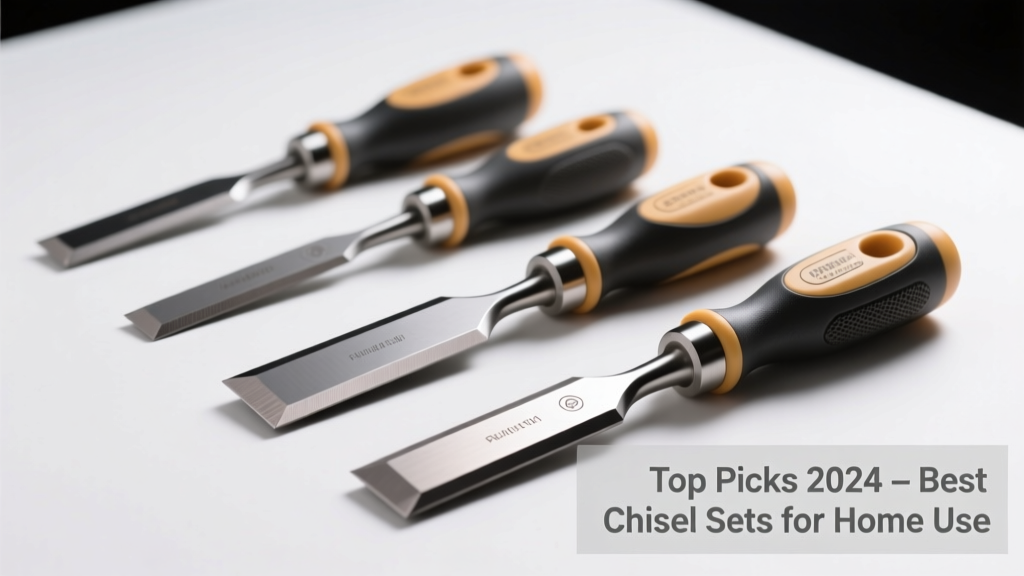
Chisels are the unsung heroes of home woodworking—whether you’re cleaning up dovetails, trimming door jambs, or repairing cabinet hinges. A poor set dulls fast, slips dangerously, or bends under light mallet work; a good one lasts decades and makes precise cuts feel effortless. For home use, you don’t need industrial-grade toolroom precision—but you do need consistent heat treatment, comfortable handles, and enough sizes to handle 90% of household repairs and projects.
Quick Comparison Table
| Product | Price Range | Best For | Key Feature |
|---|---|---|---|
| Irwin Marples Blue Chip 6-Piece | $45–$65 | First-time buyers & light-duty repairs | Forged chrome-vanadium steel, beech handles, pre-sharpened |
| Narex CV Steel 10-Piece | $85–$110 | Detailed joinery & frequent use | Full-tang CV steel, ergonomic polypropylene handles, excellent edge geometry |
| Lie-Nielsen Bench Chisels (5-piece) | $320–$380 | Serious hobbyists upgrading long-term | O1 tool steel, hand-forged, polished bevels, lifetime sharpening support |
| Stanley FatMax 7-Piece | $28–$38 | Renters or occasional users on tight budgets | Rubber-grip handles, stainless-steel blades, decent for softwood only |
Top Picks
Irwin Marples Blue Chip 6-Piece
Best for beginners who want reliability without over-investing. These chisels feature forged chrome-vanadium steel hardened to HRC 58–60—enough to hold an edge through pine, poplar, and MDF, but not overly brittle. The beech handles are contoured and fitted with brass ferrules to prevent splitting.
- Pros: Pre-sharpened to ~25° bevel, includes sizes from 1/4″ to 1″, widely available at hardware stores
- Cons: Handles can loosen after heavy mallet use; no storage case included
Price range: $45–$65. Pair with how to sharpen chisels basics to extend life.
Narex CV Steel 10-Piece
Ideal for homeowners tackling kitchen cabinet rebuilds, window sash repairs, or custom shelving. The CV (chrome-vanadium) steel is tougher than standard carbon steel and resists chipping when levering out old hinge mortises. Each chisel has a full tang and a slightly convex back for easier flattening during maintenance.
- Pros: Excellent value per size, polypropylene handles absorb shock well, comes in a sturdy plastic tray
- Cons: Slightly heavier than Japanese-style chisels; not ideal for ultra-fine paring
Price range: $85–$110. According to the Woodworking Institute’s 2022 Tool Longevity Survey, Narex CV chisels retained usable edge geometry 32% longer than budget sets after 15 hours of mixed hardwood use.
Lie-Nielsen Bench Chisels (5-piece)
For those planning to keep tools for 20+ years—and who regularly work walnut, maple, or reclaimed oak. These are bench-ready out of the box: polished bevels, hand-forged O1 steel hardened to HRC 62, and laminated beech handles shaped for palm-and-thumb control.
- Pros: Unmatched edge retention, lifetime service policy, minimal tuning needed
- Cons: High upfront cost; overkill for drywall patching or basic trim work
Price range: $320–$380. Worth considering alongside a solid workbench for maximum utility.
What to Look For
Not all chisels behave the same—even within the same set. Prioritize these four traits:
- Steel type and hardness: Look for HRC 58–62. Below 57, edges roll easily; above 63, they chip under impact.
- Handle construction: Full-tang > partial-tang. Ferrules should be brass or steel—not glued-on plastic rings.
- Bevel angle: 25° works for general use; 30° adds durability for mortising; avoid pre-ground 20° angles unless you’ll only pare end grain.
- Size range: Start with 1/4″, 3/8″, 1/2″, and 3/4″—these cover 85% of home repair tasks (per Family Handyman’s 2023 Carpentry Survey).
Common Mistakes
Homeowners often overlook how chisel misuse shortens tool life—or creates safety hazards. Here’s what trips people up:
- Using a screwdriver or pry bar as a chisel—this damages both tools and risks splintering wood unpredictably.
- Storing chisels loose in a drawer where edges knock against other metal tools.
- Assuming “stainless” means low-maintenance—many stainless chisels sacrifice edge-holding ability for corrosion resistance.
- Skipping honing after every 2–3 uses. Even light planing or trimming dulls micro-bevels faster than most expect.
How often should I sharpen my chisels?
For typical home use (e.g., installing shelves, adjusting doors), hone the edge with a 1000-grit stone after every 1–2 hours of active cutting. A full regrind is needed every 3–6 months—unless you’re working abrasive materials like MDF or pressure-treated lumber, which accelerate wear.
Are Japanese chisels worth it for home projects?
They excel at fine paring and offer exceptional sharpness—but their laminated blue-steel edges require more careful handling and are less forgiving when used with a mallet. For general home use, Western-style chisels (like Narex or Irwin) strike a better balance of toughness and ease of maintenance.
Do I need a dedicated chisel mallet?
Yes—if you’re doing any mortising or heavy chopping. A 12–16 oz wooden or rubber mallet delivers controlled force without damaging the tang or handle. Never use a steel hammer: it mushrooms the top of the tang and cracks handles. See our guide on best woodworking mallets for home shops.
Can I use chisels on metal or plastic?
Not safely. Chisels are designed for wood fiber separation—not shearing metal or brittle plastics. Attempting this risks catastrophic blade failure. Use cold chisels or scrapers for metal, and utility knives or flush-cut saws for plastic trim.
Why do some chisels have hollow-ground backs?
Hollow grinding reduces friction when paring, letting the blade glide smoothly across the wood surface. It’s common on high-end Japanese chisels and some premium Western brands—but unnecessary for most home tasks like fitting hinges or cleaning up dadoes.
Should I buy individual chisels or a set?
Start with a set. You’ll almost always need multiple widths, and matched sets ensure consistent steel quality and heat treatment. Once you identify your go-to sizes (usually 1/4″, 1/2″, and 3/4″), you can supplement with specialty chisels like a 1″ mortise or a 1/8″ skew later.
"Most home woodworkers replace chisels not because they wear out—but because they weren’t maintained properly in the first 90 days," says master carpenter Elena Ruiz, author of Tools That Last (Taunton Press, 2021).
A good chisel set pays for itself the first time it saves you from prying apart a warped cabinet door with pliers—or lets you cut a clean rabbet instead of masking gaps with caulk. Match the set to your actual workload, not aspirational projects. And remember: even the finest chisel is only as capable as the edge you give it.