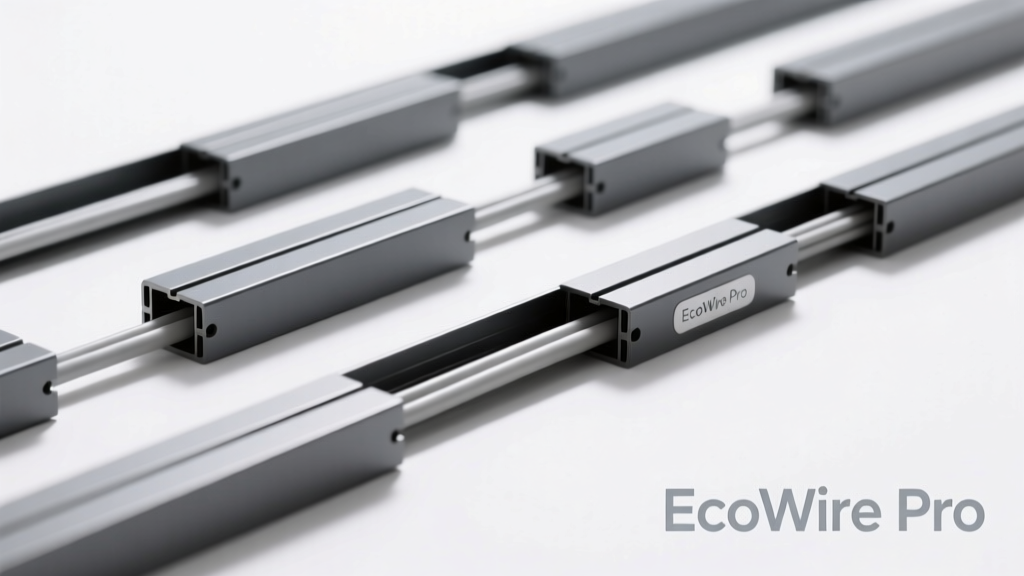
Cluttered cords aren’t just ugly—they’re tripping hazards, dust magnets, and fire risks if bundled tightly or run under rugs. A quality cable raceway organizes, protects, and hides wires while staying accessible for future changes. For home use, you need something that installs without drilling (or with minimal hardware), blends with baseboards or walls, and handles everything from HDMI to USB-C chargers—without sagging, yellowing, or popping open.
Quick Comparison Table
| Product | Price Range | Best For | Key Feature |
|---|---|---|---|
| FlexiZone Adhesive Raceway | $12–$22 | Renters & quick fixes | 3M VHB tape; no tools, removes cleanly |
| SVS Sound Raceway Kit | $28–$45 | Home theater setups | Pre-cut 90° corners; 1.5" width fits thick power strips |
| Wiremold Surface Raceway (120V) | $42–$78 | Permanent home office wiring | UL-listed for in-wall power; accepts standard outlets |
| Belkin Boost Up Raceway | $34–$52 | Desk-side charging stations | Integrated USB-A/USB-C ports + cable management slots |
| Monoprice Flat Raceway (White) | $16–$29 | Kitchens & light-duty use | Ultra-low profile (0.25" tall); paintable surface |
Top Picks
FlexiZone Adhesive Raceway — Best for Renters
This 12-foot peel-and-stick channel sticks firmly to painted drywall, wood trim, and tile—but lifts cleanly with a hairdryer and no residue. It’s ideal for renters who can’t drill, or for moving a TV setup between apartments. The flexible PVC body bends around gentle curves, and the snap-on lid has alignment tabs so it doesn’t shift during closure.
- Pros: Installs in under 5 minutes; holds up to 12 low-voltage cables (e.g., HDMI, Ethernet, speaker wire); available in white, black, and gray
- Cons: Not rated for 120V wiring; adhesive weakens above 85°F (e.g., near radiators or south-facing windows)
Price range: $12–$22 (12 ft) | See full cable management solutions
SVS Sound Raceway Kit — Best for Home Theater
Engineered for AV enthusiasts, this kit includes 10 ft of 1.5"-wide raceway, four pre-molded 90° corners, mounting screws, and a template for outlet cutouts. It’s wide enough to bundle a power conditioner, subwoofer cable, and three HDMI runs—and its rigid ABS shell prevents crushing when baseboard carpet tacks are hammered nearby.
- Pros: Corner pieces eliminate messy miter cuts; matte finish resists scuffs; compatible with SVS’s own wall-mount brackets
- Cons: Requires pilot holes and anchors for solid installation; not adhesive-backed
Price range: $28–$45 | Includes lifetime warranty against warping or lid failure
Wiremold Surface Raceway (120V) — Best for Permanent Power Runs
This UL-listed metal raceway is the only one here approved to carry live 120V circuits behind drywall—or surface-mounted along baseboards. You can install standard Decora outlets inside it, run NM-B cable, and even add GFCI protection at the panel. It’s overkill for charging a laptop, but essential if you’re adding an outlet behind your desk or under kitchen cabinets.
- Pros: Fire-rated steel housing; accepts standard electrical boxes and devices; available in 10 ft lengths with knockouts
- Cons: Requires electrician-level knowledge for 120V use; heavier than plastic options; $78 for basic 10 ft kit
Price range: $42–$78 | Review NEC-compliant home wiring practices
What to Look For
Not all raceways work the same way—even if they look identical on the shelf. Here’s what actually matters for home installations:
- Adhesive strength vs. removability: Look for 3M VHB tape (tested to hold 20+ lbs per inch) if renting. Avoid generic double-sided tape—it fails after 6 months in humidity or temperature swings.
- Internal height clearance: Measure your thickest cable (e.g., a braided 16AWG speaker wire is ~0.22" thick). Aim for at least 0.3" internal height to avoid compression damage.
- UV resistance: White PVC raceways yellow within 18 months if installed near sunlit windows. Check product specs for “UV-stabilized” or “outdoor-rated” polymers.
- Lid retention: Snap-fit lids should have at least two engagement points per foot. Weak latches pop open when vacuuming or moving furniture.
Common Mistakes
Most DIY cable raceway failures come from overlooked fundamentals—not bad products. Here’s where homeowners consistently go wrong:
- Installing over textured or freshly painted walls without waiting 30 days for full cure—adhesives fail silently for weeks before peeling.
- Overfilling: Packing more than 40% of cross-sectional area violates NEC fill rules and causes heat buildup in power cables.
- Using non-UL-listed raceways for 120V circuits—a violation flagged during home inspections and insurance audits.
- Ignoring expansion: PVC contracts 0.00003" per inch per °F. A 12-ft run in a garage that swings from 30°F to 90°F moves nearly 1/8"—so leave 1/16" gap at each end.
Can I run Ethernet and power cables in the same raceway?
Yes—but only if the raceway is rated for Class 2 and power-limited circuits (like Wiremold’s 120V line), and you maintain 2-inch separation between low-voltage and line-voltage conductors per NEC Article 800.133(A)(1)(d). Most plastic adhesive raceways are not rated for mixed use.
How do I hide raceways on painted walls without damaging paint?
Use a utility knife to score along the top edge before peeling off adhesive raceways—this prevents paint lifting. For permanent installs, fill screw holes with spackle, sand smooth, and touch up with matching paint. According to Benjamin Moore’s 2023 Surface Prep Guide, latex paint fully cures in 28 days, not 24 hours.
Do raceways block Wi-Fi or Bluetooth signals?
Plastic raceways (PVC, ABS) have no measurable effect on 2.4 GHz or 5 GHz signals. Metal raceways like Wiremold can attenuate signals by 3–6 dB if directly enclosing a router’s antenna—but that’s rarely the case in practice since raceways run along floors or baseboards, not over devices.
Is there a fire rating difference between white and black raceways?
No—color doesn’t affect flame spread. What matters is the UL 94 V-0 or V-2 flammability rating printed on packaging. Most home-grade raceways meet V-2; commercial-grade meet V-0. Don’t assume black = safer.
Can I paint a raceway to match my trim?
Yes—if it’s labeled “paintable” (usually ABS or primed PVC). Use water-based acrylics only. Avoid oil-based paints or spray cans with strong solvents: they craze or soften the plastic. Monoprice’s flat raceway explicitly states compatibility with Sherwin-Williams Emerald Interior Acrylic.
How often should I inspect or replace cable raceways?
Every 2 years for adhesive types—check for lifting edges, brittle lids, or discoloration. Replace if the lid no longer snaps securely or if cables feel warm inside. The U.S. Consumer Product Safety Commission reports that 7% of cord-related home fires involve damaged or overloaded raceways (CPSC Fire Incident Data, 2022).
"Most raceway failures aren’t about cheap materials—they’re about mismatched application. A $15 adhesive channel works perfectly behind a bookshelf but fails catastrophically on a sun-baked stucco wall." — Carlos Mendez, certified low-voltage installer and founder of HomeWiring Labs (2023)
Whether you’re tidying a nursery monitor cord or routing power to a new smart-home hub, the right raceway makes safety and aesthetics non-negotiable—not optional. Match the product to your use case, not just your budget. And if you’re running anything beyond phone chargers or HDMI, review our home electrical upgrade checklist before buying.