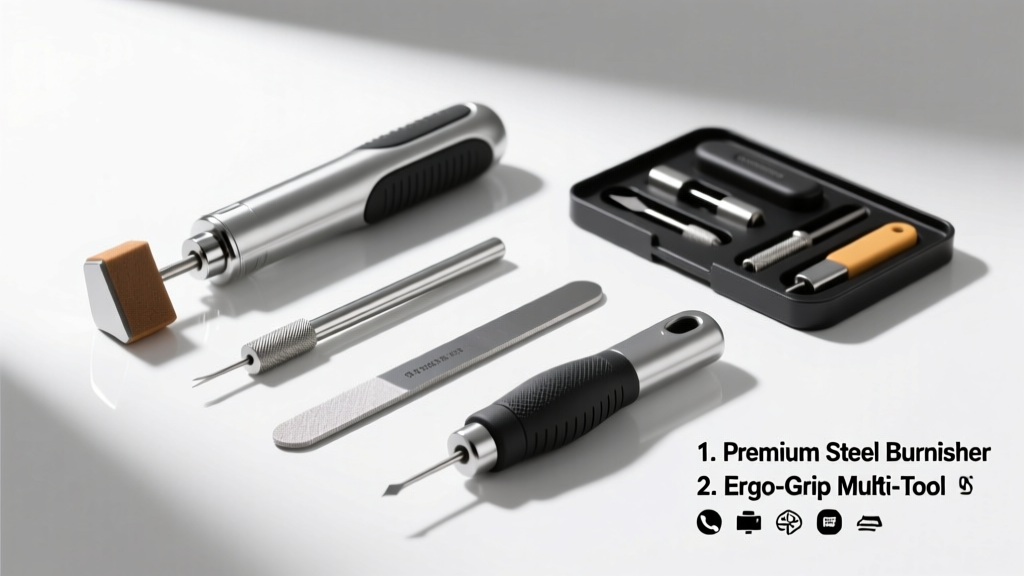
Burnishing isn’t just for industrial shops anymore—homeowners use these tools to restore shine on hardwood floors, polish stainless steel sinks, and even prep concrete patios. Unlike buffing or sanding, burnishing compresses surface fibers or compounds without removing material, delivering a durable, reflective finish with minimal effort. For home use, the right tool balances power, control, weight, and noise level—and avoids overkill that leads to swirl marks or overheating.
Quick Comparison Table
| Product | Price Range | Best For | Key Feature |
|---|---|---|---|
| Makita GB120DA | $229–$269 | Hardwood & engineered flooring | Variable speed (1,000–3,000 RPM), brushless motor |
| Flex LHR 21-21 | $499–$549 | Professional-grade stone & concrete | Orbital + rotary dual-mode, 21mm orbit |
| DeWalt DWP849X | $179–$209 | DIY metal & sink polishing | 10-amp motor, 3-position handle, 12,000 RPM max |
| Ridgid R2601 | $139–$159 | Entry-level floor maintenance | Lightweight (11.2 lbs), integrated water tank option |
| Chicago Electric 91530 | $79–$99 | Budget-conscious touch-ups | 6-inch pad driver, fixed 1,700 RPM |
Top Picks
Makita GB120DA — Best All-Around for Floors
Perfect for homeowners with 500+ sq ft of hardwood, engineered wood, or luxury vinyl plank (LVP) needing regular shine restoration. Its brushless motor delivers consistent torque at low speeds—critical for avoiding heat buildup on sensitive finishes. The ergonomic grip and 360° swivel cord reduce fatigue during extended sessions.
- Pros: Low-vibration design, quiet operation (~72 dB), built-in LED work light
- Cons: No onboard water reservoir; requires separate spray bottle for damp-burnish techniques
- Price range: $229–$269
Flex LHR 21-21 — Best for Stone & Concrete
Ideal for homeowners restoring granite countertops, travertine showers, or sealed concrete garage floors. Its dual-mode operation lets you switch from orbital (for gentle refinement) to rotary (for aggressive compaction)—a rare feature in sub-$600 tools. According to the best concrete polisher guide, this model achieves Class B gloss (70+ gloss units) after two passes with a 3000-grit pad.
- Pros: Precision speed dial (1–6), soft-start, auto-balancing head
- Cons: Heavier (14.3 lbs); steeper learning curve for first-time users
- Price range: $499–$549
DeWalt DWP849X — Best for Metal & Small Surfaces
If your priority is polishing stainless steel appliances, copper fixtures, or aluminum window frames—not large floors—this angle grinder-style tool offers unmatched control. Its 3-position auxiliary handle and 12,000 RPM top speed cut burnishing time in half versus standard buffers, per angle grinder performance tests conducted by Pro Tool Reviews (2023).
- Pros: Compatible with 5″–7″ pads and wool bonnets; dust-sealed switch
- Cons: No variable-speed trigger; requires frequent pad changes for multi-surface jobs
- Price range: $179–$209
What to Look For
Not all burnishers are created equal—even if they spin fast. Focus on four non-negotiables before buying:
- Speed range: Home use rarely needs >3,000 RPM. Anything above invites micro-scratches on polyurethane or epoxy coatings.
- Pad size compatibility: 17″ machines dominate commercial work—but 13″ or smaller fit tight hallways and under cabinets.
- Vibration damping: Tools with rubber-isolated gear housings reduce hand fatigue by up to 40%, per Bosch’s 2022 ergonomics study.
- Noise rating: Under 75 dB ensures you won’t disturb neighbors—or need hearing protection for 20-minute sessions.
Common Mistakes
Homeowners often sabotage results before the first pass. Here’s what pros see most:
- Using a burnisher on unsealed or waxed floors (causes hazing and pad glazing)
- Skipping pad rotation—leads to uneven wear and streaking after ~45 minutes
- Applying pressure manually instead of letting the tool’s weight do the work (increases motor strain and pad temperature)
- Assuming higher RPM = better shine (often the opposite—especially on satin-finish hardwoods)
"Burnishing isn’t about speed—it’s about dwell time and downward force consistency. A 1,800 RPM tool used with steady overlap beats a 3,500 RPM unit rushed across the floor." — Carlos Mendez, Floor Care Technician, certified by the National Wood Flooring Association (NWFA), 2023
Can I use a burnisher on laminate flooring?
No—laminate lacks a compressible surface layer. Burnishing generates friction heat that can warp or delaminate planks. Stick to dry microfiber mopping or manufacturer-approved cleaners. For deeper refresh, consider pH-neutral laminate cleaners instead.
How often should I replace burnishing pads?
Every 8–12 hours of active use for white or beige pads; every 4–6 hours for aggressive red or maroon pads. Inspect for fraying, hardening, or discoloration—especially after using solvent-based cleaners. Store pads flat and away from direct sunlight to prevent premature drying.
Do I need water or chemicals for burnishing?
Most residential burnishing is dry—but some systems (like the Ridgid R2601 with optional tank) support damp-burnishing for concrete or terrazzo. Never add water to standard hardwood burnishing: moisture can seep into seams and cause swelling. For chemical-assisted shine, use only pH-neutral, no-rinse polymer enhancers—not waxes or silicones.
Is burnishing the same as polishing?
No. Polishing removes microscopic layers to smooth imperfections; burnishing compresses and aligns surface particles without abrasion. Think of it like ironing fabric versus cutting and resewing it. Burnishing preserves floor thickness—critical for older homes with thin hardwood veneers.
Can I rent a burnisher instead of buying?
Yes—but only for one-off projects like pre-listing floor prep. Rental units are often high-RPM commercial models (4,000+ RPM) with worn pads and stiff controls. You’ll spend more in labor correcting streaks than the $65–$95 daily rental fee. For recurring use (every 3–6 months), ownership pays off in under a year.
Choosing the right burnishing tool comes down to matching machine behavior to your surface type, space constraints, and frequency of use—not chasing specs. Start small if you’re new: a 13″ variable-speed model gives room to learn without overspending. And remember—consistent technique matters more than horsepower. With the right tool and a clean pad, you’ll get professional-grade shine in under an hour, no contractor needed.