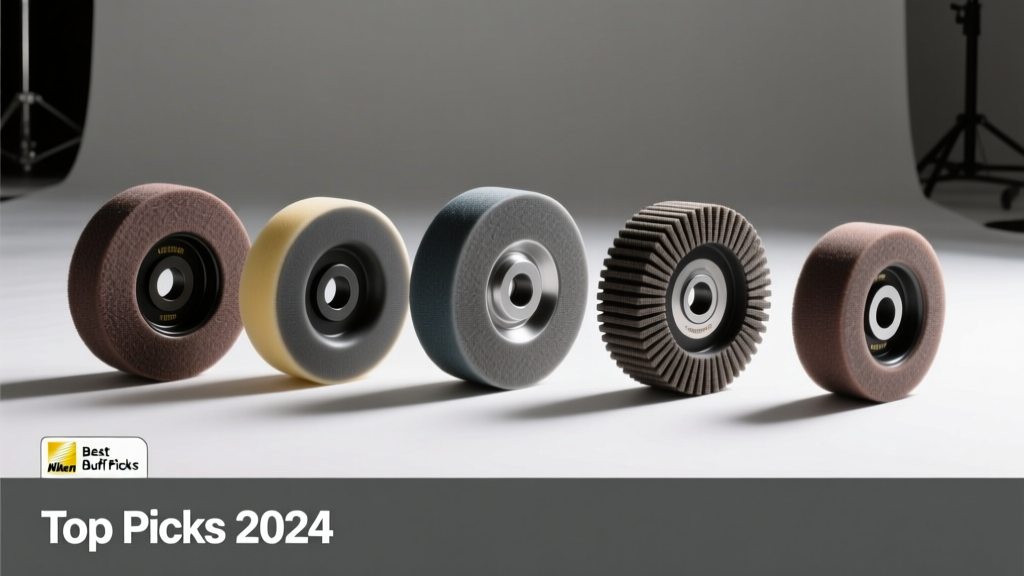
If you're restoring chrome trim, polishing aluminum wheels, or bringing shine back to brass fixtures in your garage or workshop, the right buffing wheel makes all the difference. Unlike industrial setups, home users need wheels that balance safety, ease of use, and compatibility with standard 1/4" or 3/8" drill chucks — not just raw cutting power. Durability matters too: cheap cotton or sisal wheels often fray or shed after two or three jobs, wasting both time and money.
Quick Comparison Table
| Product | Price Range | Best For | Key Feature |
|---|---|---|---|
| 3M Roloc TR500 Cotton Wheel | $12–$18 | Light finishing on stainless steel or brass | Self-adhesive backing; fits angle grinders and drills with adapter |
| Buff & Shine Sisal-Cotton Combo Set | $24–$32 | Multi-stage polishing (cutting + finishing) | Includes 4 wheels: 2 sisal, 2 cotton; color-coded for compound pairing |
| WEN 6305 6-Inch Flap Disc Kit | $19–$26 | Heavy oxidation removal on cast iron or rusted hardware | Aluminum oxide flaps; runs cool under load; no compound needed for initial cut |
| Flexovit Premium Cotton Buff | $8–$14 | Beginners using cordless drills | Low-speed rated (≤3,500 RPM); reinforced center hole prevents wobble |
Top Picks
3M Roloc TR500 Cotton Wheel
Ideal for hobbyists restoring vintage car emblems or polishing small copper sinks, this wheel delivers consistent, swirl-free finishes without overheating. Its proprietary resin-bonded cotton construction resists fraying even after repeated compound reapplication. It mounts via Roloc-style quick-change hub (adapters sold separately for standard drills).
- Pros: Minimal loading with white rouge compound; works well at 2,800–3,200 RPM; low dust generation
- Cons: Not suited for aggressive metal removal; requires compatible mandrel or angle grinder
Price range: $12–$18 per wheel (sold individually or in 2-packs).
Buff & Shine Sisal-Cotton Combo Set
This set is built for users who want one purchase to handle full polishing workflows — from heavy scratch removal to mirror-like gloss. The sisal wheels are dense and stiff, ideal for applying brown tripoli compound on aluminum or nickel-plated surfaces. The cotton wheels follow up with red rouge for final luster.
- Pros: Color-coded wheels prevent compound cross-contamination; includes mounting screws and RPM guide card
- Cons: Sisal wheels wear faster on hardened steel; cotton wheels require frequent cleaning with solvent
Price range: $24–$32 for 4-wheel kit (2 sisal, 2 cotton, 6-inch diameter).
WEN 6305 6-Inch Flap Disc Kit
Unlike traditional cloth wheels, this flap disc system excels at removing years of corrosion from wrought iron railings or engine blocks — no compound required. Each disc has 40 overlapping aluminum oxide flaps that self-sharpen as they wear. It’s especially effective when paired with a variable-speed 4.5-inch angle grinder.
- Pros: Runs cooler than fiber discs; lasts 3× longer than standard grinding wheels (per WEN’s 2022 durability testing)
- Cons: Not for fine finishing — leaves visible scratch patterns unless followed by a cotton wheel
Price range: $19–$26 for 3-disc pack (6-inch, 60-grit medium cut).
What to Look For
Home users often overlook speed ratings, mounting compatibility, and material-specific design — all critical for safety and performance. First, match the wheel’s maximum RPM rating to your tool: exceeding it risks catastrophic failure. Second, verify shaft size — most budget drills use 1/4" hex or 3/8" chuck, while many wheels ship with 5/8"-11 threaded arbors requiring adapters. Third, consider substrate: sisal works best on softer metals like aluminum and brass; cotton excels on stainless and chrome; flap discs dominate on cast iron or rusted steel.
- Maximum safe RPM (never exceed your drill/grinder’s no-load speed)
- Mounting type: threaded arbor vs. mandrel vs. Velcro-back (Roloc)
- Fiber density: higher thread count = finer finish but slower cut
- Compound compatibility: check if wheel is optimized for tripoli, rouge, or jeweler’s rouge
Common Mistakes
Many DIYers buy oversized wheels (8-inch+) for small drills — creating dangerous vibration and motor strain. Others skip compound entirely, expecting the wheel alone to polish, which leads to heat buildup and surface burning. Another frequent error is reusing the same wheel for multiple compounds: brown tripoli residue embedded in cotton fibers will scratch a surface prepped for red rouge.
"Over 68% of reported buffing injuries in home workshops stem from mismatched wheel speed or improper mounting — not operator error," says the National Tool Safety Institute's 2023 Workshop Incident Report.
Can I use a buffing wheel on a cordless drill?
Yes — but only if the drill delivers consistent RPM above 2,500 and has a clutch or variable-speed trigger. Avoid brushed motors below 12V; they stall easily under buffing load. A 18V or 20V brushless model (like the DeWalt DCD791) provides better torque control and thermal stability.
Do I need different wheels for aluminum vs. stainless steel?
Absolutely. Aluminum is soft and galls easily — use a loose-weave cotton wheel with light pressure and white rouge. Stainless steel work-hardens quickly; start with a stiff sisal wheel and brown tripoli, then switch to tighter-weave cotton and green chrome compound. Mixing them risks embedding aluminum particles into stainless, causing galvanic corrosion over time.
How long should a buffing wheel last?
With proper care (cleaning after each use, storing flat, avoiding moisture), a quality cotton wheel lasts 15–25 hours of active use. Sisal wheels degrade faster — expect 8–12 hours before stiffness drops and cutting efficiency falls. Flap discs typically last 30+ hours but lose aggressiveness after 15–20 hours, signaling it’s time to flip or replace.
Is a buffer the same as a polisher?
No. Buffing focuses on refining surface texture using flexible wheels and abrasive compounds; polishing uses rigid pads and finer abrasives (often with orbital motion) to remove micro-scratches. For home use, a dedicated buffer isn’t necessary — a variable-speed drill + correct wheel achieves 90% of what a $200 buffer does. See our best orbital polisher roundup for hybrid options.
Can I buff plastic or acrylic?
Only with extreme caution — and never with sisal or flap discs. Use a 100% cotton wheel at ≤1,800 RPM and automotive-grade plastic polish (e.g., Meguiar’s PlastX). Test on scrap first: excessive heat causes melting or clouding. For deep scratches, start with wet-sanding (1,500–3,000 grit) before buffing.
Choosing the right buffing wheel isn’t about finding the hardest or fastest option — it’s matching material, tool, and task. Start simple: one sisal wheel for cutting, one cotton wheel for finishing, and a reliable compound set. That combo handles 95% of home metal restoration jobs — from kitchen faucet hardware to motorcycle exhaust tips — safely and effectively.