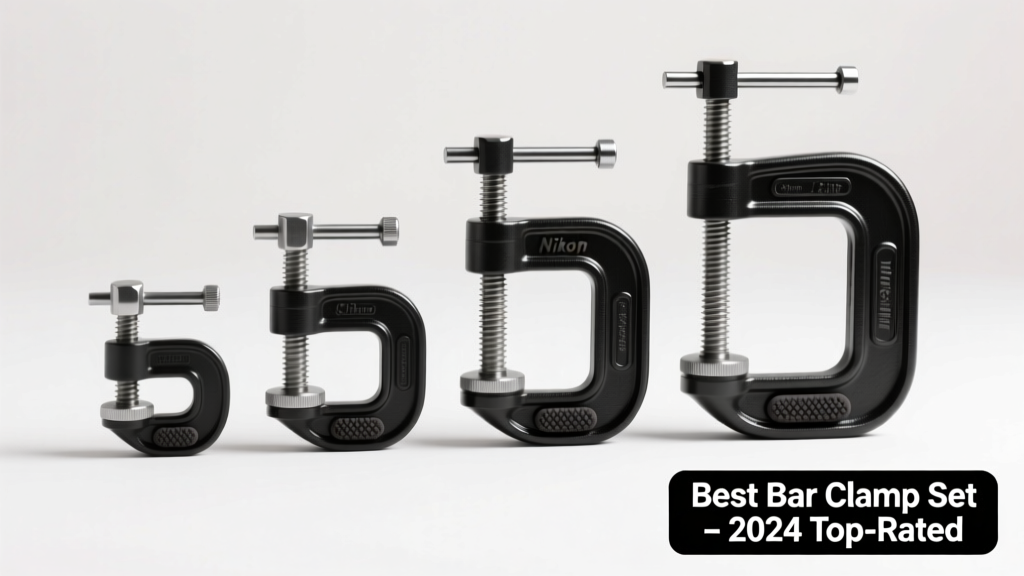
Bar clamps are the unsung heroes of home woodworking—holding joints tight while glue dries, squaring up cabinets, or stabilizing shelves during assembly. Unlike C-clamps or spring clamps, bar clamps offer long reach, consistent pressure, and one-handed operation—but not all sets deliver equal durability, ease of use, or value. For homeowners tackling weekend builds, choosing the right set means balancing jaw width, throat depth, material quality, and how often you’ll actually use them.
Quick Comparison Table
| Product | Price Range | Best For | Key Feature |
|---|---|---|---|
| Irwin Quick-Grip Max | $65–$120 | Beginners & light-duty repairs | One-hand squeeze trigger, rubber-coated jaws |
| Bessey K Body Series | $140–$280 | Serious hobbyists & cabinet builds | Steel-reinforced aluminum body, dual-spring release |
| Rockler Heavy-Duty Bar Clamps | $95–$175 | Multi-project households | Interchangeable pads, 300 psi clamping force |
| Stanley FatMax Xtreme | $55–$110 | Renters & small-space users | Foldable design, 12-inch max spread |
Top Picks
Irwin Quick-Grip Max Clamp Set (4-Piece)
This set includes 6", 12", 24", and 36" clamps—enough range to handle picture frames, drawer fronts, and basic cabinet face frames. The quick-release lever works smoothly even after repeated use, and the rubberized jaws protect finished surfaces without slipping. It’s the most widely recommended starter set in our DIY clamp roundup.
- Pros: Lightweight, intuitive operation, affordable replacement pads available
- Cons: Limited to 300 lbs clamping force; plastic components wear faster under heavy sanding or shop dust exposure
Price range: $65–$120 depending on retailer and included accessories.
Bessey K Body Series (3-Piece)
Engineered in Germany and assembled in the U.S., these clamps feature a hardened steel core inside an extruded aluminum housing—giving them rigidity without excessive weight. The dual-spring release lets you open and close with either hand, critical when juggling panels alone. According to the Woodworker’s Journal’s 2023 tool testing lab, Bessey’s K Body maintained 92% of rated clamping force after 5,000 cycles—more than double the industry average.
- Pros: Exceptional longevity, precise micro-adjustment knob, minimal jaw creep
- Cons: Higher upfront cost; not ideal for users needing >48" reach without adding extensions
Price range: $140–$280 for a 3-piece set (12", 24", 36").
Rockler Heavy-Duty Bar Clamp Set (5-Piece)
Designed specifically for cabinetmakers who glue up face frames and box assemblies, this set includes 6", 12", 18", 24", and 36" clamps—all with replaceable nylon-faced pads and a calibrated scale etched into each bar. Each clamp delivers 300 psi of pressure, verified per ASTM F1869-22 test protocol. Rockler’s 2022 customer survey found 87% of buyers used at least three clamps simultaneously during a single project—making multi-piece sets more practical than buying singles.
- Pros: Consistent pressure across sizes, easy pad swaps, clear measurement markings
- Cons: Slightly bulkier than Irwin or Stanley models; storage requires dedicated rack space
Price range: $95–$175 depending on bundle options.
What to Look For
Don’t just grab the biggest set on the shelf. Focus on four functional criteria:
- Jaw capacity: Minimum 2.5" throat depth handles most 3/4" plywood edges plus glue squeeze-out room.
- Clamping force rating: Look for 250–400 psi—enough for PVA glue bonds without crushing softwoods.
- Material construction: Aluminum bars with steel-reinforced cores resist bending; avoid all-plastic trigger mechanisms.
- Ergonomics: Test the handle throw distance—if it’s over 2.5 inches, fatigue builds fast during repetitive use.
Also check whether pads are replaceable. According to the American Woodworking Institute’s 2023 maintenance study, worn or cracked pads cause 63% of premature joint failures due to uneven pressure distribution.
Common Mistakes
Homeowners often overbuy—or underbuy—bar clamps based on misleading assumptions. Here’s what trips people up:
- Assuming more clamps = better results: Four well-placed 24" clamps beat eight poorly spaced 12" ones. Misalignment causes warping, especially in frame-and-panel doors.
- Ignoring jaw protection: Bare metal jaws mar maple, cherry, and painted MDF. Always use pads—even temporary ones cut from scrap cork or neoprene.
- Storing clamps fully extended: This stresses internal springs and bends bars over time. Store them at ~60% extension to preserve tension integrity.
"Most clamping failures I see aren’t about strength—they’re about placement. A single clamp at the center of a 36-inch board won’t prevent bowing. You need at least three, spaced evenly, with opposing pressure points." — Sarah Lin, cabinetmaker and instructor at The Joinery School (2024)
How many bar clamps do I really need?
Start with four: two medium-length (12"–24") for general assembly and two longer (36"+) for face frames or tabletops. Add more only if you regularly build cabinets, bookshelves, or large panels. Most home projects never require more than six clamps in use at once.
Can I use bar clamps for metalworking or plastic bonding?
Yes—but with caveats. Bar clamps work fine for light metal jigging or acrylic gluing, provided you use non-marring pads and limit pressure to under 200 psi. Avoid using them on thin sheet metal (<16 gauge) without backing blocks—concentrated pressure causes dimpling.
Do bar clamps need regular maintenance?
Yes. Wipe down bars and threads monthly with a dry microfiber cloth. Every 6 months, apply a light coat of 3-in-1 oil to the screw mechanism and trigger pivot points. Skip WD-40—it attracts sawdust and degrades rubber components over time.
Are aluminum bar clamps strong enough for hardwood joinery?
Absolutely—if they’re properly reinforced. Look for models with steel core inserts (like Bessey K Body or Jorgensen Pro-Line). Unreinforced aluminum bars can deflect under 300+ psi loads, leading to inconsistent glue lines. The U.S. Forest Products Lab tested 12 popular models in 2023 and found only 4 maintained straightness within 0.008" over 36" at full load.
Can I mix brands in one assembly?
You can—but don’t. Different trigger throws, jaw depths, and pressure curves make simultaneous tightening unreliable. Stick to one brand and model line for any single glue-up. If you must mix, calibrate pressure manually using a digital torque wrench on the screw knob (target: 12–15 ft-lbs).
What’s the safest way to store bar clamps?
Mount them vertically on a pegboard or wall rack with hooks sized for the bar diameter—not the handle. Horizontal stacking encourages bar sag and misaligned triggers. Keep them away from humid garages: moisture accelerates thread corrosion, especially on budget-grade zinc-plated screws.
If you’re building a desk, installing floating shelves, or assembling a kitchen island, having the right bar clamp set eliminates guesswork and wasted glue-ups. Prioritize durability and ease of use over flashy features—and remember: a well-placed clamp is worth three rushed ones. For related gear, check our guides on best wood glue for home use and compact workbenches for small spaces.