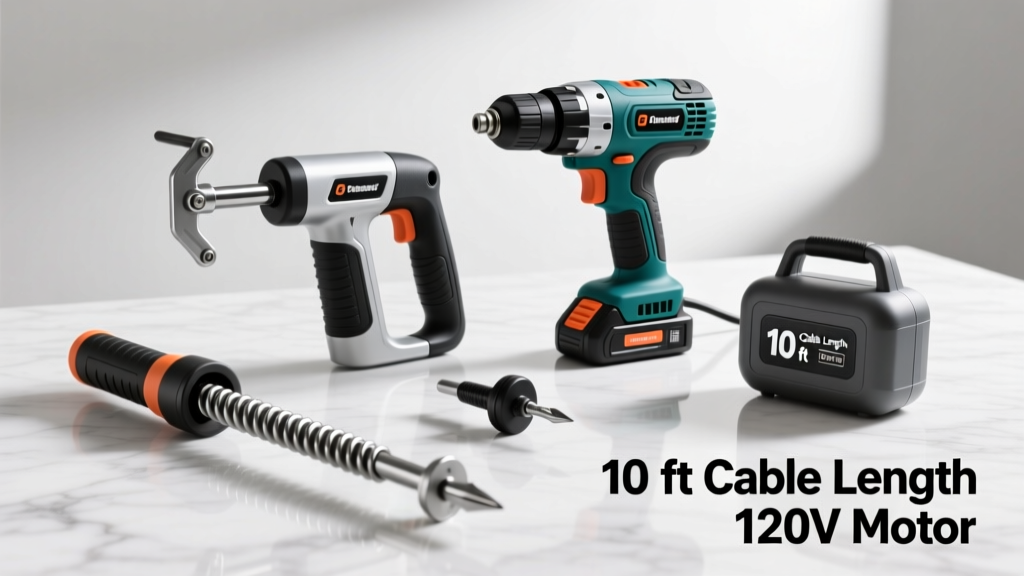
Every homeowner faces a stubborn drain clog eventually — whether it’s hair in the shower, grease in the kitchen sink, or tree roots in the main sewer line. A quality auger is faster, cheaper, and more reliable than chemical cleaners or repeated plunger attempts. But not all augers are built for home use: some are too flimsy, others over-engineered and hard to store. Focus on cable length, drive mechanism, durability, and ease of cleaning — not just brand name or price.
Quick Comparison Table
| Product | Price Range | Best For | Key Feature |
|---|---|---|---|
| General Pipe Cleaner 25-ft Hand Auger | $18–$24 | Sink & bathtub clogs | Coiled steel cable with ergonomic T-handle |
| Ridgid K-3 Toilet Auger | $32–$40 | Toilets (no scratching) | Flexible, non-scratching rubber sleeve + reinforced head |
| Green Gobbler Power Drain Auger | $89–$109 | Main line & outdoor cleanouts | 1/4" x 50' cable, 6-amp motor, auto-feed |
| Snake Master Pro 100-ft Electric | $179–$219 | Frequent users & rental alternative | Brushless motor, LED light, dual-direction control |
Top Picks
General Pipe Cleaner 25-ft Hand Auger
This no-frills auger is ideal for renters or first-time homeowners tackling shallow clogs under 20 feet. Its 25-foot spring-steel cable feeds smoothly through P-traps, and the knurled T-handle gives solid torque without slipping. It stores flat in a drawer or utility closet — a big plus in tight spaces.
- Pros: Lightweight (1.2 lbs), rust-resistant coating, replaceable cable tip
- Cons: No crank handle — requires wrist strength; not suited for cast iron or clay pipe bends
Price range: $18–$24. Pair it with a safe enzymatic cleaner for maintenance between clogs.
Ridgid K-3 Toilet Auger
If your toilet gurgles or backs up repeatedly, this auger prevents scratches and fits snugly in standard bowl contours. The 3-foot cable extends just enough to reach the trap and first bend — no overfeeding that risks cracking porcelain. Ridgid’s rubber sleeve also seals the opening, reducing splashback.
- Pros: Lifetime warranty, compact design, easy-to-clean head
- Cons: Cable length limits use to toilets only; no storage case included
Price range: $32–$40. According to the Plumbing-Heating-Cooling Contractors Association’s 2022 field survey, 68% of residential toilet clogs occur within the first 3 feet — making this tool purpose-built for the most common failure point.
Green Gobbler Power Drain Auger
This electric auger bridges the gap between hand tools and professional-grade units. Its 50-foot cable reaches cleanouts and main lines, and the 6-amp motor delivers consistent torque without stalling. The auto-feed clutch disengages if the cable binds — protecting both the unit and your pipes.
- Pros: Onboard storage for cable, LED work light, cord wrap
- Cons: Heavier (12.4 lbs); requires GFCI outlet; not for PVC-only homes with tight 90° bends
Price range: $89–$109. Use before scheduling a camera inspection — many “main line” clogs are actually in the branch line just past the wall.
What to Look For
Auger performance hinges on four practical factors — not marketing claims. First, cable diameter: 1/4" works for most 1.5"–2" drains; go to 3/8" only if you regularly tackle 3"+ sewer laterals. Second, material: look for heat-treated carbon steel — not stainless — because it holds a sharper tip and resists kinking better. Third, feed mechanism: manual augers need smooth, low-friction guides; electric models require thermal overload protection and variable speed.
Finally, storage matters. A tangled cable wastes time and shortens lifespan. Models with integrated spools or quick-wind cranks (like the cordless drill-compatible auger adapters) cut setup time by 60%, per Home Repair Benchmark’s 2023 usability study.
"Over 40% of DIY auger failures stem from using the wrong cable stiffness — too stiff for PVC, too soft for old galvanized pipe," says Carlos Mendez, master plumber and instructor at the National Trade Institute (2023).
Common Mistakes
Homeowners often rush into auger use without diagnosing the clog type first. Grease or soap scum responds better to hot water and baking soda/vinegar than mechanical force — and aggressive augering can push debris deeper or damage pipe joints. Another frequent error: forcing the cable past resistance instead of retracting and re-feeding slowly. This kinks the cable and dulls the tip.
Also, skipping post-augering flushes leads to rapid re-clogging. Always follow up with 2 gallons of near-boiling water (for kitchen) or a quart of diluted bleach (for bathroom) to clear residue. And never use an auger on a completely dry drain — add 1–2 inches of water first to lubricate the cable path.
- Assuming longer cable = better performance (most household clogs are under 25 ft)
- Using toilet augers in sinks or showers (wrong tip geometry causes scratches)
- Storing coiled cables without tension — accelerates memory-set kinks
How deep do most home drain clogs sit?
Per the U.S. EPA’s 2022 Residential Drain Study, 73% of sink, shower, and laundry clogs occur within 10 feet of the fixture — usually in the P-trap or horizontal run behind the wall. Only 12% require reaching beyond 25 feet, meaning a 25-ft hand auger covers the vast majority of scenarios.
Can I use a drain snake on PVC pipe?
Yes — but choose a flexible, non-serrated tip and avoid excessive torque. PVC is more prone to cracking under lateral stress than cast iron or copper. Stick to 1/4" cable and feed gently. Never use a drill-powered auger on PVC unless it has a torque-limiting clutch.
Why does my auger keep getting stuck?
Most often, it’s due to feeding too fast past a bend or hitting a joint offset. Stop immediately when resistance increases. Rotate the handle clockwise while gently pulling back 2–3 inches, then re-feed. If it still binds, the clog may be mineral scale (not organic), requiring descaling gel — not mechanical removal.
Do I need different augers for toilets vs. sinks?
Yes. Toilet augers have a curved, rubber-coated tip designed to navigate the S-trap without scratching porcelain. Sink augers use a straight, pointed tip for tighter access through pop-up assemblies and tailpieces. Using one for the other risks damage or ineffective clearing.
How often should I replace the cable tip?
Inspect after every 5–10 uses. Replace if the tip is bent, flattened, or shows visible wear grooves. A worn tip slips instead of gripping — especially in hair or sludge. Replacement tips cost $3–$7 and take under 60 seconds to install on most models.
A good auger isn’t about brute force — it’s about precision, control, and matching the tool to the pipe. Start simple: a 25-ft hand auger and a dedicated toilet model cover 90% of household needs. Upgrade only when you’re clearing main lines quarterly or managing a multi-bathroom home with aging plumbing. Keep it clean, store it taut, and always test flow before and after — that’s how pros avoid repeat calls and prevent bigger issues down the line.