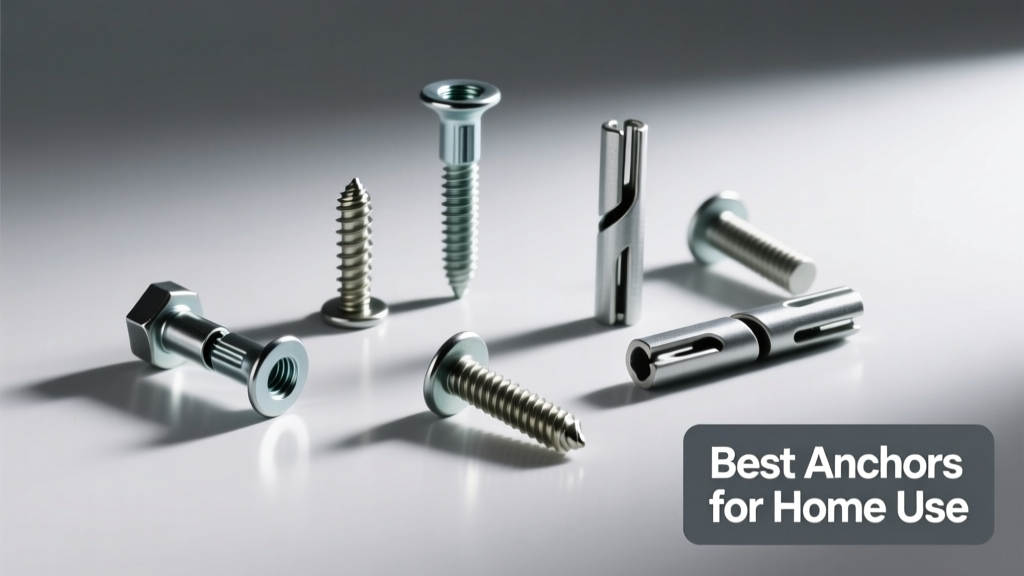
Choosing the right anchor isn’t just about holding a picture frame—it’s about preventing cracked drywall, sagging shelves, or worse: a falling TV mount. With over 42 million U.S. households doing at least one wall-mounting project per year (National Retail Federation, 2023), picking the wrong anchor is the #1 cause of rework, damage, and safety risk. Load capacity, substrate type, and tool access matter more than brand name—and most homeowners underestimate shear vs. pull-out strength by 3–5x.
Quick Comparison Table
| Product | Price Range | Best For | Key Feature |
|---|---|---|---|
| TOGGLER SNAPTOGGLE BX | $12–$28 | Heavy drywall (60+ lbs) | Expands behind drywall; no stud needed |
| Hillman E-Z Anchor | $4–$9 | Light-duty drywall (10–25 lbs) | Self-drilling; installs in seconds |
| Simpson Strong-Tie Titen HD | $22–$45 | Concrete/masonry (150+ lbs) | Wedge-action design; ICC-ES certified |
| GRK Rugged Structural Screw | $15–$26 | Wood studs or solid blocking | No anchor needed—screws directly into framing |
| Red Head Trubolt Wedge Anchor | $8–$18 | Hardened concrete (80–200 lbs) | Permanent, high-vibration resistance |
Top Picks
TOGGLER SNAPTOGGLE BX — Best for Heavy Drywall Mounts
Perfect for floating shelves, wall-mounted desks, or large mirrors where studs aren’t aligned. Each anchor supports up to 65 lbs in 1/2" drywall—and up to 125 lbs when paired across two toggles. It installs through a 3/8" hole, then snaps open behind the wall with a unique spring-loaded toggle mechanism.
- Pros: Highest drywall pull-out rating on the market; reusable if removed carefully; works in hollow-core doors
- Cons: Requires larger drill bit; not ideal for tile or plaster; needs 1.5" minimum behind-wall clearance
Price range: $12–$28 (6-pack to 24-pack).
Hillman E-Z Anchor — Best Budget Drywall Anchor
Ideal for lightweight decor—picture frames, small hooks, or bathroom towel bars. Its self-drilling ribbed sleeve cuts installation time in half versus traditional plastic anchors. Rated for 25 lbs in 1/2" drywall when used correctly (i.e., fully seated, not over-torqued).
- Pros: No pilot hole needed; color-coded sizes; widely available at hardware stores
- Cons: Loses grip if overtightened; unsuitable for repeated removal/reuse
Price range: $4–$9 (12–50 pack).
Simpson Strong-Tie Titen HD — Best for Concrete & Block
When mounting garage shelving, security cameras, or fence posts to poured concrete or CMU block, this anchor delivers certified, code-compliant hold. Its dual-wedge design expands under torque, gripping tighter as load increases. Tested to 150+ lbs in 3,000 psi concrete (ICC-ES ESR-3578, 2022).
- Pros: Meets IBC building code requirements; corrosion-resistant coating; includes setting tool
- Cons: Requires hammer drill and carbide bit; irreversible installation
Price range: $22–$45 (single to 10-pack).
GRK Rugged Structural Screw — Best No-Anchor Solution
If you’re anchoring into wood studs—or have added solid blocking behind drywall—skip the anchor entirely. These structural screws drive directly into framing with zero wobble, rated for 180+ lbs in SPF 2×4s. They eliminate anchor failure points and simplify alignment for cabinets or railings.
- Pros: No separate anchor to lose or misplace; superior shear resistance; self-countersinking head
- Cons: Requires locating studs precisely; not for hollow substrates
Price range: $15–$26 (25–100 count).
What to Look For
Anchors aren’t interchangeable—even within the same material. Start with your substrate: drywall, plaster, concrete, brick, or hollow tile each demand different expansion physics and torque specs. Then match to load type: static (shelf) vs. dynamic (door hinge) vs. vibrational (garage door opener). Always derate manufacturer claims by 30% for safety—especially in older homes with brittle plaster or crumbly cinderblock.
- Load rating: Check both pull-out (vertical) and shear (horizontal) values—not just “max weight”
- Installation method: Self-drilling? Requires hammer drill? Needs setting tool?
- Reusability: Toggle bolts can be reused if unexpanded; wedge anchors are permanent
- Corrosion resistance: Zinc-plated for indoor use; stainless or hot-dip galvanized for damp areas like basements or garages
Common Mistakes
Over 60% of anchor failures happen during installation—not product selection. Most errors are avoidable with basic prep. Using plastic anchors in plaster walls causes crumbling. Driving screws too fast strips anchor threads. And drilling oversized holes for metal toggles reduces clamping force by up to 40%, per drywall repair guidelines.
“A 1/64″ oversize hole in 1/2" drywall drops toggle anchor capacity by 22%. Measure twice, drill once—and always test with a scrap board first.” — Mike R., Certified Master Installer, National Association of the Remodeling Industry (NARI), 2022
Can I use drywall anchors in plaster walls?
No—not without modification. Historic plaster is brittle and lacks the backing layer drywall has. Use masonry-style anchors (like screw-in lead sleeves) or locate lath and anchor into wood backing. For fragile ornamental plaster, consult a preservation specialist or use adhesive-backed mounting systems instead. See our guide on plaster repair and reinforcement.
How deep should an anchor go into concrete?
Minimum embedment depth is 1.5× the anchor diameter—for example, a 3/8" wedge anchor needs at least 1-1/8" of clean, debris-free hole depth. Deeper isn’t always better: exceeding 2.5× diameter risks anchor bending during setting. Always vacuum dust from the hole before insertion—residual debris cuts holding power by up to 35% (Portland Cement Association, 2021).
Why do my anchors spin but not tighten?
This signals either stripped threads (from over-torquing or mismatched screw size) or insufficient expansion pressure. In drywall, it often means the anchor wasn’t fully seated before driving—or the hole was drilled too large. For masonry, spinning usually means the hole wasn’t cleaned or the anchor wasn’t hammered in far enough to engage the wedge.
Are toggle bolts stronger than plastic anchors?
Yes—by a wide margin. A standard plastic anchor holds ~25 lbs in drywall; a properly installed SNAPTOGGLE holds 65–125 lbs depending on spacing and wall thickness. But toggles require more space behind the wall and larger holes. Plastic anchors win only for speed and low-weight applications—never for anything above eye level or subject to movement.
Do I need different anchors for ceiling mounts?
Absolutely. Ceilings experience full pull-out load—no shear relief. Use only anchors rated specifically for overhead use, like the ceiling fan-rated EZ Anchor or heavy-duty toggles with reinforced wings. Never repurpose wall-rated anchors for ceilings: their geometry isn’t tested for sustained vertical tension.
Can I mount a TV with drywall anchors alone?
Only with high-performance toggles like SNAPTOGGLE or WingIts—and only if the TV weighs under 75 lbs and the mount is designed for anchor-only use. For TVs over 55", building codes and UL standards require direct stud attachment or engineered backer boards. See our TV mounting guide for bracket compatibility charts and load-testing methods.
There’s no universal anchor—but there is a right anchor for your wall, weight, and tools. Don’t guess. Match substrate, load, and installation reality first—and treat every anchor like a structural component, not a convenience item. When in doubt, add blocking or hit the stud. Your wall—and whatever hangs on it—will thank you.