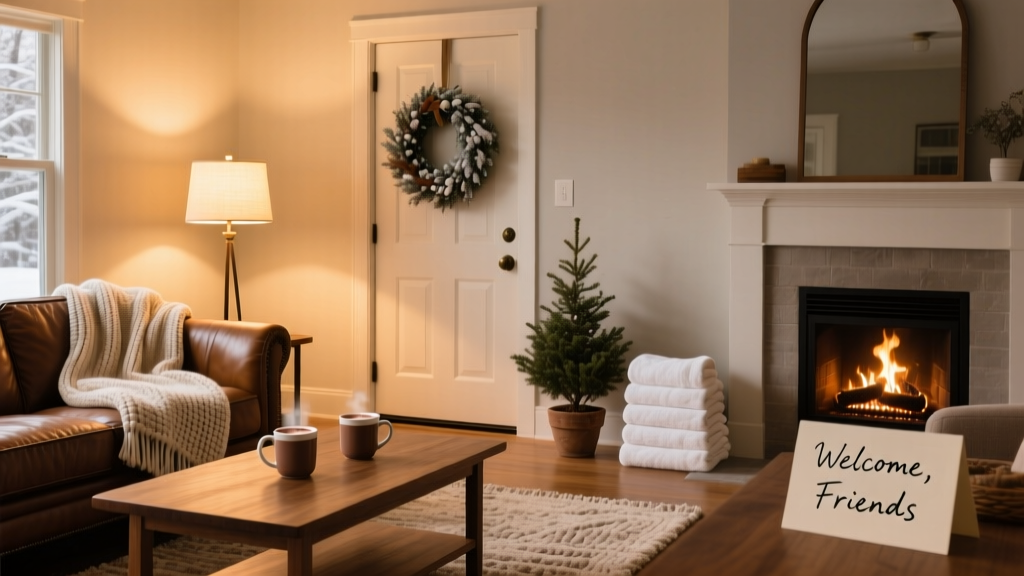
It’s 3 p.m. on a December Saturday. Your sister texts: ‘On the road—be there in 90 minutes.’ Snow’s falling, the furnace is wheezing, and your guest room hasn’t been aired out since October. Winter guest prep isn’t about perfection—it’s about predictable warmth, functional space, and zero last-minute panic.
Heat Smart, Not Hard
Cranks up the thermostat to 72°F the moment guests arrive? That spikes your January bill—and strains aging HVAC systems. Instead, use zone heating: keep living areas at 68–70°F and bedrooms at 65–67°F. Close vents in unused rooms (but never more than 20% of total vents—that disrupts airflow and risks heat exchanger cracks, per furnace maintenance best practices).
- Install a programmable thermostat like the Nest Learning Thermostat (2023 model) to auto-adjust temps 2 hours before arrival
- Use draft stoppers under exterior doors—especially at entryways and basement stairs—where 15–25% of heat loss occurs (U.S. Department of Energy, 2022)
- Layer rugs over hardwood or tile in hallways and bedrooms; wool or felt pads add R-value without bulk
Stock the ‘Cold-Weather Kit’
Guests don’t ask for extra blankets—but they’ll grab them if they’re visible, accessible, and clean. Skip the linen closet deep dive. Build a dedicated winter kit near the guest bed or entryway.
According to the American Red Cross’s Home Preparedness Guide (2023), households with overnight visitors are 3.2× more likely to report hypothermia-related discomfort when bedding isn’t pre-warmed or layered.
“I keep a heated blanket on low in the guest room 30 minutes before arrival—not just for comfort, but because it raises ambient air temp by 2–3°F without touching the thermostat.” — Lena M., certified home energy auditor (BPI, 2022)
- One flannel sheet set + one down-alternative duvet (350+ fill power)
- Two folded fleece throws (machine-washable, no pills)
- A ceramic space heater with tip-over shutoff (tested & UL-listed—never use older oil-filled models near bedding)
- Reusable hot-water bottle + instructions taped to lid
Prep the Entryway Like a Pro
Your front mat is soaked. Boots are dripping. Coats are damp. This is where winter hospitality starts—or stalls. A 3-foot-wide landing zone prevents mud, salt, and slush from tracking inward.
What to place within arm’s reach:
- Deep rubber boot tray (minimum 3″ depth—holds 2+ pairs plus snowmelt)
- Woven jute rug (not cotton—dries faster and traps salt crystals)
- Hooks at three heights: adult coat, child jacket, dog leash
- Small lidded bin for wet gloves, scarves, and knit hats
Add motion-sensor LED lighting above the door—critical for nighttime arrivals and safer than fumbling for switches with icy hands.
Quick Reference Checklist
| Task | Time Required | Done? |
|---|---|---|
| Test smoke & CO detectors (press test button) | 2 min | ☐ |
| Clear 3 ft. path from driveway to door (shovel/salt) | 5 min | ☐ |
| Set guest room temp to 66°F (start 2 hrs prior) | 1 min | ☐ |
| Fill electric kettle + leave on counter with tea bags | 2 min | ☐ |
Common Mistakes
Even seasoned hosts misfire in winter. These four errors cost time, money, or goodwill:
- Overloading outlets — Plugging space heaters, phone chargers, and humidifiers into one power strip trips breakers and risks fire (NFPA reports 1,700+ heater-related fires annually, 2023)
- Forgetting the bathroom — Cold tiles shock bare feet; keep a bath mat pre-warmed in dryer 10 mins before arrival, and stock hand towels with a single-use warming pad inside
- Using scented candles near coats — Wax residue transfers to wool and down—opt for unscented soy votives in enclosed lanterns instead
- Leaving windows cracked — Even ¼” gaps cause convective drafts that drop perceived temp by 4–6°F (ASHRAE Fundamentals Handbook, 2022)
How do I keep pipes from freezing while guests use hot water?
Run both hot and cold taps for 30 seconds every 2 hours during extended stays—especially in guest bathrooms far from the water heater. Insulate exposed pipes in basements or crawlspaces with foam sleeves rated for below-freezing temps (R-3 minimum). If you’ve had freeze issues before, consider installing a pipe-heating cable with built-in thermostat (prevent frozen pipes guide).
Should I offer slippers or just let guests wear socks?
Offer both—but label them. Keep a basket of washable, non-slip slippers (size L/M/S) beside the guest bed, and fold two pairs of thick merino-wool socks in drawer #2. Guests who decline slippers often have foot sensitivities or orthotics; socks respect autonomy without sacrificing warmth.
What’s the best way to store extra bedding long-term?
Vacuum-seal bags trap moisture and degrade down clusters. Instead, use breathable cotton storage sacks (like those from The Container Store’s “Linen Vault” line) with cedar blocks—not mothballs. Store flat, not rolled, and rotate seasonally. Replace duvet inserts every 3–5 years—even with light use, fill power drops 20% after 48 months (Textile Care Institute, 2021).
Is it okay to run a humidifier overnight in the guest room?
Yes—if it’s ultrasonic and cleaned daily. Dry winter air below 30% RH irritates sinuses and worsens snoring. But mineral buildup in cool-mist units breeds mold in 48 hours. Use distilled water, scrub the tank with vinegar weekly, and empty/reservoir daily. For low-maintenance, try a steam vaporizer with auto-shutoff (best humidifiers comparison).
How do I handle dietary restrictions without making guests feel singled out?
Label everything—including condiments. A small chalkboard next to the coffee station reads: ‘Oat milk (barista blend), almond butter (no peanuts), maple syrup (vegan-certified).’ No questions asked. Prep one versatile dish—like roasted root vegetables with tahini drizzle—that’s naturally gluten-free, dairy-free, and vegan. Then quietly adjust protein sides based on RSVP notes.
Winter guest prep isn’t about turning your home into a lodge—it’s about removing friction so people relax the second they step inside. Heat the bed, not the whole house. Dry the boots, not the story behind them. And remember: the best hospitality feels effortless because you did the work before the knock came.