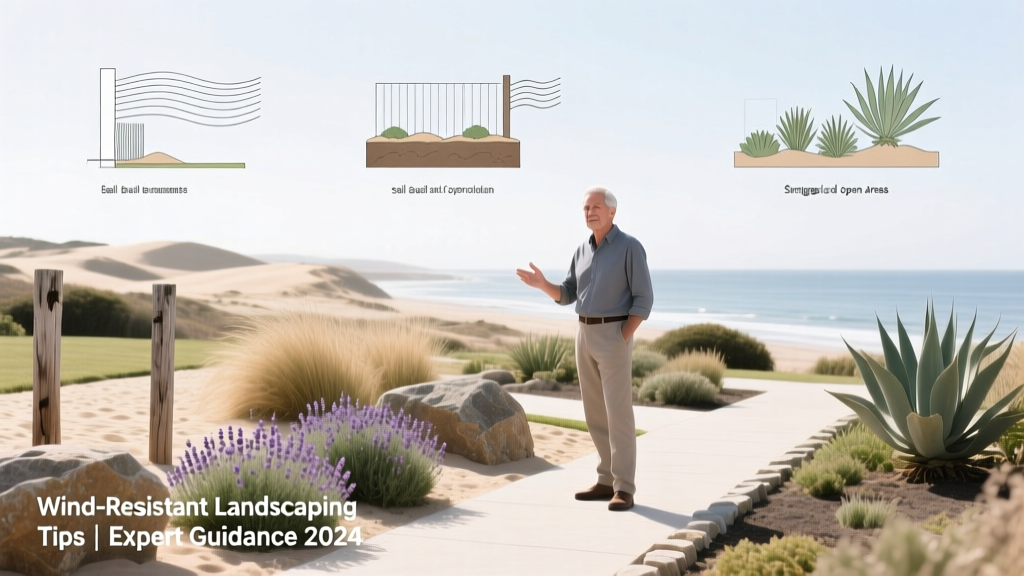
Strong winds don’t just rattle windows—they dry out soil, snap branches, erode mulch, and increase winter heating costs by up to 25% in exposed homes (Insurance Institute for Business & Home Safety, 2023 report). Wind-resistant landscaping isn’t about eliminating airflow—it’s about slowing, redirecting, and filtering it with living buffers that grow stronger over time.
Plant Smart Windbreaks, Not Walls
Aim for layered, permeable windbreaks—not solid barriers. Solid fences or walls create turbulent eddies behind them, increasing localized wind speed by up to 40% at ground level (University of Nebraska-Lincoln Extension, 2022). Instead, use staggered rows of shrubs and trees: tall evergreens like Eastern red cedar (Juniperus virginiana) as the back row, mid-height viburnums or hollies in the middle, and low-growing junipers or rugosa roses up front.
- Space rows 5–8 ft apart to allow air movement through the canopy
- Plant evergreens on the prevailing wind side (NW in most of the U.S., W in Pacific Northwest)
- Include at least 30% deciduous species to prevent snow loading in winter
Anchor Soil With Deep-Rooted Groundcovers
Wind erosion starts at ground level—especially on slopes or sandy soils. Shallow-rooted mulch blows away fast; deep-rooted perennials hold soil in place while reducing evaporation. Creeping phlox (Phlox subulata), bearberry (Arctostaphylos uva-ursi), and switchgrass (Panicum virgatum) all develop taproots or dense fibrous systems within 18 months.
According to the USDA Natural Resources Conservation Service’s 2021 Soil Health Assessment, sites planted with native groundcovers saw 68% less topsoil loss during spring wind events compared to bare or mulched plots.
“A 3-foot-tall windbreak of native grasses and low shrubs reduces wind speed at ground level by 50%—and does it without blocking sunlight or views.” — Dr. Elena Torres, Horticulture Extension Specialist, Oregon State University (2022)
Strategic Hardscaping That Works With Wind
Hard surfaces can amplify wind if poorly placed—but they can also diffuse and deflect it when designed intentionally. Use low stone walls (no taller than 3 ft) angled at 30° to prevailing winds to break up gusts. Perforated metal screens or lattice panels mounted 12–18 inches off a fence provide turbulence control without creating suction zones.
Avoid large expanses of smooth pavers or concrete directly upwind of gardens—they accelerate wind velocity near grade. Replace them with gravel beds interplanted with sedges or blue fescue, which dampen flow and trap sediment.
- Use berms no higher than 2 ft and slope them at 3:1 (horizontal:vertical) for natural deflection
- Install permeable pavers with 10–15% void space to let wind pass beneath surface layer
- Set patio furniture on gravel or decomposed granite—not concrete—to minimize dust lift
Quick Reference: Wind-Resistant Plant Checklist
| Plant | Max Height | Zones | Key Trait |
|---|---|---|---|
| Eastern red cedar | 40–50 ft | 2–9 | Dense branching, drought-tolerant roots |
| Beach plum | 5–7 ft | 3–8 | Salt- and sand-tolerant, thicket-forming |
| Little bluestem | 2–3 ft | 3–9 | Fibrous root system, clumping habit |
| Japanese yew | 10–15 ft | 4–7 | Flexible stems, narrow needles resist desiccation |
| Rugosa rose | 4–6 ft | 3–9 | Leathery leaves, suckering roots stabilize soil |
Common Mistakes That Invite Wind Damage
Even well-intentioned designs backfire when fundamentals are overlooked. The top three missteps we see in site assessments: planting only one species (monocultures collapse under stress), installing tall evergreens too close to foundations (root pressure + moisture trapping), and pruning shrubs into tight balls (reduces flexibility and increases sail effect).
- Using non-native ornamentals with shallow roots (e.g., boxwood cultivars) in high-wind zones
- Ignoring seasonal wind shifts—winter NW winds differ from summer SW thunderstorm gusts
- Installing drip irrigation under windbreaks without windbreak-specific emitters (standard emitters clog with blowing debris)
How far from my house should I plant a windbreak?
For energy savings, position the first row of tall evergreens 2–3 times their mature height from your home’s windward wall. So a 30-ft cedar should go 60–90 ft away. Closer placements create snow drifts and root intrusion; farther placements lose effectiveness. This spacing cuts winter heat loss by 10–25%, per IBHS modeling.
Can I use bamboo as a windbreak?
Only clumping bamboo (Bambusa multiplex, Fargesia spp.)—never running types. Running bamboo spreads aggressively and weakens under wind shear, snapping stalks unpredictably. Clumping varieties form dense, flexible stands but require staking for the first two seasons in exposed sites.
Do wind-resistant plants need special soil prep?
Yes—especially on compacted or clay-heavy sites. Till 12 inches deep and mix in 2–3 inches of composted pine bark or coarse sand. Deep-rooted species fail without initial vertical drainage. Skip peat moss: it dries out and cracks in wind, worsening erosion.
What’s the fastest-growing wind-resistant shrub?
Wax myrtle (Morella cerifera) adds 3–5 ft per year in Zones 7–11 and tolerates salt, sand, and occasional flooding. It’s not drought-proof, so irrigate weekly for the first 18 months—but once established, its waxy leaves shed wind-driven moisture loss effectively.
How do I protect young plants during their first windy season?
Stake with flexible ties (not wire) and wrap trunks with burlap or jute mesh—only on the windward side. Remove wraps after 4–6 weeks; prolonged coverage encourages weak growth. Mulch with shredded hardwood (not straw or pine needles), applied 3 inches deep and pulled 4 inches from stems to deter voles drawn to wind-blown cover.
Should I prune windbreaks annually?
No—over-pruning invites dieback and structural weakness. Light thinning every 3 years removes crossing branches and opens the interior to light. Never top evergreens: they won’t regrow from bare wood. Instead, selectively shorten leaders by one-third in late winter to encourage lateral density.
Wind-resistant landscaping pays dividends beyond protection—it cools microclimates, supports pollinators, and builds soil resilience season after season. Start small: replace one vulnerable foundation planting with a trio of rugosa roses and little bluestem this fall. You’ll feel the difference before next spring’s first gale. For related strategies, see our guides on native plants for erosion control and drought-tolerant groundcovers.