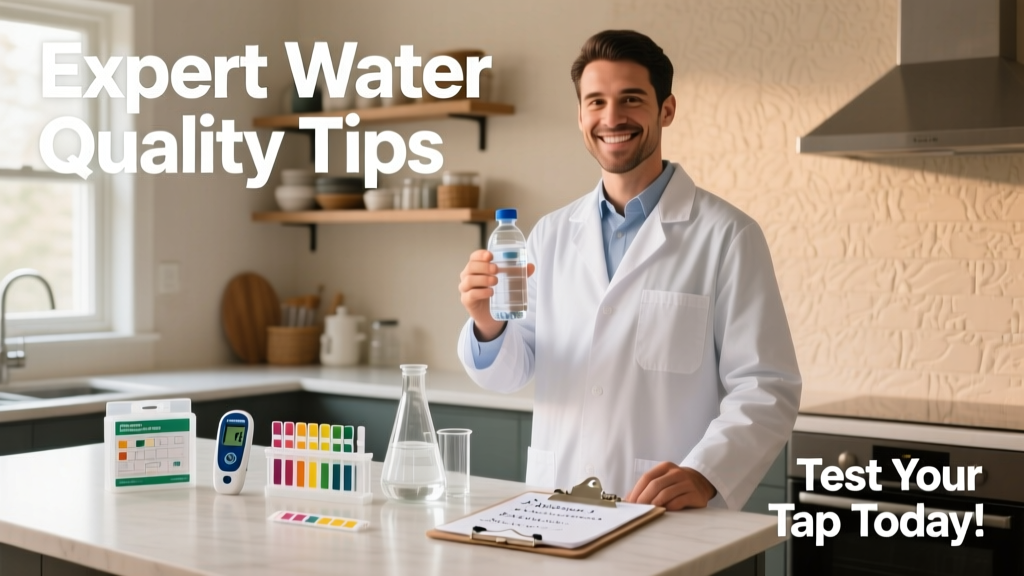
If your faucet water tastes metallic, your aquarium fish are gasping at the surface, or your well water left orange stains on your sink—your first move shouldn’t be panic. It should be testing. But not all tests are equal: strip kits miss volatile organic compounds, smartphone meters drift after two weeks, and DIY pH drops can’t detect lead at EPA’s actionable level of 10 ppb.
Test the Right Parameter for Your Situation
Don’t default to ‘full panel’ every time. Match the test to your risk profile. Well owners in rural Pennsylvania need arsenic and nitrate checks (both common in fractured shale aquifers); city dwellers in older buildings should prioritize lead and copper; aquarium hobbyists must track ammonia, nitrite, and dissolved oxygen—not just pH.
- Well water: Test annually for coliform bacteria, nitrates, arsenic, and fluoride (per CDC 2022 guidelines)
- City tap: Focus on lead if your home was built before 1986—or if you notice blue-green staining on fixtures
- Aquariums: Use liquid reagent kits (not strips) for ammonia; test daily during cycling, weekly thereafter
Timing and Technique Matter More Than the Kit
Testing first thing in the morning—after water has sat in pipes overnight—reveals worst-case lead/copper leaching. Let cold water run for 5 minutes before sampling if you’re checking for metals; for bacteria, collect from an unsanitized faucet spout without rinsing first.
According to the U.S. EPA’s Safe Drinking Water Act Guidance Manual (2021), 68% of false-negative bacterial results stem from improper sample chilling—samples must reach the lab at ≤6°C within 30 hours.
“A sterile 125-mL bottle filled to the brim—not ¾ full—cuts air exposure and preserves chlorine residual for accurate disinfectant testing.” — Dr. Lena Cho, EPA Microbiology Lab, 2020
How often should I test well water?
Annually for bacteria and nitrates; every 3–5 years for heavy metals and VOCs—unless you notice odor changes, staining, or nearby land use shifts (e.g., new fertilizer-heavy farm upstream).
Can I trust my $15 pool test kit for drinking water?
No. Pool kits measure free chlorine and total alkalinity—not lead, PFAS, or coliforms. They also use DPD reagents calibrated for 1–10 ppm chlorine; drinking water standards cap at 4 ppm, so readings lack precision below 0.2 ppm.
Lab vs. At-Home: When Each Makes Sense
At-home kits work for screening: chlorine residuals, hardness, nitrate (up to 10 mg/L), and pH. But send samples to a state-certified lab for anything health-critical—especially lead, uranium, PFAS, or E. coli confirmation. Labs use EPA Method 200.7 (ICP-MS) for metals and Method 1603 for E. coli—techniques no consumer device replicates.
| Parameter | At-Home Kit Accuracy | Lab Required? |
|---|---|---|
| Lead | ±50% error above 15 ppb; unreliable below 10 ppb | Yes — EPA Method 200.7 |
| E. coli | Colilert-18 gives presence/absence only; no quantification | Yes — for colony counts & strain ID |
| pH | ±0.2 units (adequate for pools/aquariums) | No |
| Hardness | ±25 mg/L as CaCO₃ (fine for appliance scaling checks) | No |
Quick Reference Checklist
Before you test, verify these five steps:
- Clean and rinse sampling container with distilled water (never tap or soap)
- Label bottles with date, time, location, and source (e.g., “kitchen cold,” “basement well head”)
- Fill to the line—no air gaps—for volatile compound tests
- Keep chilled (4°C) and deliver to lab within 30 hours for bacteria, 7 days for metals
- Record ambient conditions: recent rain? Plumbing repairs? New filter installed?
Common Mistakes That Skew Results
Most errors aren’t technical—they’re procedural. People forget that flushing the tap for 30 seconds isn’t enough for lead testing (EPA requires 5+ minutes of stagnation first). Others dip test strips into hot water—heat degrades DPD reagents and inflates chlorine readings by up to 40%.
- Using expired test strips (most lose accuracy after 6 months unopened, 3 months opened)
- Testing immediately after installing a new carbon filter—residual manufacturing dust can spike turbidity and false-positive iron readings
- Assuming clear water = safe water (PFAS, radon, and nitrate are odorless, colorless, and tasteless)
What does a red TDS reading mean on my meter?
TDS (total dissolved solids) alone doesn’t indicate safety—it measures conductivity, not toxicity. A reading of 350 ppm could be harmless calcium carbonate—or sodium nitrate contamination. Always pair TDS with ion-specific tests. For context, the WHO recommends ≤600 ppm for palatability, but health thresholds vary by ion.
My test shows zero chlorine—should I shock the system?
Not necessarily. Municipal systems sometimes switch to chloramine (a chlorine-ammonia blend) that standard DPD-1 tests miss. Use a chloramine-specific reagent (DPD-3) or check your water utility’s annual Consumer Confidence Report—available online at water utility reports.
How do I know if my reverse osmosis system is failing?
Test pre- and post-filter TDS monthly. A healthy RO should reduce TDS by ≥85%. If output TDS creeps above 15% of inlet (e.g., 200 ppm in → 35 ppm out is OK; 200 ppm in → 50 ppm out is failing), replace membranes. Also watch for slow flow or black specks—signs of carbon fines escaping the sediment filter. See our RO maintenance checklist for timing.
Testing isn’t about perfection—it’s about pattern recognition. One high nitrate reading may be a fluke; three in a row points to septic failure. Track results over time using a simple spreadsheet or logbook. And remember: if your test confirms contamination, don’t stop at treatment. Dig deeper—check local geology, plumbing age, and recent land use. Because clean water starts with knowing exactly what’s in it—and why. For help interpreting lab reports, see our how to read water test results guide.