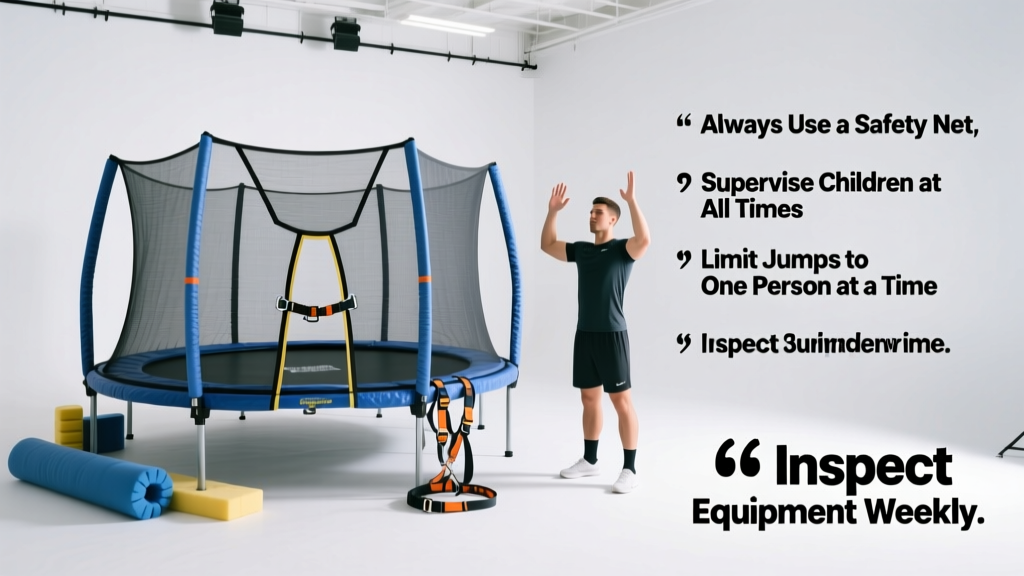
Every summer, emergency departments see a spike in trampoline-related injuries—nearly 100,000 U.S. cases annually, according to the CPSC’s 2023 Injury Report. Most happen at home, not parks or gyms, and over 75% involve children under 14. The good news? Over 90% are preventable with consistent, practical safeguards—not just rules on paper.
Anchor It Down—Literally
Wind gusts as low as 25 mph can flip or launch an unanchored trampoline. In 2022, the National Weather Service documented 17 incidents of airborne trampolines causing property damage or injury in Midwest states alone. Use ground anchors rated for at least 200 lbs of pull resistance—four is the minimum, but six is ideal for larger 14- or 16-foot models. Drive them at a 45-degree angle into undisturbed soil, not mulch or gravel. Check anchor tension monthly: if the frame wobbles more than ½ inch when pushed sideways, re-tighten or replace stakes.
- Use galvanized steel anchors (not plastic or aluminum) — they resist corrosion for 5+ years in most climates
- Avoid anchoring near underground utilities—call 811 before driving any stake deeper than 6 inches
- If you have pavers or concrete, use bolt-down kits with epoxy-set anchors (not surface adhesives)
One Jumper at a Time
Multiperson bouncing accounts for 74% of trampoline fractures and spinal injuries, per a 2024 Journal of Pediatric Orthopaedics study. The physics are unforgiving: a 60-lb child landing off-center while another jumps creates impact forces up to 3.5x body weight—enough to buckle a wrist or compress a vertebra. Enforce a strict 'one jumper, one turn' rule—even for siblings who swear they’ll ‘be careful.’ Post a laminated sign on the enclosure net: ‘Wait your turn. No sharing air time.’
For families with multiple kids, use a visual timer (like a sand timer or digital kitchen timer) set to 2 minutes per turn. Rotate clockwise so no one gets skipped. And never allow teens or adults to jump with younger kids—even if they’re ‘just spotting.’ Their mass changes the mat’s rebound dynamics unpredictably.
Why Spotting Doesn’t Work
Spotting—standing on the edge to ‘catch’ a jumper—is ineffective and dangerous. A 2021 biomechanics analysis at Ohio State found spotters misjudge landing zones 68% of the time and suffer 3× more ankle sprains than jumpers. Instead, teach safe dismounts: feet-first, knees bent, hands at sides. Practice on grass first.
Net Enclosures Aren’t Foolproof—But They’re Essential
A high-quality enclosure reduces fall-off injuries by 58%, according to the Insurance Institute for Business & Home Safety’s 2023 Trampoline Safety Assessment. But only if installed correctly: gaps between net and mat must be ≤2 inches, poles must be padded with 1-inch-thick closed-cell foam (not pool noodles), and zippers must close fully—not ‘mostly.’ Replace netting every 2 years, even if it looks fine; UV exposure degrades polyethylene fibers silently. Look for visible ‘fuzzing’ or stiffness—those are early failure signs.
“We see too many cases where parents think the net is ‘good enough’—but a 3-inch gap at the bottom lets a toddler slip through headfirst. Measure every seam twice before first use.” — Dr. Lena Cho, pediatric trauma surgeon, Nationwide Children’s Hospital, 2023
How to Test Net Integrity
- Press firmly on each seam with your thumb—no stretching or separation
- Shine a flashlight upward through the net at dusk—if light passes through holes, replace immediately
- Check pole padding for cracks or compression—replace if thickness drops below ¾ inch
Quick Reference Safety Checklist
| Item | Pass Criteria | Frequency |
|---|---|---|
| Spring cover condition | No tears, full coverage over all springs and hooks | Weekly |
| Frame bolts & nuts | No missing hardware; torque to 18–22 ft-lbs (use torque wrench) | Monthly |
| Mat integrity | No fraying, holes >¼ inch, or sagging >2 inches at center | Biweekly |
| Ground clearance | Minimum 8 ft vertical clearance; 6 ft horizontal from fences, trees, sheds | Seasonally |
Common Mistakes That Cause Real Harm
Parents often assume ‘supervision equals safety’—but passive watching isn’t enough. The top five errors we see in home injury reports:
- Letting kids wear socks or flip-flops (causes slips; bare feet or grip socks only)
- Placing trampolines on slopes—even 3° incline increases rollover risk by 40%
- Using DIY padding (old carpet, yoga mats) instead of ASTM-certified spring covers
- Allowing flips or somersaults without certified coaching (spinal cord injury risk jumps from 0.2% to 12% with unsupervised tricks)
- Ignoring manufacturer weight limits—overloading stresses welds and causes frame collapse
Can Adults Jump Safely?
Yes—but only if the trampoline is rated for adult use (check max weight limit: ≥300 lbs) and has a reinforced frame (octagonal or rectangular, not round). Adults should avoid jumping after sunset (depth perception drops 40%), skip double-bounce games, and never jump with kids. For fitness use, pair with a home gym safety checklist and consider a rebounder with handlebars instead.
What Age Is Safe to Start?
The American Academy of Pediatrics recommends no trampoline use under age 6. Younger children lack neck strength, balance control, and spatial awareness to land safely. If you own one with preschoolers in the house, lock the enclosure zipper with a carabiner and store the ladder indoors. See our childproofing backyard guide for layered outdoor safety.
Do In-Ground Trampolines Eliminate Risk?
They reduce fall height—but introduce new hazards. Soil erosion around the pit edge can destabilize the frame, and poor drainage leads to rust in under-mat springs. A 2023 University of Florida study found in-ground units had 22% higher corrosion rates within 18 months in humid climates. Always install French drains and inspect the pit wall monthly for cracks or shifting.
Is Trampoline Insurance Coverage Standard?
No. Most standard homeowners policies exclude trampoline-related liability unless you add an endorsement—and even then, medical payments may cap at $5,000. Ask your agent about umbrella policies and document your safety measures (anchor receipts, net purchase date, inspection logs). Some insurers require video proof of enclosure installation before issuing coverage. Read your policy’s ‘recreational equipment’ clause carefully—it’s often buried in Section II, Exclusions.
How Often Should You Replace the Mat?
Every 3–5 years, depending on UV exposure and usage. In Arizona or Florida, replace at 3 years. In Minnesota or Washington, 5 years is typical. Look for these signs: stitching loosens near springs, mat sags more than 2 inches when stepped on center, or color fades unevenly (indicates polymer breakdown). Never patch—replacing the whole mat costs less than rehabilitating a torn ACL.
Trampoline safety isn’t about eliminating fun—it’s about aligning habits with how bodies actually move and fail. Anchor it. Enforce turns. Inspect like it’s your car’s brakes. Because unlike a scraped knee, some trampoline injuries change lives in seconds. Start tonight: grab a tape measure, check that net gap, and tighten one bolt. Small actions compound—and that’s how backyard joy stays joyful.