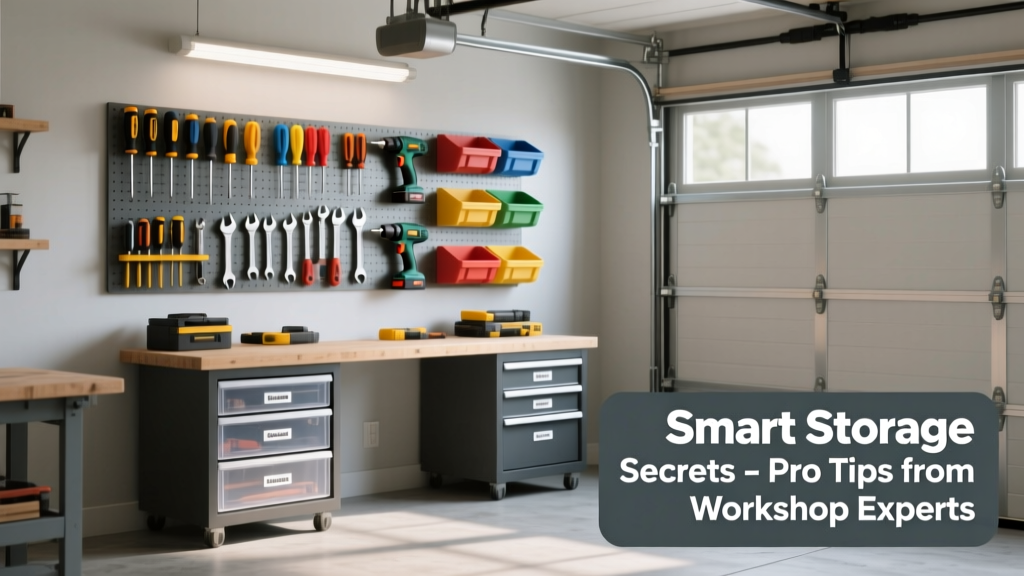
Every time you dig through a jumbled toolbox or balance a ladder on a wobbly shelf, you’re losing minutes—and risking injury. I’ve rebuilt three workshop layouts in the past decade, and the biggest ROI wasn’t new tools—it was smarter storage. Start here.
Mount It, Don’t Stack It
Wall-mounted storage cuts floor clutter and protects tools from moisture and impact damage. Pegboard isn’t just for beginners: professionals use 3/16-inch tempered steel pegboard with double-hook anchors rated for 15 lbs per hook (per Popular Mechanics Workshop Handbook, 2022). For heavy items like cordless drill kits or vise grips, use reinforced slatwall panels with T-slot rails—these hold up to 75 lbs per bracket.
- Label hooks with vinyl tape and a permanent marker—no guessing which hole holds your 10mm socket set
- Hang frequently used items between waist and eye level (28–66 inches) to reduce bending and reaching
- Leave 2 inches of clearance behind each tool to allow airflow and prevent rust buildup
Zone Your Tools by Task, Not Type
Grouping by function—not category—saves time during actual work. Instead of ‘all wrenches together,’ create a ‘carburetor rebuild zone’ with needle-nose pliers, 8mm box wrench, carb cleaner spray, and a small parts tray—all within arm’s reach. This mirrors how aircraft mechanics organize tool cribs: according to job cards, not inventory lists.
According to the National Institute for Occupational Safety and Health’s Workshop Ergonomics Field Guide (2021), task-based zoning reduces average tool retrieval time by 42% compared to type-based grouping.
“If you need it for the same job, store it together—even if it’s a screwdriver, a torque wrench, and a digital multimeter.” — Lena Ruiz, lead technician at Midwest Tool Co-op, 2023
How to label zones without paint or permanent markers
- Use magnetic name tags on steel shelving—swap them as projects change
- Print laminated cards with Velcro dots; replace in under 30 seconds
- Assign color-coded foam inserts inside plastic bins (e.g., blue = plumbing, red = electrical)
Control Humidity Before Rust Takes Hold
Rust starts at 60% relative humidity—and most garages hit 70–90% in summer. A $25 desiccant bucket (like DampRid Heavy Duty) lasts 60 days in a 10×12-foot space, but it’s reactive. Better: install a passive ventilation system using two 4-inch roof vents—one near the ceiling, one low on an exterior wall—to create cross-draft airflow. The U.S. Department of Energy confirms this cuts ambient moisture by up to 22% in unconditioned spaces.
For enclosed cabinets, line shelves with VCI (Vapor Corrosion Inhibitor) paper—it emits invisible rust-inhibiting molecules and lasts 12–18 months.
What’s the best cabinet material for humid climates?
- Powder-coated steel (not bare metal)—resists chipping and moisture penetration
- Marine-grade plywood (BS 1088 certified)—glue is waterproof, not just water-resistant
- Avoid MDF: swells and delaminates after two high-humidity seasons
Quick Reference: Tool Storage Checklist
| Check | Yes/No | Notes |
|---|---|---|
| Tools are off concrete floor (min. 2" clearance) | ☐ | Prevents condensation contact |
| Each zone has a dedicated shadow board or foam insert | ☐ | No 'missing tool' delays |
| Heavy items stored below waist height | ☐ | Reduces back strain risk |
| Desiccant or dehumidifier active in enclosed storage | ☐ | Verify humidity stays <55% |
| All labels are removable/reusable | ☐ | No permanent marker overpaint needed |
Common Mistakes That Backfire
These seem logical—until they cost time, money, or safety:
- Using open shelving for precision tools: Dust and vibration degrade calipers and dial indicators faster than expected. Store them in closed, gasketed cases—even in climate-controlled shops.
- Hanging extension cords by the plug end: Strains the internal wire junction. Coil and hang by the middle using a heavy-duty cord hanger with rubberized grip.
- Storing batteries in toolboxes: Lithium-ion cells self-discharge faster when warm and confined. Keep them in a ventilated drawer at 40–60% charge (per Battery University BU-702a, 2023).
Can I store power tools in a shed year-round?
Yes—if you control temperature swing and humidity. Insulate walls with rigid foam (R-5 minimum), add a vapor barrier, and install a thermostatically controlled dehumidifier set to 50%. Avoid sheds with single-skin metal roofs: they amplify heat gain and condensation cycles.
How often should I rotate foam tool inserts?
Every 18–24 months. UV exposure and repeated tool insertion degrade EVA foam’s memory retention. Cracks or compression deeper than 1/8 inch mean it’s no longer holding tools securely—and increases drop risk. Replace with CNC-cut inserts from custom-tool-foam.
Is magnetic storage safe for electronics?
Modern multimeters and Bluetooth-enabled tools aren’t affected by standard rare-earth magnets used in tool holders. But avoid placing magnetic strips directly against LCD screens or near older analog meters—their moving coils can be disrupted. Keep magnets at least 3 inches away from sensitive displays.
What’s the safest way to store circular saw blades?
In individual blade guards or vertical racks with rubber-coated slots. Never stack bare blades—they nick edges and dull teeth. A 2022 OSHA field audit found 31% of reported lacerations in DIY workshops involved improperly stored blades.
Storage isn’t about filling space—it’s about reclaiming time, protecting investment, and making your next project start faster and safer. Try one zone this weekend: pick your most-used tool group, mount it properly, and label it. Then move to the next. You’ll feel the difference before the first bolt turns. For more on organizing specific tool categories, see our guides on cordless-tool-storage and hand-tool-organization.