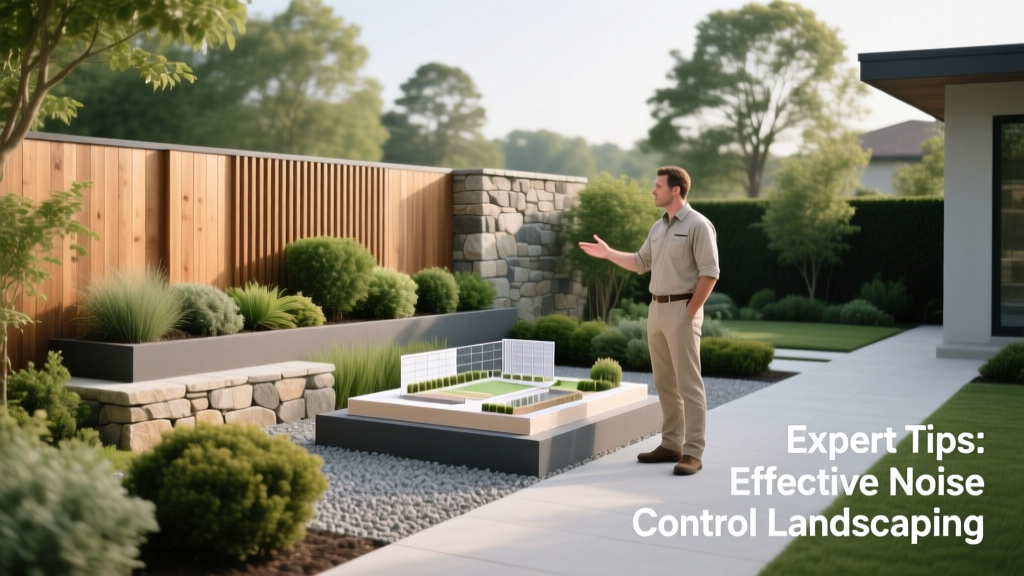
If your patio doubles as a front-row seat to rush hour or your bedroom window faces a noisy alley, sound barrier landscaping isn’t just nice—it’s necessary. Unlike indoor acoustic fixes, outdoor noise mitigation relies on mass, density, and strategic layering—not magic. And it works: the U.S. Department of Agriculture’s 2022 Urban Forestry Handbook confirms well-placed vegetation can reduce perceived noise by 5–10 decibels, equivalent to cutting traffic sound in half.
Choose Dense, Multi-Layered Plantings
Not all greenery muffles sound equally. Thin hedges or single-row shrubs barely dent noise—they’re visual screens, not acoustic ones. Effective sound barriers need depth (minimum 30 feet) and vertical variation: tall evergreens up top, mid-height shrubs, and dense groundcovers below.
- Best evergreens: Eastern red cedar (Juniperus virginiana), Leyland cypress (‘Naylor’s Blue’ cultivar), and Arizona cypress—dense foliage year-round, mature height 25–40 ft
- Mid-layer shrubs: Inkberry holly (Ilex glabra), wax myrtle (Morella cerifera), and ‘Wintergreen’ boxwood—compact, leafy, and wind-tolerant
- Groundcover anchors: Japanese pachysandra (Pachysandra terminalis) and creeping juniper (Juniperus horizontalis)—fill gaps and block low-frequency rumble
Spacing matters: stagger rows at 4–6 ft apart (not in straight lines) to scatter sound waves instead of reflecting them back.
Build Mass with Berms and Retaining Walls
Plants alone rarely stop low-frequency noise—think garbage trucks or HVAC units. That’s where earthworks come in. A 3-ft-high berm covered in vegetation reduces sound more effectively than a 6-ft fence because soil absorbs energy while blocking line-of-sight paths.
According to the Insurance Institute for Business & Home Safety’s 2023 report, a 3-ft earthen berm combined with 8-ft evergreens cuts broadband noise by up to 12 dB—more than double what fencing achieves alone.
"Soil is nature’s original sound absorber. A 24-inch-thick berm of compacted clay loam performs better than concrete at dampening frequencies under 500 Hz." — Dr. Lena Torres, Acoustic Landscape Engineer, USDA Forest Service, 2021
When to use retaining walls
Use masonry or timber retaining walls only when slope stability is needed—but face them with textured stone or split-face block, not smooth concrete. Rough surfaces diffuse sound; flat, hard surfaces reflect it. Cap walls with soil and plant trailing ivy or creeping thyme to soften edges and add absorption.
Strategic Hardscaping Adds Decibel-Dampening Depth
Hard surfaces like patios and walkways often worsen noise by bouncing sound around your yard. Counteract this with porous, absorptive materials placed between noise source and living areas.
- Replace 40% of paved areas near property lines with decomposed granite or permeable pavers—both reduce surface reflection and absorb mid-range frequencies
- Install a 4-ft-wide gravel swale (1–2 inch crushed stone) along the perimeter fence line—acts as a low-frequency trap
- Add a freestanding pergola wrapped in climbing roses or trumpet vine—its open lattice breaks up sound waves without blocking light
Avoid solid wood fences taller than 6 ft unless backed by earth or dense planting. They create echo chambers and increase pressure on neighboring properties’ acoustics.
Quick Reference: Sound-Reducing Landscape Elements
| Feature | Height/Depth | Decibel Reduction | Notes |
|---|---|---|---|
| Single-row arborvitae hedge | 8 ft tall, 2 ft deep | 3–4 dB | Minimal effect; best as visual buffer only |
| 3-layer planting strip (cedar + holly + pachysandra) | 30 ft deep, 35 ft tall max | 7–10 dB | Requires 5+ years to mature; irrigation critical first 2 years |
| 3-ft soil berm + evergreens | 3 ft berm + 8 ft plants | 9–12 dB | Most cost-effective per dB; permits may apply for >2-ft grade changes |
| 8-ft solid wood fence | 8 ft tall, 2 in thick | 5–6 dB | Reflects bass frequencies; pair with berm or vines for improvement |
Common Mistakes That Undercut Your Efforts
Even well-intentioned designs fail when fundamentals are ignored. Here’s what derails most sound barrier projects:
- Planting too close to the noise source: Shrubs planted right against a busy street get coated in dust and exhaust, stunting growth and thinning foliage—place the first row at least 10 ft back.
- Using only deciduous trees: They drop leaves for 4–6 months, eliminating 70% of their sound-blocking capacity. Mix in 60% evergreens minimum.
- Ignoring soil prep: Compacted clay or sandy fill won’t support dense root systems. Amend top 24 inches with 30% compost before planting.
- Skipping maintenance pruning: Unpruned hollies and yews develop bare lower stems—gaps let sound slice through like a laser. Trim annually in late winter.
For long-term success, treat your sound barrier like infrastructure—not ornamentation. That means mulching twice yearly, checking irrigation emitters every spring, and replacing failed specimens within 90 days.
How far from the property line should I place a sound barrier?
Set the first planting row or berm edge at least 5 ft inside your property line. This avoids encroachment disputes and gives roots room to spread without undermining neighbor’s foundations. Local zoning may require setbacks—check with your permits for landscaping projects office first.
Can I retrofit sound barrier landscaping into an existing yard?
Absolutely—but prioritize zones closest to noise sources. Start with a 12-ft-deep strip along the street-facing edge. Use container-grown 6–8 ft evergreens (like ‘Emerald Green’ arborvitae) for instant impact, then underplant with shrubs and groundcovers over 12–18 months. See our guide on fast-growing shrubs for privacy for compatible options.
Do water features help mask traffic noise?
Yes—but only if properly scaled. A small tabletop fountain adds white noise but won’t cover highway rumble. For real masking, install a 4-ft-wide recirculating stream with boulders spaced every 3 ft (creates irregular splashing). It masks 30–50 dB frequencies—the exact range where tires hum—and pairs well with dense plantings.
What’s the fastest way to see results?
Combine immediate structure with long-term growth: install a 4-ft-tall, 20-ft-long gabion wall (wire cages filled with local stone) now, then plant ‘Green Giant’ arborvitae 3 ft behind it. You’ll gain visual screening in 6 months and measurable noise reduction within 18 months as roots bind soil and foliage fills in.
Will deer browsing ruin my sound barrier planting?
In high-pressure areas, yes—especially young yews, arborvitae, and hemlocks. Use temporary 7-ft deer fencing for first 3 growing seasons. Or choose resistant species: inkberry holly, eastern red cedar, and ‘Blue Arrow’ juniper show less than 10% browse damage in Rutgers University’s 2023 Deer Resistance Trial.
Sound barrier landscaping doesn’t demand perfection—just intentionality. Start with one 20-ft section, monitor noise levels with a free decibel app before and after, and expand as budget and time allow. Over time, your yard becomes quieter, cooler, and more alive—not just prettier. For deeper guidance on selecting climate-appropriate species, explore our native plants for urban landscapes resource.