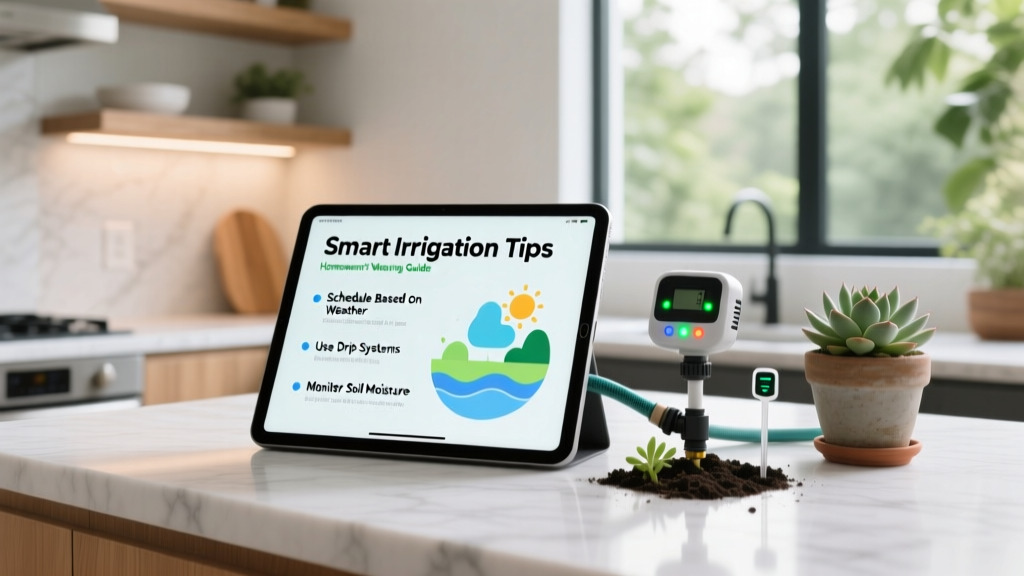
Most homeowners overwater their lawns by 30–50%—not because they’re careless, but because traditional timers don’t adapt to weather, soil, or plant needs. A smart irrigation system isn’t just about convenience; it’s the single most effective way to reduce landscape water waste while keeping your yard healthy. And it pays for itself in under two years in many dry climates, according to the U.S. EPA’s water conservation report (2023).
Match Your Controller to Your Yard’s Reality
Not all smart controllers are equal—and pairing the wrong one with your site leads to wasted water or stressed plants. Start by mapping your zones: group plants by sun exposure, soil type, and root depth—not just proximity. For example, a zone with shallow-rooted annuals and full sun needs more frequent, shorter cycles than a zone of mature oaks on clay soil.
- Use Wi-Fi-enabled controllers like Rachio 3 or RainMachine Touch HD if you have reliable home internet and want remote adjustments
- Choose cellular models (e.g., Orbit B-hyve XR) for rural properties with spotty Wi-Fi
- Avoid ‘weather-based’ only controllers if your yard has microclimates—add soil moisture sensors for precision
According to the Irrigation Association’s Smart Controller Performance Study (2022), systems combining ET (evapotranspiration) data + in-ground sensors reduced overwatering by 42% compared to weather-only units.
Install Sensors Where They Tell the Truth
Soil moisture sensors work—but only if placed correctly. Don’t tuck them beside a downspout, under a tree canopy, or in compacted soil near a walkway. These spots misrepresent average root-zone conditions.
Best placement practices:
- Insert at root depth: 4–6 inches for turf, 8–12 inches for shrubs, 18+ inches for trees
- Position midway between emitters or sprinkler heads—not directly under either
- Use at least one sensor per distinct soil type or slope (e.g., sandy berm vs. clay swale)
Mount weather stations in open, unshaded areas—never on south-facing walls or rooftops, where temperature and humidity readings skew high.
Tune Schedules Seasonally—Not Just Annually
Your smart controller’s default ‘spring start’ setting assumes uniform growth and rainfall. It doesn’t. In Phoenix, peak evapotranspiration hits mid-May—not June. In Seattle, April soil temps lag air temps by 3 weeks, delaying root activity.
Manually adjust your seasonal curve every 3–4 weeks from March through October. Reduce run times by 10–15% after each cool, rainy stretch—even if the app says “normal.” The U.S. EPA estimates that 14% of household water usage is from leaks and inefficient outdoor watering—most avoidable with this habit.
“A smart controller without seasonal tuning is like cruise control on a mountain road—you’ll overshoot every hill.” — Dr. Lena Torres, UC Davis Landscape Water Management Extension (2023)
Quick Reference Checklist
| Task | Frequency | Notes |
|---|---|---|
| Verify sensor battery levels | Every 90 days | Low batteries cause false dry readings |
| Calibrate rain gauge | Twice per year (spring/fall) | Test with measured ¼-inch pour |
| Check nozzle alignment & pressure | Monthly during peak season | Misaligned rotors waste up to 25% of output |
| Review controller logs for skipped cycles | Weekly | Recurring skips signal valve or wiring issues |
Common Mistakes That Waste Water
Even experienced gardeners fall into these traps—often because smart tech lulls them into ‘set-and-forget’ mode.
- Ignoring drip zone calibration: Drip emitters clog or degrade. Test flow rates annually with a bucket-and-timer method—replace emitters delivering <10% below rated output.
- Running rotor zones same as spray zones: Rotors apply water slower but deeper. Running them as long as sprays drowns roots and encourages fungal disease.
- Using ‘smart’ mode exclusively: Most controllers default to conservative ET estimates. Override with manual soak cycles after extended droughts—roots need deep recharge, not just surface wetting.
- Skipping winter dormancy settings: Grass may go dormant at 40°F—but your controller won’t know unless you set minimum temperature thresholds.
How often should I replace soil moisture sensors?
Most last 3–5 years, but accuracy degrades faster in high-salt or high-clay soils. If your controller consistently overrides schedules during dry spells despite low sensor readings, test with a handheld meter (see our soil tester guide)—it’s likely time for replacement.
Can I retrofit smart tech onto old sprinkler valves?
Yes—wireless smart modules like the Orbit B-hyve Smart Valve Adapter snap onto existing 24V AC solenoids. No trenching or rewiring required. Just confirm your transformer outputs ≥20VA (many pre-2010 systems don’t).
Why does my app show ‘watering skipped’ even when it’s hot and dry?
Check your rain sensor threshold and recent historical data. Many controllers skip if >0.1” fell in the prior 24 hours—even if that rain evaporated off pavement before soaking soil. Lower the skip threshold to 0.05” or disable it temporarily during heat domes.
Do smart controllers work with well water systems?
Yes—but pressure fluctuations can confuse flow meters. Install a pressure regulator upstream and choose controllers with adjustable flow sensitivity (e.g., Hunter Hydrawise Pro). Also, log pump runtime: sudden increases hint at clogged nozzles or leaking valves.
Is it worth adding a weather station if my controller already uses local forecasts?
Yes—if your property sits in a microclimate. A $120 AcuRite Atlas weather station captured 17°F cooler temps and 32% higher humidity than the nearest airport station in a Santa Barbara hillside trial (UCCE Ventura County, 2023). That difference changes ET calculations by ~20%.
Smart irrigation isn’t about letting technology do all the work—it’s about using data to make better decisions, faster. Start small: pick one zone, add a sensor, and manually compare its readings against your finger-in-the-soil test for two weeks. You’ll spot patterns no algorithm catches. Then scale up. Your water bill—and your lawn—will thank you.