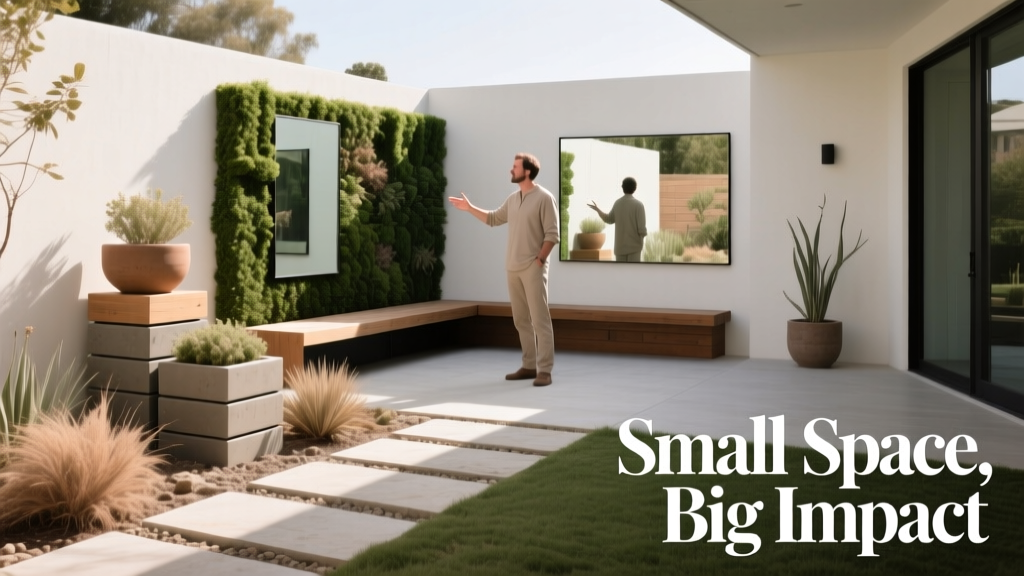
Most homeowners with a postage-stamp yard assume they’re stuck with bare dirt, potted plants on the deck, or a lonely patch of grass. They’re wrong. A 25' x 30' lot (750 sq ft) can feel spacious, layered, and intentional — if you stop thinking like a suburban landscaper and start thinking like an urban designer.
Use Vertical Space Like a Pro
Ground area is scarce, so go up — not just with trellises, but with layered vertical elements that serve multiple roles. Install a 6' cedar lattice panel along a fence line, then train 'Zephirine Drouhin' roses (thornless, fragrant, disease-resistant) and 'Jackmanii' clematis to climb it. Add staggered wall-mounted planters at 2', 4', and 6' heights filled with trailing verbena, dwarf lavender, and creeping thyme. This creates depth while freeing up floor space for seating or a narrow gravel path.
- A single 4' x 8' vertical garden panel adds ~32 sq ft of planting surface without using ground space
- Wall-mounted irrigation kits (like Rainbird’s EZ-FLO Micro-Drip) cut watering time by 40% vs. hand-watering pots
- Always anchor vertical structures into fence posts or house framing — not just surface-mounted screws
Choose Plants That Earn Their Keep
Every square foot must multitask: screen, scent, feed pollinators, or provide year-round texture. Skip standard foundation shrubs like boxwood — they demand pruning and offer little payoff. Instead, use dwarf Korean lilac ('Palibin'), which stays under 5' tall, blooms heavily in late spring, and tolerates clay soil. Underplant with carex 'Frosted Curls' — a fine-textured ornamental grass that suppresses weeds and needs zero mowing.
According to the University of Minnesota Extension’s 2022 Urban Landscape Report, 68% of small-yard plant failures stem from overplanting mature-size specimens too close together — leading to stunting, disease, and constant pruning.
"In tight spaces, I treat plants like furniture: measure their *mature* spread, then add 18 inches of breathing room — even if it feels empty at first." — Lena Cho, ASLA-certified designer, Minneapolis-based Small Plot Studio
What’s the best small-yard privacy screen?
Install a 4' tall, 10' long bamboo screen (like 'Gracilis') in a buried, root-barrier-lined planter. It grows fast, filters wind, and won’t invade neighbors’ yards like running bamboo. Pair with espaliered 'Columnar Apple' trees (e.g., 'Northpole') trained flat against the screen frame — fruit + screening + zero footprint.
How do I make a tiny yard feel bigger?
Use forced perspective: place the largest element (a sculptural urn or bench) closest to the house, medium elements (a raised planter) mid-yard, and smallest details (gravel raking patterns or stepping stones) at the far end. Paint the back fence a cool, receding color like Benjamin Moore’s 'Gray Owl' — studies show cool tones increase perceived depth by up to 23% (Color Marketing Group, 2021).
Design for Function First
Before choosing a single plant, map your non-negotiables: Where does the trash bin go? Does the AC unit need airflow? Is there a utility box that must remain accessible? Build your hardscape around those anchors — not the other way around. Use modular concrete pavers (like Belgard’s Biltmore series) to create a 3' wide L-shaped patio that wraps around a corner utility box. Fill joints with drought-tolerant creeping thyme instead of sand — it softens edges and releases scent when stepped on.
- A 6' x 8' paved zone fits a bistro table, two chairs, and a compact fire pit — all within code-mandated clearances
- Embed LED step lights (12V, low-heat) into paver edges for safe night use without overhead fixtures
- Leave at least 36" clearance around all utility access points — inspectors routinely fail permits for blocked panels
Quick Reference: Small Yard Must-Dos
| Action | Why It Matters | Time Required |
|---|---|---|
| Measure mature plant width (not pot size) | Prevents overcrowding, disease, and annual pruning battles | 5 minutes per plant |
| Install drip irrigation with pressure regulator | Reduces runoff on slopes; cuts water use by 30–50% (EPA WaterSense, 2023) | 2–3 hours |
| Use one dominant material (stone, wood, metal) | Creates cohesion; avoids visual clutter in tight sightlines | Planning only |
| Leave 24" minimum walkway width | Meets ADA-informed accessibility; allows two people to pass comfortably | During layout phase |
Common Mistakes That Shrink Your Yard Further
Overcomplicating the design is the top error — especially adding too many materials or curves. A zigzag brick path in a 20' deep yard eats 30% of usable space and makes mowing impossible. Another frequent misstep: installing full-height fences. They trap heat, block light, and visually compress space. Swap solid fencing for alternating 2' wood slats with 4" gaps — it maintains privacy while allowing air and dappled light through.
Also avoid dwarf varieties marketed as “small yard friendly” without checking root spread. 'Dwarf Mugo Pine' may stay 3' tall, but its roots extend 6' wide — enough to crack nearby pavers or lift flagstone.
Can I grow vegetables in a small yard?
Absolutely — but skip sprawling vining types. Focus on compact, high-yield crops: 'Littl' Bit' cherry tomatoes (grows to 20" tall in containers), 'Paris Market' round carrots (mature in 55 days, fit shallow beds), and 'Red Sails' lettuce (cut-and-come-again, shade-tolerant). Use self-watering fabric grow bags (like GeoPot 5-gallon) — they prevent root circling and reduce watering frequency by 60% versus plastic pots (container gardening tips).
What lighting works best for tiny yards?
Stick to low-voltage (12V) path lights no taller than 18" — taller fixtures cast long shadows that make spaces feel cramped. Embed them every 6' along walkways, and use warm-white LEDs (2700K) to avoid glare. For ambiance, wrap mini string lights (UL-rated for outdoor use) around a single focal tree — never across the entire perimeter, which reads as festive clutter.
How do I handle drainage in a small, flat yard?
Even slight grade issues compound in tight areas. Dig a 4" wide, 6" deep French drain trench along the lowest edge, fill with ¾" washed gravel, and cover with landscape fabric and 1" of mulch. Connect it to a dry well (minimum 3' deep, lined with perforated pipe) — rain garden design principles apply here, just scaled down. The U.S. EPA estimates 14% of household water usage is from leaks, but poor yard drainage causes another 9% in basement seepage and foundation stress.
Small yards aren’t limitations — they’re invitations to edit ruthlessly and invest thoughtfully. You’ll spend less on plants, less on maintenance, and more time actually enjoying the space. Start with one change this weekend: replace that overgrown yew with a sculptural Japanese maple — and notice how much more air, light, and calm enters your yard instantly.