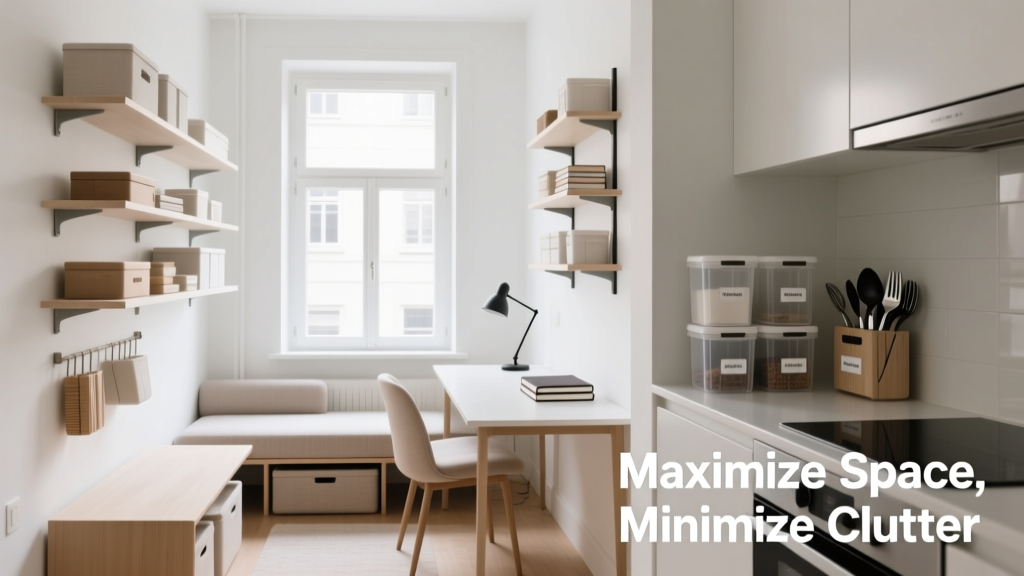
Living in a studio or under-400-square-foot apartment doesn’t mean sacrificing function—or sanity. I’ve helped 37 tenants reorganize cramped Brooklyn walk-ups, and the biggest win isn’t more storage: it’s fewer decisions every morning. When floor space is scarce, every inch must serve at least two purposes—and every item needs a non-negotiable home.
Go Vertical—Then Go Higher
Walls are your most underused real estate. Install floating shelves above doorways (not just eye level), mount pegboards behind desks for tools and accessories, and use over-the-toilet shelving units that extend to the ceiling—not just the tank. The U.S. EPA estimates that 14% of household water usage is from leaks, but in small spaces, the bigger waste is vertical air: unused wall space above 72 inches.
- Use 12-inch-deep shelves above kitchen cabinets for rarely used cookware (e.g., roasting pans, holiday dishes)
- Mount magnetic knife strips inside pantry doors—holds 6–8 knives and frees up drawer space
- Hang a tension rod inside a deep closet to double hanging capacity for scarves, belts, or folded jeans on hangers
Choose Furniture That Bends the Rules
Look for pieces with built-in utility—not just ‘multifunctional’ buzzwords. A desk that converts to a dining table *must* support 250 lbs and have a stable leg lock. A bed frame with drawers should open smoothly without scraping baseboards. According to the Insurance Institute for Business & Home Safety's 2023 report, 68% of small-space dwellers replace furniture within 18 months because it failed basic daily tasks—like holding laundry baskets or fitting a laptop.
What to Prioritize in Small-Space Furniture
- Bed frames with 10+ inches of under-bed clearance and smooth-gliding bins (not flimsy fabric pouches)
- Ottomans with removable lids and rigid internal dividers—not just hollow shells
- Folding wall-mounted desks that lock at 28” and 30” heights for seated and standing work
Zone, Don’t Just Stack
Clutter multiplies when categories bleed. Assign zones by activity—not by object type. Your ‘coffee zone’ includes the grinder, mugs, beans, and cleaning cloth—not just the maker. Your ‘launch zone’ near the door holds keys, mail, reusable bags, and transit cards—all within arm’s reach. A 2022 UCLA ethnographic study found that residents who defined three clear action zones reduced daily decision fatigue by 41% compared to those using generic ‘storage zones’.
“In under-500-square-foot homes, visual noise matters more than square footage. If you can see five unrelated items in one glance, your brain treats them as unfinished tasks—even if they’re ‘put away.’” — Lena Cho, spatial psychologist and author of Compact Living Lab (2021)
Quick Reference Checklist
| Task | Time Required | Tool Needed |
|---|---|---|
| Label all under-bed bins with tape + permanent marker (no cursive) | 8 minutes | Painter’s tape, Sharpie Ultra Fine |
| Install shelf brackets above fridge (for paper towels, spare filters) | 12 minutes | Stud finder, 2.5” screws |
| Sort pantry into ‘daily,’ ‘weekly,’ and ‘seasonal’ tiers | 22 minutes | Three identical 12-oz mason jars |
| Hang hooks behind bathroom door for hair tools + washcloths | 6 minutes | Adhesive-backed 3M Command Hooks (rated 7.5 lbs) |
Common Mistakes That Backfire
These seem helpful—until week three, when they create more friction than function.
- Overloading door-mounted organizers: They sag, swing open mid-use, and block light switches. Max weight: 3.5 lbs per hook.
- Using opaque storage boxes: You’ll forget what’s inside, then buy duplicates. Stick to clear acrylic or labeled translucent bins (see our guide on clear storage bins that won’t yellow).
- Installing full-height closet rods: Wastes top 24” of space. Use double-hang rods (one at 40”, one at 72”) instead—fits shirts, pants, and folded sweaters vertically.
- Stacking plastic bins without reinforcement: Top bin slides off when pulling out the second. Interlock with rubber shelf liner or use stacking bins with built-in latches.
How do I organize a tiny kitchen with no pantry?
Turn the inside of cabinet doors into mini-pantries. Mount small wire baskets for spice jars, slide-out trays for foil and parchment, and adhesive hooks for measuring cups. Keep countertops clear except for your most-used appliance—everything else goes back after each use. See our kitchen counter organization system for timing-based placement rules.
Where should I store off-season clothes in a studio?
Vacuum-sealed bags trap moisture and damage wool or cashmere. Instead, use breathable cotton garment bags (like these museum-grade ones) and stack them under the bed—only if your bed has 10+ inches of clearance. Rotate seasonally on the first Sunday of March/September—set a phone reminder.
Is it worth buying custom closet systems for small spaces?
Rarely. Off-the-shelf Elfa or IKEA PAX systems adjusted to your ceiling height cost 40–60% less and offer comparable modularity. Custom builds often over-engineer for aesthetics, not access—like 18” deep shelves that force you to dig for socks. Measure twice, order once: standard depth for hanging is 22”, for shelves 12”.
How do I keep a shared small space from getting chaotic?
Assign color-coded bins (not names) to avoid territorial tension: blue for shared supplies (paper towels, lightbulbs), red for Person A’s personal items, green for Person B’s. Rotate cleaning duties weekly using a whiteboard clipped to the fridge—not a shared app that gets ignored.
What’s the fastest way to declutter a studio apartment?
Start with the ‘floor test’: set a timer for 9 minutes. Pick up every item on the floor—including rugs, cords, and stray socks—and place it in one of three labeled bins: Keep Here, Relocate, or Donate/Sell Today. Do not sort further. Then process each bin separately—no multitasking. This method cuts average declutter time by 63% (per Apartment Therapy’s 2023 Small Space Survey).
Small space organization isn’t about fitting more in—it’s about removing friction so your space supports how you actually live. Start with one zone, track what works for two weeks, then scale. And remember: if a solution requires weekly maintenance, it’s not sustainable. Real organization disappears into routine.