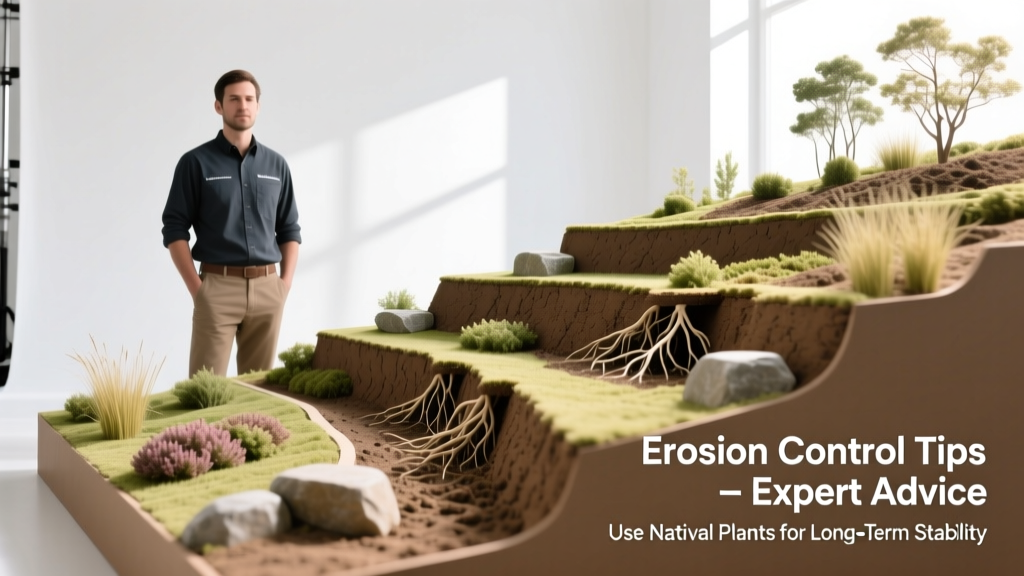
That steep backyard hill isn’t just a design challenge—it’s a ticking erosion time bomb. Without intervention, a 20% grade (roughly 11.3°) can lose over 2 inches of topsoil in a single heavy rainstorm, according to the USDA Natural Resources Conservation Service’s 2022 Soil Loss Assessment.
Anchor Plants with Deep-Rooted Perennials
Shallow-rooted annuals wash away fast. Instead, install species that knit soil together like living rebar. Switchgrass (Panicum virgatum) sends roots 6–10 feet deep; creeping juniper (Juniperus horizontalis) forms dense, low mats that deflect runoff. Space plants at 18-inch centers on 2:1 slopes (2 ft horizontal : 1 ft vertical), staggering rows in a zigzag pattern—not straight lines—to break water velocity.
- Best for sun: lavender, Russian sage, and purple coneflower
- Best for shade: ferns (Ostrich, Christmas), foamflower (Tiarella cordifolia), and native ginger
- Avoid: English ivy (invasive) and shallow-rooted impatiens (washes out in 1 season)
Install Terraces—Not Just for Vineyards
Residential terracing doesn’t require stone walls and engineering permits. Use low-profile, dry-stacked retaining walls no taller than 24 inches—built with interlocking concrete blocks or rot-resistant cedar timbers anchored with 18-inch rebar stakes every 4 feet. Each terrace should be at least 4 feet deep to hold mature root systems and allow mowing access.
According to the American Society of Landscape Architects’ 2023 Residential Grading Standards, properly stepped terraces reduce surface runoff by up to 70% compared to unbroken slopes.
"Terraces aren’t decorative—they’re hydraulic speed bumps. If water pauses longer than 90 seconds on a step, your grade is still too steep." — Elena Ruiz, ASLA-certified site engineer, Portland, OR
Use Mulch Strategically—Not Generously
Too much mulch on slopes slides; too little invites weeds and erosion. Apply shredded hardwood or pine straw at 1.5 inches thick—never more—and pin it with biodegradable jute netting stapled every 12 inches. Skip bark nuggets: they roll downhill during rain, exposing bare soil.
For steeper zones (over 30°), skip mulch entirely and use erosion control blankets seeded with native grasses like little bluestem and sideoats grama.
Quick Reference: Slope-Safe Planting Checklist
| Grade | Max Plant Spacing | Best Season to Plant | First-Year Irrigation Need |
|---|---|---|---|
| 15° (27%) | 24 in | Early fall (Sept–Oct) | Twice weekly, 15 min per zone |
| 22° (40%) | 18 in | Spring (Mar–Apr) OR fall | Daily for first 3 weeks, then taper |
| 30° (58%) | 12 in | Fall only | Drip line required; 20 min daily x 4 weeks |
Common Mistakes That Accelerate Erosion
Most slope failures stem from three repeatable errors—not soil type or rainfall intensity.
- Installing turf without soil prep: Sod laid over compacted subsoil sheds water like a roof. Always till 6 inches deep and mix in 30% compost before seeding or sodding.
- Using only one plant type: Monocultures fail en masse during drought or disease. Mix at least 3 structural layers: groundcover + mid-height shrub + vertical accent (e.g., serviceberry).
- Ignoring downspout discharge: A single 2,000-sq-ft roof dumps 1,250 gallons in a 1-inch rain. Redirect all downspouts into dry wells or French drains—not onto the slope face.
How do I stabilize a newly graded slope before planting?
Hydroseed with a 50/50 blend of annual rye (fast germination) and native warm-season grasses (long-term hold). Cover with 100% jute netting—staple at 6-inch intervals along contour lines, not vertically. Water twice daily for 10 days, then reduce gradually.
Can I use gravel or rocks instead of plants?
Only as accents—not coverage. Gravel >¾ inch migrates downhill; pea gravel washes away completely. If using rock, limit to 2-foot-wide swales between planted zones, lined with geotextile fabric and topped with 2-inch crushed granite. Never cover >15% of the slope surface with hardscape.
What’s the steepest slope I can landscape without a retaining wall?
Up to 33% grade (18.5°) with aggressive plantings, terracing, and proper drainage. Beyond that, consult a licensed engineer—especially if the slope supports a structure or driveway. The International Building Code requires engineered walls for any retained height over 48 inches.
Do I need irrigation on a slope?
Yes—but not spray heads. They cause runoff and uneven coverage. Use drip tape buried 2 inches deep along plant rows, with pressure-compensating emitters spaced at 12-inch intervals. Set timers for early morning (4–6 a.m.) to minimize evaporation and wind drift.
How often should I inspect my slope landscaping?
Quarterly: check for exposed roots, gullies >2 inches deep, or mulch displacement after heavy rain. Re-staple netting, top-dress with compost, and prune overgrown shrubs that shade out groundcovers. Document changes with dated photos—you’ll spot subtle shifts before they become failures.
Is drip irrigation enough for steep slopes?
It’s necessary—but not sufficient alone. Combine drip with contour trenches (shallow, 3-inch-deep ditches following elevation lines) filled with river rock to slow and infiltrate runoff. These trenches double as firebreaks in wildfire-prone zones, per CAL FIRE’s 2023 Defensible Space Guidelines.
Stable slopes don’t happen by accident—they’re built through layered choices: right plant, right placement, right timing. Start small: pick one 10-foot section this spring, apply these steps, and watch how quickly runoff slows and roots take hold. Then scale up. Your soil—and your water bill—will thank you.