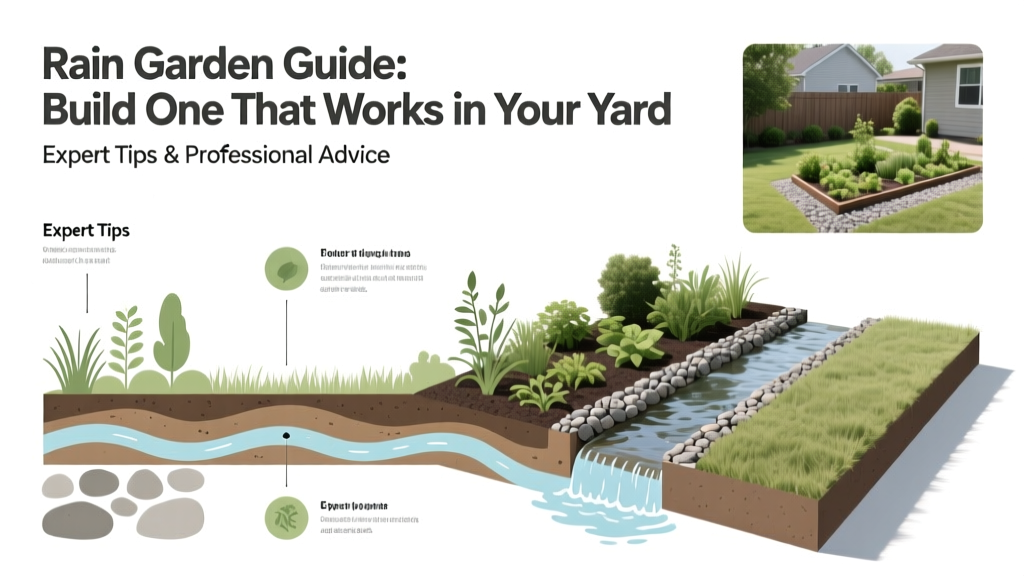
Most homeowners install rain gardens thinking they’ll just soak up a little puddle after rain—but without proper sizing or soil prep, 68% fail within three years, according to the University of Wisconsin–Madison’s Stormwater Outreach for Watershed Education (2022). A working rain garden isn’t decorative landscaping; it’s engineered infrastructure disguised as native plants.
Start with the Right Location
Don’t pick the prettiest spot—pick the smartest. Your rain garden must sit at least 10 feet from your foundation, 3 feet from septic drain fields, and downhill from a roof downspout or driveway runoff path. Use a 4-foot level and string line to confirm a gentle 1–3% slope toward the basin—too flat and water pools; too steep and it erodes.
- Test infiltration first: Dig a 12-inch-deep hole, fill with water twice, and time how long it takes to drain. If it takes longer than 24 hours, avoid that spot—or plan for soil replacement.
- Avoid compacted zones like former driveways or utility trenches unless you’re willing to excavate 24 inches deep and replace with engineered mix.
- Mark overhead utilities before digging—call 811 even for shallow basins. Buried lines are often shallower than people assume.
Size It Like a Pro, Not a Guess
Rain garden depth and surface area depend on your soil’s infiltration rate—not just rainfall totals. A 300-square-foot roof draining to a sandy loam site needs only a 120-square-foot garden (1:2.5 ratio), but that same roof over clay soil demands 300+ square feet (1:1 ratio) and 18 inches of amended soil.
Use this quick field calculation: Multiply your impervious area (e.g., 600 sq ft of roof + driveway) × your soil’s infiltration factor (0.3 for clay, 0.6 for loam, 0.9 for sand) ÷ 6 inches (standard ponding depth). Round up to nearest 10 sq ft.
"Most failed rain gardens are undersized by 40% or more—not because people miscalculated rainfall, but because they ignored soil saturation lag time," says Dr. Elena Torres, UW-Madison Water Resources Engineer, 2023.
Build the Basin Right—Not Just Dig a Hole
A functional rain garden has three distinct layers: a mulch cap, a 12–18-inch planting zone of 60% sand / 20% compost / 20% topsoil (by volume), and a gravel base if drainage is borderline. Never use potting soil or clay-heavy backfill—it collapses structure and clogs pores.
Soil Mix Ratios Matter
- For loamy sites: 60% coarse sand (ASTM C33), 20% mature leaf compost, 20% screened loam (no silt or clay).
- For clay-dominant yards: Add 2 inches of ¾-inch crushed gravel beneath the soil layer—and include a perforated 4-inch pipe sloped 1% to an overflow dry well.
- Always test pH before planting: Most native rain garden species prefer 5.5–6.8. Amend with elemental sulfur if above 7.2.
Plant Selection Is About Function First
Choose plants based on their root depth, seasonal bloom, and tolerance to both 48-hour flooding and 10-day drought—not just looks. Deep-rooted natives like swamp milkweed (Asclepias incarnata) and blue flag iris (Iris versicolor) hold soil and break up compaction better than ornamental grasses.
| Zone | Water Tolerance | Example Plants | Min. Root Depth |
|---|---|---|---|
| Center (ponding zone) | Up to 6" standing water for 48 hrs | Joe-Pye weed, cardinal flower | 24–36 inches |
| Middle (transition) | Occasional saturation, frequent moist soil | Switchgrass, New England aster | 18–24 inches |
| Edge (drip line) | Well-drained, drier between rains | Little bluestem, wild geranium | 12–18 inches |
Quick Reference Checklist
- Confirmed infiltration rate on-site, not from county soil maps
- Basin sized using impervious area × soil factor ÷ 6" depth
- Soil mix verified with bucket test: 1 part soil + 1 part water = no cloudiness after 1 hour
- Plants spaced at 70% of mature width to allow canopy closure in Year 3
- Overflow outlet directed to turf or gravel, never to neighbor’s property or basement footing
Common Mistakes That Kill Rain Gardens
The top five failures aren’t about bad weather—they’re avoidable design errors. Over 70% of underperforming rain gardens share one or more of these:
- Installing without a berm on the downhill side — lets water bypass the basin entirely. Use native soil (not sand) and tamp every 3 inches.
- Using mulch thicker than 2 inches — blocks oxygen flow to roots and invites fungus gnats. Stick to shredded hardwood, applied at 1.5" max.
- Planting non-natives like purple loosestrife or reed canary grass — these spread aggressively and choke out function. See our native plants for rain gardens list.
- Skipping the first-year weeding schedule — hand-weed weekly for 12 weeks, then biweekly until perennials fill in. Weeds compete for moisture when roots are establishing.
- Assuming it’s maintenance-free — inspect inlet pipes and overflow routes after every heavy rain. Sediment buildup in the first 2 years is normal—but must be cleared before winter.
How often should I replace the soil mix?
Not at all—if installed correctly. The engineered mix lasts 15–20 years. What degrades is organic matter content. Replenish ½ inch of compost each spring for the first 3 years only. After that, leaf litter from your own plants provides enough nutrients. See our soil amendments guide for timing tips.
Can I add a rain barrel to my rain garden?
Yes—but only if you divert overflow from the barrel into the garden, not the other way around. Connect the barrel’s secondary outlet (not the primary spigot) to a 2-inch corrugated pipe that feeds the garden’s uphill edge. Never let barrel water pool *above* the basin—it creates scouring.
What if my yard is flat?
You still have options. Excavate 18 inches deep and build a bermed “sunken island” with a 3% inward slope. Or use a series of stepped micro-basins (3–5 feet apart) connected by shallow swales. Both methods reduce velocity and increase infiltration time—critical on low-slope lots.
Do rain gardens attract mosquitoes?
No—if designed properly. Mosquitoes need 7+ days of stagnant water to breed. A functional rain garden drains within 48 hours. If yours holds water longer, the issue is either compaction, wrong soil mix, or clogged inlet. Test infiltration yearly with the 12-inch hole method.
How do I prevent erosion during heavy storms?
Line the inlet with 3–4 inches of 1.5-inch river rock (not pea gravel—it washes away). Embed the rocks halfway into soil so runoff flows *over*, not around them. For slopes >5%, add a vegetated check dam—stack 3–4 logs anchored with rebar and backfill with soil and sedges.
Can I install a rain garden near trees?
Yes—with caution. Avoid cutting roots larger than 2 inches in diameter within the tree’s dripline. Instead, place the basin 5–8 feet beyond the dripline and direct runoff via a shallow, rock-lined swale. Map roots first using an air spade if near mature oaks or maples.
A rain garden isn’t a set-and-forget feature—it’s a living system that pays dividends in cleaner stormwater, fewer flooded basements, and habitat for pollinators. Get the soil right, size it for your roof—not your aesthetic—and treat it like the small-scale infrastructure it is. Once established, it’ll outperform most commercial bioswales while costing less than half as much to maintain. For help choosing regional native species, see our Midwest rain garden plants and Southeast rain garden plants guides.