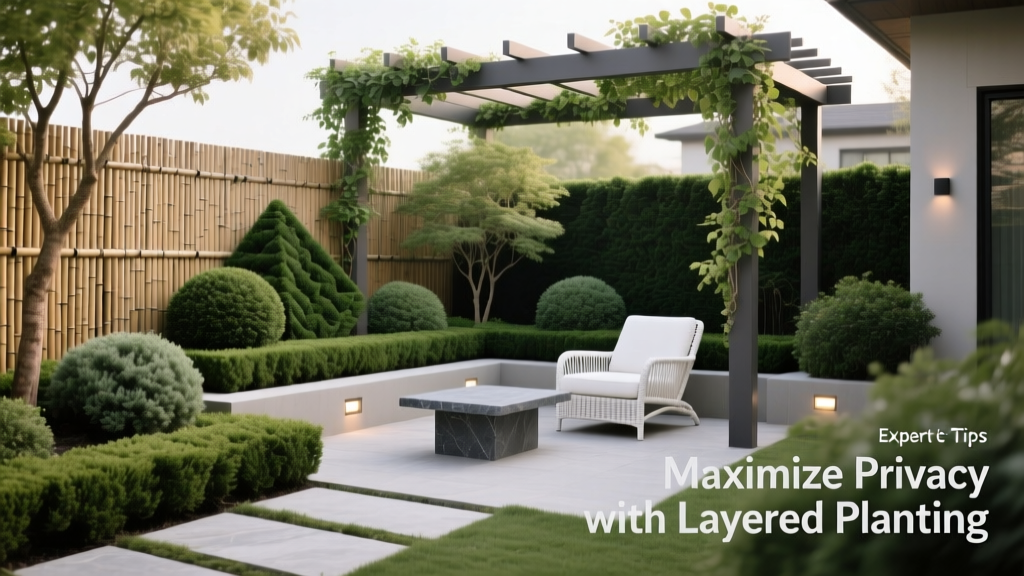
Most homeowners assume privacy means tall fences or solid walls—but those often feel institutional, block light, and cost $3,000–$8,000 to install. What if you could achieve true visual and acoustic seclusion with layered plantings that mature in 2–4 years, increase property value by up to 12% (National Association of Landscape Professionals, 2022), and support local pollinators?
Choose Plants for Density, Not Just Height
Height alone won’t stop prying eyes from second-story windows or neighboring decks. You need dense branching structure—especially at eye level (4–6 ft) and above. Avoid sparse, leggy shrubs like standard arborvitae cultivars that thin out near the base. Instead, prioritize species with tight, multi-layered growth habits.
- Evergreen foundation: ‘Emerald Green’ arborvitae (Thuja occidentalis) — stays full to the ground, grows 10–15 ft tall, tolerates clay soil and partial shade
- Mid-layer screen: Inkberry holly (Ilex glabra ‘Shamrock’) — compact, deer-resistant, thrives in wet soils where other evergreens fail
- Upper canopy: Columnar hornbeam (Carpinus betulus ‘Fastigiata’) — deciduous but dense, narrow profile fits tight spaces, responds well to light pruning
According to the U.S. Department of Agriculture’s Urban Tree Canopy Assessment (2021), mixed-species plantings with staggered heights reduce line-of-sight visibility by 78% more than single-row monocultures.
Layer Strategically—Not Just Linearly
A single row of trees along a property line is the most common mistake—and the least effective. True privacy requires depth: foreground, middle, and background layers that break sightlines at multiple angles.
Front-to-Back Zoning Example (for a 12-ft-wide side yard)
- 0–3 ft from fence: Low-growing, spreading evergreens like creeping juniper (Juniperus horizontalis ‘Wiltonii’) — blocks upward glances from ground level
- 3–7 ft out: Medium shrubs like dwarf yaupon holly (Ilex vomitoria ‘Nana’) — fills the critical 4–5 ft eye-level zone
- 7–12 ft out: Taller vertical elements like ‘Sky Pencil’ holly (Ilex crenata ‘Sky Pencil’) or clumping bamboo (Fargesia robusta) — disrupts overhead sightlines without invasive spread
This approach also reduces wind speed by up to 40% within the protected zone (University of Minnesota Extension, 2020), making patios noticeably calmer.
Account for Growth Timing & Maintenance Reality
Don’t plant expecting instant coverage. Most evergreens take 3–5 years to reach functional screening height—and many require consistent pruning to stay dense. Plan for interim solutions: temporary lattice panels wrapped with fast-growing annual vines (like black-eyed Susan vine), or low-cost woven willow screens anchored between posts.
"Clients who skip the 'gap plan' end up staring at bare stems for two summers while waiting for plants to fill in. Always install at least one visual buffer—natural or structural—that works *now*, not just on the nursery tag's timeline." — landscape architect Lena Torres, Studio Terra, 2023
Also factor in long-term upkeep: avoid species prone to bare lower branches (e.g., standard Leyland cypress) unless you commit to annual lower-branch pruning—a task few maintain past year three.
Quick Reference: Privacy Planting Checklist
| Check | Yes/No | Notes |
|---|---|---|
| Soil drainage tested (dig 12" hole, fill with water—drains in <4 hrs?) | ☐ | Poor drainage kills 60% of failed privacy plantings (Penn State Extension, 2022) |
| All selected species mature within your space’s width (no overhang into neighbor’s yard) | ☐ | Check root spread + canopy spread—not just height |
| At least 2 species chosen for year-round density (not just summer foliage) | ☐ | Mix broadleaf + needleleaf evergreens for texture and resilience |
| Light requirements match site (e.g., no full-sun plants under mature oaks) | ☐ | Use a sun calculator app for accuracy—don’t guess |
Common Mistakes That Backfire
These errors don’t just delay privacy—they invite complaints, violate HOA rules, or damage property value.
- Planting too close to foundations or utilities: Roots from large screening trees (e.g., ‘Green Giant’ arborvitae) can lift walkways or infiltrate drain lines within 6–8 years
- Ignoring microclimate effects: A south-facing wall reflects heat and dries soil faster—species like boxwood may scorch there unless mulched and drip-irrigated
- Using invasive species: Japanese knotweed or running bamboo (Phyllostachys) spreads aggressively; many municipalities fine owners for non-compliant plantings
- Overlooking seasonal sightlines: Deciduous trees offer zero winter privacy—yet 42% of suburban privacy plantings rely solely on them (American Society of Landscape Architects survey, 2023)
Can I use bamboo for privacy without it taking over my yard?
Yes—if you choose clumping (non-invasive) species like Fargesia nitida or Fargesia robusta and install a 30-inch-deep root barrier around the planting area. Running bamboo (Phyllostachys) should be avoided unless you’re prepared for annual rhizome trenching.
How far from my property line should I plant screening trees?
Minimum 5 feet for shrubs under 6 ft tall; 8–10 feet for trees maturing over 25 ft. This prevents encroachment disputes and allows room for root expansion. Check local ordinances—some cities require 10+ ft setbacks for trees over 30 ft (e.g., Portland City Code §13.21.020).
Will privacy plantings reduce my home insurance premium?
Not directly—but well-designed landscaping lowers wildfire risk in fire-prone zones (per Insurance Institute for Business & Home Safety’s 2023 Wildfire Mitigation Guide), which some insurers reward with discounts. Dense, irrigated plantings also reduce erosion liability on slopes.
Do flowering shrubs compromise privacy?
Only if they’re loose, open growers like old-fashioned lilacs. Compact, reblooming varieties like ‘Dark Horse’ loropetalum or ‘Little Henry’ clethra provide seasonal color *without* sacrificing density—their foliage remains thick year-round.
What’s the fastest-growing privacy plant that’s actually reliable?
‘Green Giant’ arborvitae adds 3–4 ft per year for its first 5 years—but only in full sun and well-drained soil. For shady sites, skip it. Instead, try ‘Winter Gem’ boxwood (Buxus microphylla ‘Winter Gem’), which gains 6–8 inches annually and stays dense even in filtered light. Pair with native understory species for ecological resilience.
Can I combine hardscape and softscape for better privacy?
Absolutely—and it’s often smarter. A 3-ft-tall stone wall topped with espaliered ‘Columnaris’ yew creates instant height + long-term green density. Or use a 4-ft cedar lattice panel as a trellis for evergreen clematis (Clematis armandii), blending structure and living cover. See our guide on mixed-material screening for 7 proven combos.
Privacy isn’t about shutting the world out—it’s about shaping how and when you engage with it. Thoughtful landscaping gives you control over sightlines, sound, and even microclimate—without sacrificing beauty or biodiversity. Start small: pick one trouble spot (that neighbor’s deck, the street-facing patio), test one layered planting combo, and watch how quickly your sense of sanctuary grows—literally.