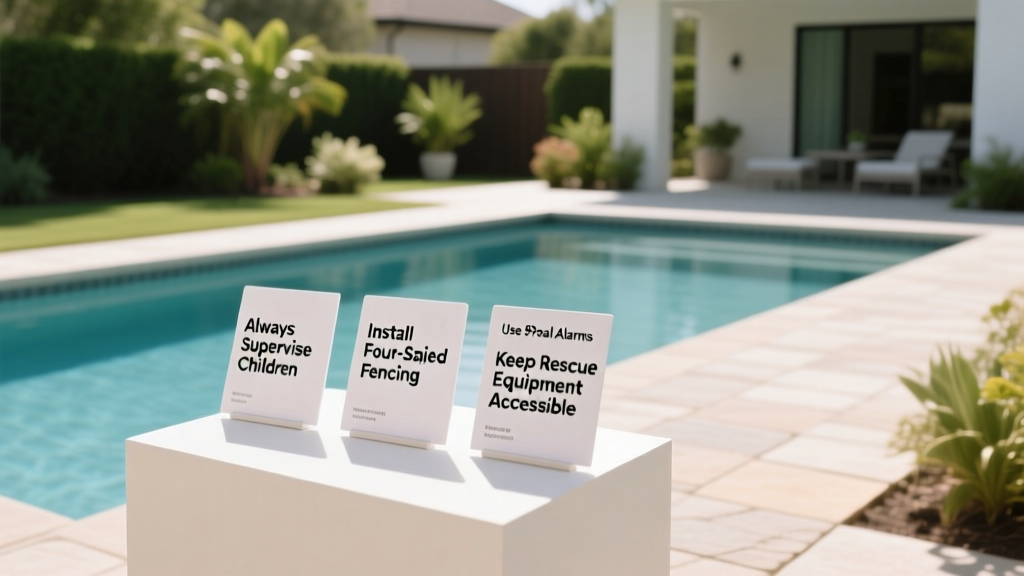
Every year, nearly 4,000 people in the U.S. visit emergency departments for nonfatal drowning injuries—and over 3,500 die, with children under 5 accounting for 25% of fatalities (CDC, 2022). Most occur in residential pools during unsupervised moments lasting less than two minutes. That’s why practical, consistent safety habits—not just equipment—make the real difference.
Supervise Without Distraction
Active supervision means eyes on the water, no phone scrolling, no cooking, no side conversations—even for ‘just a minute.’ Designate one adult as the official ‘water watcher’ during gatherings, rotating every 20 minutes to prevent fatigue-induced lapses. Keep toddlers within arm’s reach at all times; floaties and water wings are not safety devices.
- Use a timer or wristband to track rotation shifts for water watchers
- Store phones and tablets in a locked kitchen drawer during swim time
- Teach older kids to alert the supervisor immediately if someone goes under
Install Physical Barriers That Work
A four-sided isolation fence—separate from the house perimeter—is the single most effective structural deterrent. It must be at least 4 feet tall, with self-closing, self-latching gates that open outward and have latches placed 54 inches above the ground (ASTM F1960-23 standard). Mesh fencing is preferable to wrought iron for small children—it eliminates footholds.
According to the Insurance Institute for Business & Home Safety's 2023 report, homes with compliant four-sided fencing cut child drowning risk by 83% compared to those with three-sided or no fencing.
“Fencing isn’t about keeping kids out—it’s about buying seconds. Those seconds let adults intervene before submersion becomes irreversible.” — Dr. Susan Lassiter, Pediatric Emergency Medicine, Children’s Hospital Los Angeles, 2021
Secure Drains and Suction Outlets
Drain entrapment causes 10–15 hospitalizations annually and has led to multiple child fatalities. Check that all main drains meet ANSI/APSP-7 2022 standards: dual-drain systems, anti-entrapment covers (VGB-compliant), and clearly labeled shut-off valves within 3 feet of the pool edge.
How to test your drain cover
- Turn pump on and place a tennis ball gently over the drain—no suction should hold it in place
- Look for embossed ‘ASME A112.19.8-2022’ or ‘VGB 2017’ on the cover
- If cover is cracked, warped, or missing screws, replace it immediately (cost: $45–$85)
Quick Reference: Pool Safety Checklist
| Action | Frequency | Notes |
|---|---|---|
| Test gate latch height and operation | Monthly | Latch must be >54″ high and self-locking |
| Inspect drain covers for damage or debris | Weekly | Clean hair and leaves; replace if worn |
| Verify CPR/AED location and access | Before each season | Keep AED near pool gate; post CPR instructions on pump house |
| Review emergency contacts on poolside sign | Quarterly | Include local EMS, poison control (1-800-222-1222), and nearest hospital |
Common Mistakes That Undermine Safety
Many well-intentioned families unknowingly create false confidence. Leaving a toddler in a ‘toddler pool’ on the patio without supervision is one of the top missteps—these hold enough water to drown a baby in 20 seconds. Another: relying solely on pool alarms. While helpful, they’re secondary tools—the CPSC reports 72% of alarm-triggered incidents involved delayed response due to alarm fatigue or battery failure.
- Assuming lifeguard certification replaces active adult supervision
- Using inflatable arm bands instead of Coast Guard–approved life jackets for weak swimmers
- Delaying swim lessons until age 4—AAP recommends formal instruction starting at age 1
- Storing pool chemicals in unlocked sheds accessible to children (see pool chemical safety)
Can older kids really drown silently?
Yes—and it happens fast. Unlike movies, drowning rarely involves splashing or shouting. The Instinctive Drowning Response means head low in water, mouth at surface level, arms pressing down for support, and inability to wave or call for help. Watch for: glassy-eyed stares, vertical body position with no leg movement, and attempts to roll onto back that fail.
Do pool alarms actually work?
Surface wave alarms detect disturbances but miss submerged children. Subsurface pressure alarms (like the Poolguard PGRM) trigger at 2+ inches of submersion and have 94% reliability in independent lab tests (UL 2017). But they’re only effective if paired with immediate response—so keep your phone charged and nearby, not in the house.
Is a pool cover enough protection?
No. Automatic safety covers (ASTM F1346-22 compliant) can support weight and prevent access—but only when fully deployed and locked. Manual covers, solar blankets, and leaf nets offer zero drowning prevention. One study found 68% of cover-related incidents involved partial deployment or improper anchoring (National Drowning Prevention Alliance, 2021).
What’s the right age to start swim lessons?
The American Academy of Pediatrics recommends formal lessons starting at age 1, with evidence showing reduced drowning risk by 88% for children aged 1–4 who complete ≥24 cumulative lessons (Pediatrics, 2022). Focus early on breath control, floating, and safe entry—not strokes.
How often should I update my CPR skills?
Every two years. Skills degrade quickly: chest compression depth and rate accuracy drop 40% after 12 months without practice (American Heart Association, 2023). Sign up for a hands-on course with manikin feedback—or use the free AHA CPR training resources for home drills.
Pool safety isn’t about perfection—it’s about consistency, clarity, and calibrated vigilance. Replace assumptions with tested habits: lock the gate, rotate the watcher, check the drain, and rehearse the 911 call. Because the safest pool isn’t the deepest or the newest—it’s the one where everyone knows exactly what to do, and when to do it. For more on maintaining safe water chemistry, see our guide on pool pH balancing.