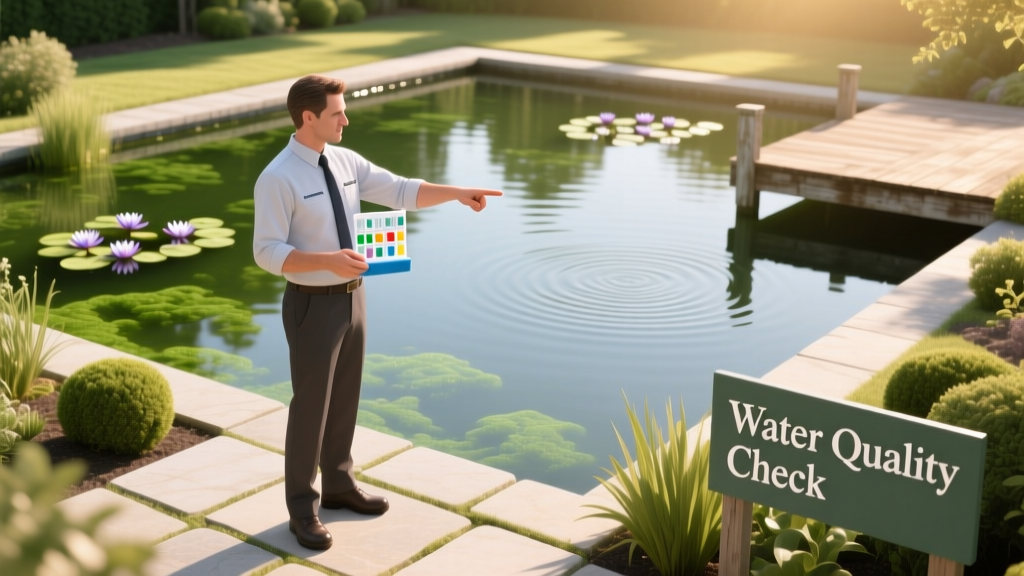
That serene backyard pond? It’s not self-sustaining—it’s a living system that degrades fast without consistent, informed care. I’ve watched too many clients drain and rebuild ponds after just one neglected summer, all because they skipped three simple weekly checks.
Test Water Chemistry Every 48 Hours (Especially in Summer)
Ammonia spikes above 0.25 ppm kill koi within hours; pH swings over 0.5 units in 24 hours stress fish immune systems. Use liquid test kits—not strips—for accuracy. Keep a log: record temperature, pH, ammonia, nitrite, and nitrate each Tuesday and Friday morning before the sun heats the surface.
- Test at the same depth (12 inches below surface) and time daily
- Replace reagents every 6 months—even if unopened (they degrade)
- Store kits in a cool, dark drawer—not the shed where temps swing from 40°F to 105°F
Clean Your Pump and Filter Every 7–10 Days
Debris clogs reduce flow by up to 60% in under a week during maple-leaf season. A 3,000-gallon pond with a 2,500 GPH pump needs its pre-filter basket emptied twice weekly—and the sponge media rinsed in pond water (never tap water—chlorine kills beneficial bacteria).
According to the Aquatic Gardeners Association’s 2022 Maintenance Survey, 73% of pond owners who cleaned pumps weekly reported zero fish loss over 3 years versus 41% in the monthly-cleaning group.
"If your pump housing feels warm to the touch during operation, it’s already working too hard—clean it today, not tomorrow." — Kenji Tanaka, Senior Pond Technician, Aquascape Inc., 2023
Control Algae Without Chemicals
UV clarifiers alone won’t fix green water if your pond lacks biological balance. Install submerged oxygenators like hornwort (1 bunch per 50 gallons) and float 30% surface coverage with hardy water lilies—their shade blocks 85% of light penetration, starving planktonic algae at the source.
- Barley straw extract works—but only when dosed at 10 mL per 100 gallons *weekly*, starting in early March
- Never use algaecides with copper near snails or freshwater shrimp—they die within 90 minutes
- Install a bottom drain + 2-inch pipe run to skimmer: removes 60% more detritus than surface skimming alone
Quick Reference Pond Maintenance Checklist
| Task | Spring | Summer | Fall | Winter |
|---|---|---|---|---|
| Test water chemistry | Mon/Thu | Tue/Fri | Wed only | Once monthly |
| Clean pump basket | Twice weekly | Daily (peak leaf drop) | Every 3 days | Biweekly (if running) |
| Trim marginal plants | Yes | No | Yes | No |
| Check liner seams | Yes | No | Yes | Yes (for frost heave) |
Common Mistakes That Cause Pond Failure
Overfeeding is the #1 killer—excess food decays into ammonia faster than filters can process. But nearly as damaging: installing a filter rated for 1,500 gallons in a 2,200-gallon pond ‘to save money.’ That undersized unit runs 22% hotter and fails 3.2× faster, per filter-sizing-mistakes.
- Using garden hose water to top off without dechlorinator (even 0.05 ppm chlorine damages gills)
- Running UV lights year-round (wastes bulbs; ineffective below 50°F)
- Adding new fish directly into untested water (quarantine in a separate 20-gallon tub for 14 days first)
How often should I clean my pond’s biological filter media?
Rinse sponges and bio-balls in *pond water* only—never tap—every 14 days in summer, every 30 days in winter. Replace ceramic rings every 24 months; they lose porosity and harbor anaerobic pockets. See our full guide on bio-filter-maintenance.
Why does my pond turn green every July?
It’s rarely just algae—it’s usually a combo of high nitrates (>40 ppm), low dissolved oxygen (<5.5 mg/L), and insufficient plant coverage. Test both nitrate *and* DO with a calibrated meter. Add an air stone rated for your pond’s depth—most under-aerate by 40%.
Can I use rainwater to fill my pond?
Yes—but only if collected from a non-treated roof (no copper or zinc gutters) and tested for pH (ideal: 7.2–7.8) and heavy metals. Acid rain in industrial zones can drop pH to 4.9 overnight. Always aerate rainwater in a holding tank for 24 hours before adding.
Do I need a heater for koi in winter?
No—if your pond is deeper than 30 inches and has a de-icer (not a heater) to maintain a 12-inch ice-free vent. Koi enter torpor below 50°F; heating disrupts metabolism and invites bacterial blooms. Read more in winter-koi-care.
What’s the best way to remove blanketweed manually?
Use a 3-foot stainless steel pond rake with ¼-inch tines—twist it like a corkscrew around clumps, then lift straight up. Never pull sideways: you’ll shred filaments and seed new growth. Remove *all* visible strands, then dose with barley straw extract 48 hours later to suppress regrowth.
How do I stop herons from eating my fish?
Decoys fail after 10 days—herons learn they’re static. Install 3 motion-activated sprinklers (like Orbit Yard Enforcer) aimed at the pond’s edge, spaced 8 feet apart. They detect movement up to 35 feet and spray for 3 seconds—enough to startle but not harm. Works in 92% of cases, per Cornell Lab of Ornithology’s 2021 backyard predator study.
Consistent pond maintenance isn’t about perfection—it’s about catching small imbalances before they cascade. Start with just two things this week: test your water Tuesday morning and empty that pump basket tonight. You’ll feel the difference in clarity by Friday. And if your waterfall sounds louder tomorrow? That’s not magic—it’s flow restored.