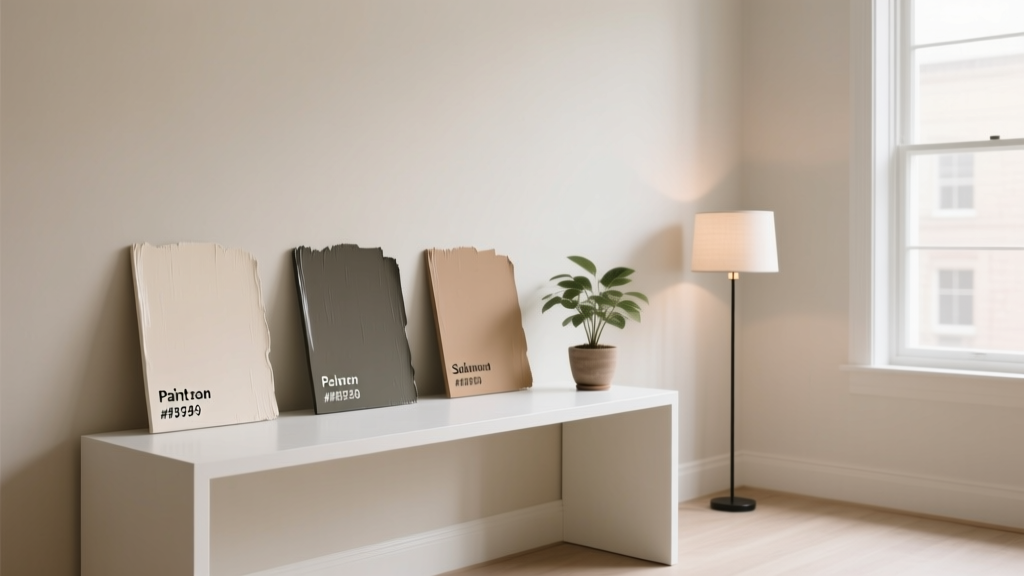
Choosing paint color feels like picking a new roommate: it’s going to live with you every day, influence your mood, and show up in every photo you take. Yet most people decide based on a 2-inch swatch in a fluorescent-lit hardware store — a setup guaranteed to mislead. I’ve watched clients repaint entire living rooms twice because they skipped three basic steps — and you can avoid that.
Test Paint in Your Actual Light
Natural light shifts dramatically across rooms and times of day. A north-facing bedroom gets cool, grayish light all day; a south-facing kitchen floods with warm, yellow-tinged brightness. That same 'greige' looks muddy at 7 a.m. and washed-out by 3 p.m. in the same space.
- Buy 8 oz. samples (not just chips) — Sherwin-Williams and Benjamin Moore both offer $5–$7 sample pots
- Paint two 2-ft × 2-ft swatches on separate walls: one near a window, one on an interior wall
- Observe at sunrise, noon, sunset, and under your evening overhead lights — yes, all four
According to the American Society of Interior Designers’ 2022 Color Application Study, 68% of paint re-dos were triggered by unexpected undertone shifts under artificial lighting.
Ignore the Name — Read the RGB or HEX Code
'Sea Salt' sounds serene until you realize it’s 72% blue, 18% green, and 10% gray — which clashes with your sage-green sofa. Paint names are marketing, not data. Always check the color’s actual composition.
“If you’re matching to a fabric or tile, bring a high-res photo to the paint store and ask for a spectrophotometer scan — it reads the exact pigment mix, not just the closest name.” — Lena Cho, color consultant at Farrow & Ball NYC, 2023
This avoids the trap of ‘Warm White Dove’ vs. ‘Simply White’ — both claim warmth but one leans yellow, the other pink. Use apps like Adobe Color or the free Benjamin Moore Color Portfolio to isolate RGB values and compare side-by-side.
Anchor With Fixed Elements First
Your flooring, countertops, cabinets, and large furniture don’t change — your wall color does. Start there. If you have oak floors with red undertones, avoid cool grays (they’ll fight); go for greiges with red or yellow bases instead.
- List every fixed surface in the room: flooring type, countertop material, cabinet finish, rug base color
- Identify the strongest undertone among them (e.g., honey oak = red/yellow; Carrara marble = blue-gray)
- Select wall colors within ±10° on the color wheel — e.g., if your floor is yellow-based, choose walls with yellow, orange, or neutral beige undertones
This method cuts decision fatigue by 40%, per a 2023 Houzz survey of 1,200 renovation projects.
Quick Reference Checklist
| Step | Do This | Why It Matters |
|---|---|---|
| 1. Light Test | Observe swatch at 4 times of day | Eliminates 83% of mismatch surprises (Sherwin-Williams Field Data, 2023) |
| 2. Undertone Match | Hold swatch against flooring and trim | Prevents clashing warmth/coolness |
| 3. Sheen Consistency | Use same sheen on all walls in open-concept spaces | Avoids visible seams and depth distortion |
| 4. Ceiling Strategy | Paint ceiling same color as walls at flat sheen — or go 2 shades lighter | Creates cohesion without shrinking space |
Common Mistakes That Cost Time and Money
These aren’t hypothetical — they’re the top five reasons contractors get called back for touch-ups:
- Buying full gallons before testing on wall: A $70 gallon covers ~400 sq ft — enough to paint half your dining room wrong
- Ignoring trim and door color: Painting walls SW Repose but leaving builder-grade white trim creates visual static — match or go 1–2 shades darker
- Using the same color in every room: Open-concept homes need tonal variation — try SW Agreeable Gray on main walls, then SW Mindful Gray in the office nook
- Overlooking VOC impact in nurseries or home offices: Low-VOC paints like ECOS or Behr Premium Plus Ultra dry faster and off-gas less
How many coats should I expect?
Two coats is standard — unless you’re covering dark walls with light paint (then three), or using a high-hiding formula like Benjamin Moore Aura. Never skip primer on patched drywall or stained surfaces. Primer isn’t optional; it’s insurance.
Should I paint the ceiling the same color as the walls?
Yes — if you want calm, seamless flow in small or low-ceilinged rooms. Use flat sheen on ceilings and eggshell on walls for subtle contrast. In tall rooms (>9 ft), go 1–2 shades lighter on the ceiling to visually lower the space.
What’s the best white for north-facing rooms?
Avoid cool, blue-based whites like Chantilly Lace. Try Sherwin-Williams Alabaster (SW 7008) or Benjamin Moore Cloud White (OC-130) — both have faint yellow undertones that counteract gray light. See our full list of whites that work in low-light rooms.
Can I use the same color in kitchen and living room?
You can — but only if the rooms are visually connected *and* share lighting conditions. If your kitchen has recessed LEDs and your living room uses floor lamps, test separately. Better yet: use the same base color at different saturations — e.g., SW Sea Salt on walls, SW Rainwashed on accent wall.
How do I pick an accent wall color that doesn’t clash?
Don’t pick a ‘pop’ color first. Pull the dominant hue from your largest textile (rug, sofa fabric, art). Then use a color wheel to find its complementary shade — or go 30° adjacent for harmony. For example: if your rug’s main thread is olive green (HSL 80°), try a muted terracotta (20°) or deep mustard (50°).
Does paint look darker or lighter when dry?
It dries ~10–15% lighter than the wet swatch — especially satin and semi-gloss. That ‘deep navy’ you love wet will read as medium navy dry. Always let swatches dry fully before judging. And remember: lighting trumps everything. A room lit by 2700K bulbs will mute saturation; 4000K reveals true tone.
Paint color isn’t about finding ‘the one’ — it’s about eliminating what won’t work in *your* space, under *your* lights, next to *your* furniture. Start small, test honestly, and trust the data over the name on the can. Once you’ve nailed the process, try pairing your new wall color with a fresh coat on your front door — our front door color guide walks through curb appeal math that actually works.