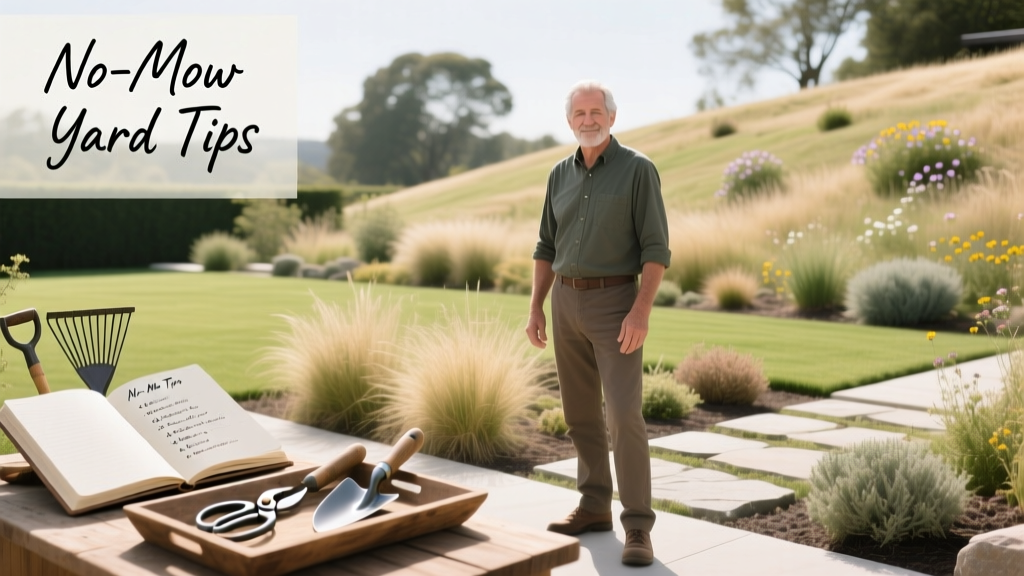
Most homeowners spend 40–50 hours per year just mowing — time that adds up to over 1,000 hours across a 25-year ownership period (U.S. Department of Agriculture, 2022). A no-mow yard isn’t about neglect; it’s about intention — choosing plants and materials that match your climate, soil, and lifestyle from day one.
Select the Right Ground Cover
Not all low-growing plants tolerate foot traffic or suppress weeds equally. Start by testing your soil pH and sun exposure — then match species accordingly. Creeping thyme (Thymus serpyllum) handles light foot traffic and blooms purple in late spring. Bearberry (Arctostaphylos uva-ursi) thrives in sandy, acidic soils common in New England and the Pacific Northwest. For shady, moist areas, consider Pennsylvania sedge (Carex pensylvanica) — a grass-like native that forms a soft, dense mat and needs zero mowing.
- Creeping thyme: Tolerates drought after establishment; plant 6–8 inches apart
- Pennsylvania sedge: Spreads slowly; best installed as plugs in early fall
- Blue star creeper (Isotoma fluviatilis): Avoid in Pacific Northwest — listed as invasive in Washington State (WA Noxious Weed Control Board, 2021)
Layer Mulch Strategically
Mulch isn’t just decorative — it’s your first line of defense against weeds and moisture loss. Use shredded bark or wood chips 3 inches deep around shrubs and perennials. For pathways or open beds, go heavier: 4–6 inches of coarse mulch like pine nuggets deters bindweed and crabgrass far better than thin layers.
Replenish mulch every 18–24 months — not annually. Over-mulching suffocates roots and invites voles. And never pile mulch against tree trunks ("volcano mulching"); keep it 3–4 inches away to prevent rot and girdling.
Best Mulch Types by Use Case
| Use Case | Recommended Mulch | Depth | Reapplication Interval |
|---|---|---|---|
| Under native shrubs | Shredded hardwood | 3 inches | 24 months |
| Pathways | Pine nuggets | 5 inches | 36 months |
| Perennial beds | Composted leaf litter | 2.5 inches | 18 months |
| Steep slopes | Woven jute fabric + 2" bark | 2 inches over fabric | 36 months |
Integrate Hardscaping Thoughtfully
Hardscaping reduces mowing area *and* creates functional space — but avoid over-paving. Aim for 30–40% hardscape coverage in residential yards to maintain stormwater absorption. Permeable pavers (like Unilock Turfstone) let rain infiltrate while supporting light vehicle weight. Gravel paths with edge restraints last longer than loose rock — especially if you’re using them daily.
Pro tip: Lay 4–6 inches of compacted crushed stone base before installing pavers. Skip this step, and you’ll get sinking, shifting, and weed growth between joints within two seasons.
"We see 70% more long-term success when homeowners install permeable hardscape *before* planting — it prevents compaction of amended soil and gives roots room to settle." — Sarah Lin, Landscape Architect, Ecotone Design Group (2023)
Quick Reference Checklist
- Test soil pH and drainage before planting
- Remove existing turf with solarization (4–6 weeks in summer) or smothering (cardboard + 6" mulch)
- Plant natives in fall (Sept–Oct) for strongest root establishment
- Install drip irrigation on a timer for first 12 weeks — then taper off
- Label all new plants with stake tags showing name and care notes
Common Mistakes
Many no-mow attempts fail because of three recurring oversights. First: skipping site prep. Leaving grass roots intact invites regrowth — even under mulch. Second: planting non-natives that demand irrigation or fertilizer, defeating the low-maintenance goal. Third: assuming ‘no mow’ means ‘no care.’ These landscapes still need seasonal weeding, pruning, and debris removal — just less frequently.
Another frequent error is overcrowding. Planting ground covers too close (e.g., 3-inch spacing instead of 8-inch) causes fungal die-off in humid summers. Give them breathing room.
How much does a no-mow yard cost upfront?
Expect $2–$5 per square foot for plants and mulch alone — less if you propagate from divisions or trade with neighbors. Hardscaping runs $12–$25/sq ft installed. But factor in savings: the average homeowner spends $180/year on mowing services (LawnStarter 2023 survey), so break-even typically hits in 3–4 years.
Can I convert just part of my lawn?
Absolutely — and it’s often smarter. Start with the least-used zone: the side yard, back corner, or beneath large trees where grass struggles anyway. Use curved edging to soften transitions. Then expand annually as confidence and budget allow. See our native plant ideas for zone-specific starter lists.
Do no-mow yards attract more ticks or mosquitoes?
Not inherently — but poor design can. Avoid tall, unmanaged grasses and stagnant water features. Keep ground covers trimmed to 4–6 inches, and eliminate standing water in pots or depressions. Native plantings actually support more insect predators (like dragonflies and spiders) that reduce pest populations naturally.
What if my HOA prohibits no-mow yards?
Check your CC&Rs carefully — many bans target "weeds" or "untended property," not specific plant types. Frame your plan as "low-water native landscaping" and submit sketches. In California, Florida, and Colorado, state laws (like AB 2109 or HB 1029) limit HOA restrictions on water-wise yards. You can also start small: replace 25% of front lawn with creeping thyme and ornamental grasses — most HOAs won’t object to that level of refinement. See our HOA-friendly landscaping guide for compliant examples.
How do I handle leaves in a no-mow yard?
Don’t blow or rake aggressively — it damages low-growing plants and disturbs beneficial insects. Instead, use a leaf vacuum on low suction, or lay a lightweight tarp and gently sweep leaves onto it. Shred fallen leaves with a mower (on highest setting) and use as mulch in perennial beds — they break down fast and feed soil microbes. For sedge or thyme beds, skip shredding: just lift leaves with a wide-tined rake held flat to the surface.
Will a no-mow yard increase my home’s resale value?
Data is mixed, but location matters. In drought-prone areas (Phoenix, Austin, Sacramento), buyers pay 3–5% more for water-wise yards (National Association of Realtors, 2022). In high-rainfall zones, perceived “wildness” can lower appeal unless design is polished — think clean lines, defined edges, and intentional structure. That’s why we recommend working with a designer for front-yard conversions, and tackling backyard zones DIY-first. Our low-water landscaping post breaks down curb-appeal tactics that work nationwide.
A no-mow yard grows more rewarding with each season — fewer chores, richer soil, and more birdsong. It’s not about giving up on your yard. It’s about growing something that works *with* you, not against you.