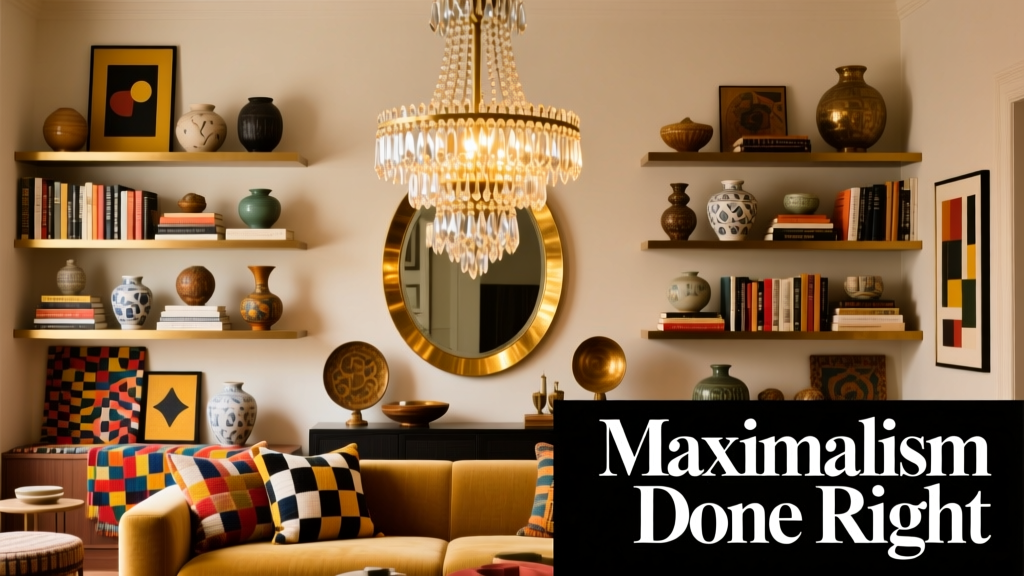
Maximalism isn’t about hoarding — it’s about intentionality dressed in velvet, brass, and clashing florals. When done right, a maximalist room feels alive, personal, and deeply curated, not cluttered. Think of it like a well-composed symphony: every element has a role, even the dissonance.
Start with a Cohesive Color Anchor
Before you hang that third tapestry or stack six throw pillows, lock down one dominant hue or tone that appears in at least three major elements: walls, upholstery, and a large rug or artwork. Interior designer Justina Blakeney recommends using a 60-30-10 rule — but flipped: 60% base color (e.g., emerald green walls), 30% secondary (terracotta ceramics, rust velvet), and 10% high-contrast accent (gold-framed mirrors, cobalt glass). This prevents visual fatigue while allowing boldness.
- Paint one wall in a saturated matte finish (like Farrow & Ball’s Green Smoke) and repeat that pigment in a vintage kilim rug and two ceramic vases
- Use tonal variation instead of strict matching — e.g., olive, forest, and bottle green all count as your ‘green anchor’
- Avoid introducing a fourth dominant color unless it’s a deliberate, repeated motif (like brass hardware appearing on lamps, drawer pulls, and picture frames)
Layer Textures Like a Pro Stylist
Texture is where maximalism earns its depth. Flat surfaces kill energy; tactile contrast invites touch and slows the eye. The key is varying scale and origin: rough + smooth, woven + glossy, organic + engineered.
According to the 2022 AD100 survey by Architectural Digest, 78% of top-tier maximalist spaces included at least five distinct textures within a single seating zone — think nubby bouclé sofa, hammered brass side table, raw-edge walnut shelf, silk-draped lampshade, and a hand-stitched macramé plant hanger.
"If everything feels the same under your fingers, it looks flat — even if it’s visually busy." — Amber Lewis, founder of Amber Interiors, 2023
- Pair a high-pile wool rug with a lacquered coffee table and linen-upholstered armchair
- Add unexpected texture combos: a cracked-glaze ceramic vase next to a mirrored tray, or a snakeskin-print pillow against shearling throws
- Rotate textiles seasonally — swap cotton dhurries for heavy brocade throws in winter, then introduce raffia and seagrass baskets in summer
Curate, Don’t Accumulate
True maximalism is edited. That means every object must pass the ‘three-question test’: Does it spark joy? Does it reflect your history (a souvenir, heirloom, or handmade piece)? Does it contribute to rhythm or contrast? If two answers are ‘no’, it goes into the ‘maybe’ box — not on the shelf.
The U.S. EPA estimates the average American home contains over 300,000 items — but a maximalist living room needs only 45–65 carefully placed objects to feel rich and layered. It’s not quantity; it’s curation density.
How do I choose art for a maximalist wall?
Group pieces by theme, not frame style: all botanical prints, all neon-lit signs, or all mid-century travel posters. Hang them tight — no more than 1.5 inches between edges — and vary heights so the top edges create a gentle wave, not a rigid line. Use museum wax to secure heavier frames without visible hardware.
Can maximalism work in small spaces?
Absolutely — but scale down the footprint, not the impact. Use vertical real estate: floor-to-ceiling bookshelves with books, framed postcards, and small sculptures; mirrored cabinets that double as display zones; and wallpaper with large-scale motifs (like Schumacher’s Chinoiserie Garden) to create optical expansion. Avoid low-slung furniture — opt for leggy, transparent, or reflective pieces to preserve airiness.
What lighting works best?
Layer three types: ambient (a bold chandelier or clustered pendant), task (a sculptural brass desk lamp), and accent (LED strip lights behind open shelving or under glass display cabinets). Dimmers are non-negotiable — maximalist moods shift with light temperature and intensity.
How do I avoid visual overwhelm?
Build ‘breathing zones’: one solid-color wall in a busy room, a single minimalist shelf amid patterned cabinetry, or a clear pathway (minimum 36 inches wide) through furniture groupings. These pauses let the eye reset before diving into the next layered vignette.
Quick Reference Checklist
| Category | Must-Have | Avoid |
|---|---|---|
| Color | One dominant hue repeated in ≥3 anchor pieces | Four+ equally loud colors competing for attention |
| Pattern | At least one large-scale + one small-scale pattern in same palette | Three medium-scale florals with identical scale and saturation |
| Texture | Five+ distinct tactile surfaces in focal zone | Everything upholstered in same fabric (e.g., all velvet) |
| Scale | Mix tall, squat, narrow, and wide forms in each grouping | All objects same height or width (e.g., uniform 12" vases) |
Common Mistakes
Even seasoned decorators misstep. Here’s what derails most maximalist attempts:
- Forgetting negative space — cramming every surface leaves no visual rest. Leave at least one horizontal plane (e.g., mantel top or sideboard) with 40% empty space.
- Ignoring lighting hierarchy — relying solely on overhead fixtures flattens dimension. Maximalist rooms need at least three independent light sources with separate switches.
- Using only new items — vintage, thrifted, and handmade pieces add soul. According to Design Sponge’s 2023 trend report, 92% of successful maximalist interiors included at least 40% pre-owned objects.
- Skipping the edit — hanging every frame you own, or stacking every book, signals randomness — not richness. Rotate collections quarterly (how to curate a bookshelf) and store off-season decor in labeled bins (smart storage solutions).
How do I incorporate family heirlooms without looking dated?
Recontextualize them. Place a Victorian porcelain doll inside a modern acrylic shadow box. Frame a faded quilt swatch alongside abstract ink drawings. Mount an antique brass compass on a matte black steel plaque. The goal isn’t preservation — it’s conversation across time.
Is maximalism expensive?
Not inherently. A $12 flea-market mirror, $8 yard of remnant silk, and $5 vintage buttons can anchor a vignette more powerfully than a $400 mass-produced sculpture. Focus budget on structural pieces (sofa, rug, lighting) and source personality elsewhere — thrift flip ideas offer dozens of low-cost upgrades.
Maximalism rewards patience, editing, and personal truth. It’s not about filling space — it’s about filling it with meaning. Start small: commit one shelf, one wall, or one corner. Then step back, live with it for three days, and ask: Does this feel like *me* — not just ‘more’? If yes, you’re already speaking the language.