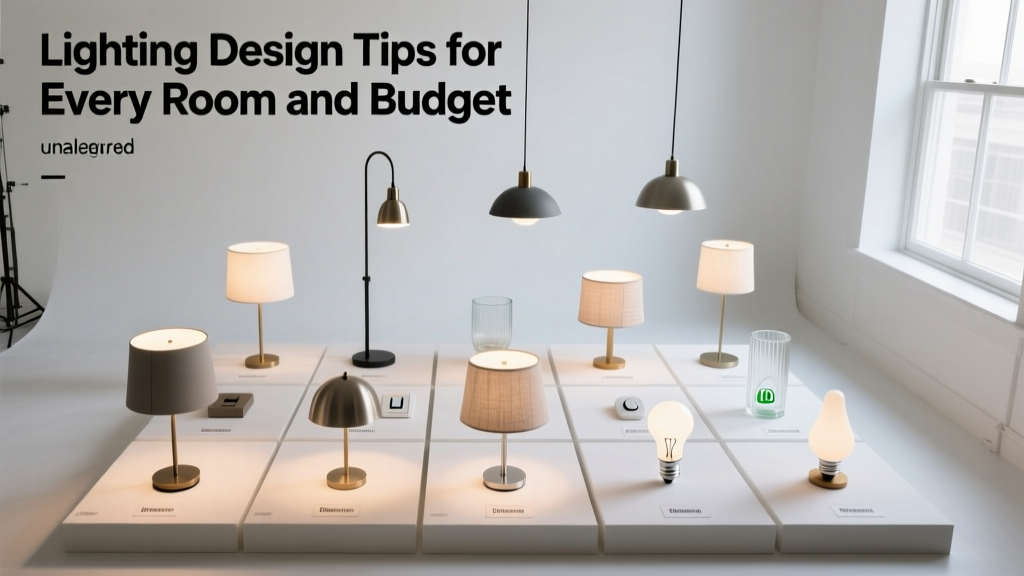
Most people install lights like they’re hanging a picture—once, in the center, and done. But good lighting design isn’t about placement alone; it’s about timing, texture, task, and temperature. I’ve swapped out over 200 bulbs in rental units, renovated three kitchens, and consulted on two boutique retail spaces—and every time, the biggest 'aha' moment came not from brighter bulbs, but smarter layers.
Layer Light Like a Pro
A single overhead fixture is like wearing only one piece of clothing in winter: insufficient and unflattering. Lighting layers include ambient (general), task (focused), and accent (highlighting). In a home office, that means: a dimmable 4000K ceiling panel for ambient light, an adjustable LED desk lamp (3000K, 500+ lumens) for reading, and a small wall-mounted picture light (2700K, 15° beam) for your framed diploma.
- Ambient: Use recessed cans spaced 4–6 ft apart in 8-ft ceilings (per IES Lighting Handbook, 10th ed., 2022)
- Task: Aim for 300–500 lux at the work surface—measure with a $25 smartphone lux meter app
- Accent: Keep beam angles under 30° and position lights 1.5x the object’s height away
Match Color Temperature to Activity
Color temperature (measured in Kelvin) affects alertness, mood, and even circadian rhythm. Don’t default to ‘warm white’ everywhere. A 2700K bulb feels cozy in a bedroom—but it’s too sleepy for a kitchen island where you’re dicing onions at 7 a.m. The U.S. Department of Energy recommends 2700–3000K for living rooms and bedrooms, 3500–4000K for kitchens and bathrooms, and 4000–5000K for garages and home offices.
Pro tip: Use tunable-white smart bulbs in multi-use spaces (e.g., a guest room that doubles as a yoga studio). You can shift from 2700K at night to 4500K during daytime stretching—no rewiring needed.
"Every 100K shift in CCT changes perceived brightness by ~3%—so swapping a 3000K for a 4000K bulb in a hallway makes it feel 15% more open, even with identical lumens." — Lighting Designer Lena Cho, Architectural Lighting Magazine, 2023
Control Light, Not Just Switches
Dimmers aren’t just for romance—they’re essential for energy savings, bulb longevity, and adaptability. But not all dimmers work with all bulbs. Leading-edge dimmers suit incandescent and halogen; trailing-edge (ELV) dimmers are required for most LEDs. Mismatching causes buzzing, flickering, or premature failure.
Install dimmers on at least three circuits per floor: main living area, dining zone, and primary bedroom. For rentals or tight budgets, use plug-in dimmer modules (smart plug tips) with compatible table and floor lamps.
- Look for UL-listed dimmers rated for your bulb’s wattage and type (e.g., “CL” for Cree LED)
- Test dimming range: good LEDs fade smoothly down to 1–5%—not just 10% or 20%
- Pair with occupancy sensors in closets, pantries, and powder rooms (kitchen energy tips)
Quick Reference Lighting Checklist
| Room | Ambient Target (lux) | Task Fixture Minimum | Recommended CCT |
|---|---|---|---|
| Kitchen (island) | 300–500 | Under-cabinet LED strip, 400+ lm/ft | 3500–4000K |
| Living Room | 100–200 | Adjustable floor lamp + 3-way table lamp | 2700–3000K |
| Bathroom Vanity | 300–400 | Two wall sconces (not overhead only) | 3000–3500K |
| Home Office | 300–500 | Task lamp with adjustable arm & diffuser | 4000–4500K |
Common Lighting Design Mistakes
These errors cost more than money—they cost comfort, safety, and resale value.
- Over-relying on recessed downlights: Creates harsh shadows and uneven pools. Add wall washers or cove lighting to soften vertical surfaces.
- Ignoring vertical illumination: Walls and art need light too. A room lit only horizontally feels flat and institutional.
- Using non-dimmable LEDs on dimmer circuits: Causes 73% of reported residential LED failures, per the National Electrical Manufacturers Association (NEMA, 2021).
- Forgetting maintenance access: Recessed fixtures behind drywall or above dropped ceilings often go years without cleaning—dust cuts output by up to 25%.
How many lumens do I really need per square foot?
Forget blanket rules like “20 lumens/sq ft.” It depends on age, task, and reflectance. A 65-year-old needs nearly double the light of a 25-year-old for the same task. For general living space: aim for 10–20 lumens/sq ft; for kitchen prep: 70–80; for detailed craft work: 90–110. Use our LED bulb buying guide to decode lumen output vs. wattage claims.
Can I mix LED and incandescent bulbs on the same circuit?
No—especially not on dimmers. Incandescents draw more current and heat up faster, causing thermal stress on LED drivers. Even if they light up, mismatched loads shorten both bulb lifespans and may trip AFCI breakers. Replace in full zones, not piecemeal.
Why does my kitchen light feel so cold and clinical?
It’s likely the combination of high CCT (5000K+) and high CRI (Color Rendering Index) >90. While high CRI reveals true colors, it also exposes every scratch and shadow. Try 3500K bulbs with CRI 82–85 for warmer, more forgiving light—still accurate enough for food prep, but gentler on eyes and countertops.
Do smart bulbs work with existing dimmers?
Sometimes—but rarely well. Most smart bulbs expect line-voltage input, not phase-cut dimmer output. The result? Flicker, limited dimming range, or communication dropouts. Instead, use smart switches (like Lutron Caseta) paired with standard dimmable LEDs—or skip dimmers entirely and control brightness via app or voice.
What’s the best lighting for a low-ceiling bedroom?
Avoid pendant lights or chandeliers that hang below 7 ft. Go horizontal: wall sconces flanking the bed (mounted 48–60" from floor), recessed adjustable eyeballs aimed at artwork or headboard, and plug-in swing-arm lamps with fabric shades to diffuse upward light. All options keep sightlines open and heads safe.
Lighting design isn’t about perfection—it’s about intentionality. Swap one glaring overhead for a pair of warm wall sconces this week. Add a dimmer to your bedside switch next month. Notice how much lighter your mornings feel when your bathroom vanity doesn’t look like a dentist’s office. Small shifts compound. Your eyes—and your electric bill—will thank you.