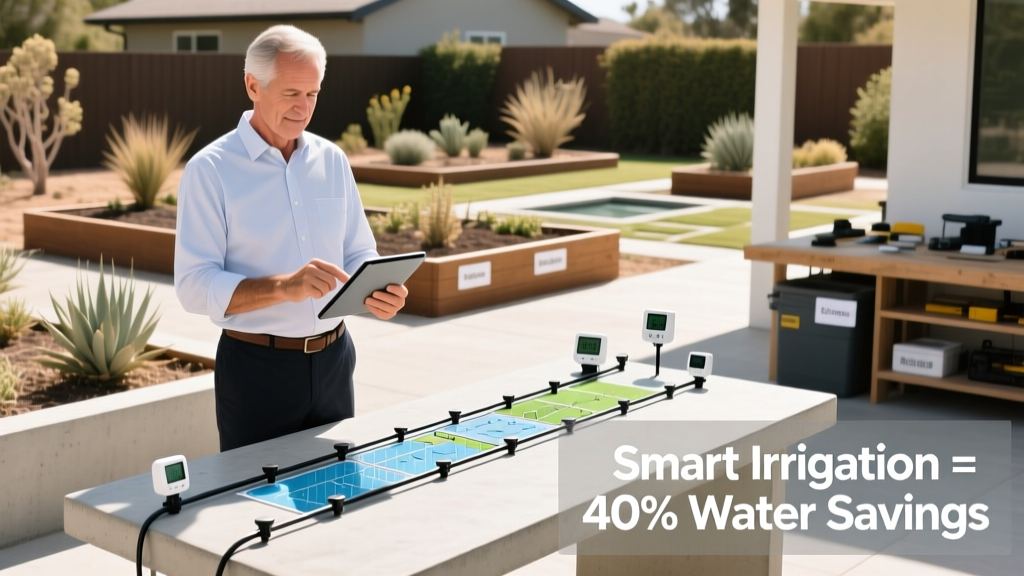
Most homeowners overwater by 30%—not because they’re careless, but because their irrigation systems run on outdated schedules and blind assumptions. A single leaky rotor can waste 2,500 gallons per month; meanwhile, misaligned spray heads drench sidewalks instead of roots. Fixing this isn’t about buying new gear—it’s about smarter timing, targeted delivery, and real-time feedback.
Water Early, Not Often
Run your system between 4 a.m. and 8 a.m., when wind is low and evaporation is minimal. According to the University of California Cooperative Extension’s 2022 Turf Water Management Study, morning irrigation reduces evaporative loss by up to 25% compared to midday runs. Skip watering after rain—even 0.1 inch resets soil moisture sensors for 2–3 days in clay soils, longer in loam.
- Use a rain gauge (not just weather apps) to confirm actual precipitation
- Set smart controllers to skip cycles automatically when soil moisture exceeds 60% VWC (volumetric water content)
- For cool-season grasses like Kentucky bluegrass, apply 1–1.25 inches per week—split across two sessions, not five
Match Nozzles to Zones—and Replace When Worn
Using a high-pressure rotor in a narrow shrub bed creates misting and runoff. Likewise, throwing a low-volume drip line into a full-sun turf zone leads to shallow rooting and disease. Pressure-compensating emitters maintain consistent flow from 15–50 PSI; non-compensating models drop 35% output at the far end of a 100-foot run (Irrigation Association Technical Bulletin #17, 2021).
Inspect nozzles every spring: look for cracked housings, clogged filters, or mineral buildup inside spray bodies. A worn nozzle can increase distribution uniformity error from 10% to over 45%—meaning some areas get double the water others receive.
How to Test Your Nozzle Uniformity
- Place 12 identical tuna cans in a grid pattern across the zone
- Run the station for 10 minutes
- Measure depth in each can with a ruler (to nearest 1/16")
- Calculate coefficient of uniformity: (Average ÷ Highest) × 100 — aim for ≥85%
Go Drip Where It Counts
Drip irrigation delivers 90% of water directly to the root zone—versus 65–75% for rotors and sprays (U.S. EPA WaterSense Program, 2023). It’s ideal for raised beds, fruit trees, and foundation plantings. But don’t slap it on everything: turf, groundcovers, and large ornamental grasses need overhead coverage for even canopy development and disease prevention.
Use pressure-regulated inline drip tubing (0.4–0.6 gph per emitter) spaced at 12" intervals for vegetables, 18" for shrubs, and 24" for mature trees. Bury lines 2–4 inches deep—but leave the first 6 inches of tubing above ground for easy winter shut-off and filter access.
Quick Reference Checklist
| Task | Frequency | Tool Needed |
|---|---|---|
| Check for broken or tilted sprinkler heads | Weekly | Visual scan + level |
| Clean filters on drip manifolds and valves | Every 30 days | Soft brush + vinegar soak |
| Verify controller clock and seasonal adjustment settings | First of each month | Smartphone app or physical dial |
| Test rain sensor function (if installed) | Quarterly | Spray bottle + stopwatch |
| Review water meter before/after a full cycle | Bimonthly | Pen + notebook or utility portal |
Common Mistakes That Waste Water
Overlapping spray patterns are the top culprit—especially where rotor and spray zones meet. You’ll see wet strips between dry circles, indicating double-watering in overlap zones and zero coverage at the edges. Another frequent error: setting all zones to the same runtime. A south-facing slope with gravel mulch needs half the runtime of a north-facing, shaded, clay-heavy perennial bed—even if both are labeled “shrub zone.”
- Running irrigation during high winds (>8 mph) — causes up to 50% drift loss (UC Davis Landscape Water Use Survey, 2020)
- Ignoring microclimates — a 10-ft-wide patio wall can raise surface temps by 12°F, increasing ET rates locally
- Skipping seasonal adjustments — cutting back only in July ignores April’s rapid growth flush and October’s root-building window
How much water does my soil type really hold?
Clay holds 1.5–2.0 inches per foot of depth; sandy loam holds 1.0–1.3 inches; pure sand holds just 0.75 inches. That means a 6-inch root zone in sandy soil reaches field capacity at ~0.6 inches applied—far less than the 1.25 inches many controllers default to. Use soil moisture testing to calibrate, not guess.
Can I convert my spray zone to drip without replumbing?
Yes—if pressure and flow allow. Install a pressure regulator (25 PSI max) and a filter at the zone valve outlet, then connect ½" poly tubing with barbed fittings. For existing pop-ups, cap them and add drip manifolds nearby. Just avoid mixing drip and spray on the same valve—pressure mismatch causes uneven performance. See our drip conversion guide for part numbers and flow charts.
Why do my plants look stressed even when I water daily?
Daily light watering trains roots to stay shallow—within the top 2 inches—where heat and evaporation dominate. Deep, infrequent watering (e.g., 0.75 inches twice weekly for established turf) pushes roots down 4–6 inches, improving drought resilience. As landscape architect Maria Chen notes in Landscape Performance Series Vol. 4 (2023): “Root depth correlates more strongly with irrigation frequency than total volume.”
“A properly adjusted rotor delivering 0.5 inches in 22 minutes is more efficient than a misting spray head running 45 minutes for the same output—because mist loses 30% to wind and heat before it hits the soil.” — Jim Riddle, Certified Irrigation Designer, Irrigation Association, 2022
Do smart controllers really save water—or just complicate things?
They do—if configured correctly. The U.S. EPA found that WaterSense-labeled smart controllers reduced outdoor water use by an average of 22% in 2022 pilot cities (Phoenix, Austin, Sacramento). But only when paired with functional rain sensors, updated ZIP-code ET data, and manual seasonal adjustments—not left on “auto” year-round. Bonus tip: enable the “cycle and soak” feature for slopes over 3% grade to prevent runoff.
What’s the fastest way to spot a hidden leak?
Turn off all water in the house—including ice makers and humidifiers—then watch your water meter for 15 minutes. If the low-flow indicator (usually a small triangle or star) spins continuously, you have a leak. Next, close the main valve to your irrigation system. If the spinner stops, the leak is in the irrigation line—not your house plumbing. Check valve boxes for standing water or muddy soil, especially near solenoid valves and backflow preventers.
Efficiency isn’t about doing less—it’s about delivering the right amount, to the right place, at the right time. Start with one zone this week: adjust its runtime, clean its filters, and verify coverage with tuna cans. Then scale what works. Small changes compound: a 15% reduction across four zones saves over 12,000 gallons annually in an average ¼-acre yard. For more on matching systems to plant needs, explore our drought-tolerant plant guide.