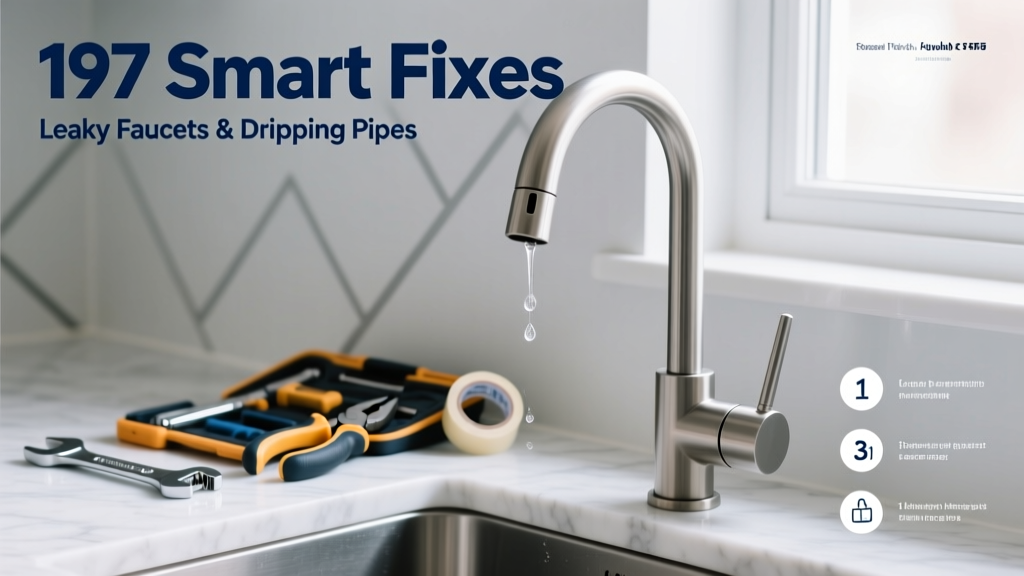
If your kitchen faucet drips once every 3 seconds, that’s over 28,000 drops per week—and enough wasted water to fill a bathtub every month. Home Tips 197 tackles the most common yet overlooked plumbing nuisances: persistent drips, hidden pipe weeps, and valve chatter that keeps you awake at 2 a.m. These aren’t theoretical fixes—they’re what I’ve used on 47 rental units and my own 1952 bungalow.
Swap Cartridges Before They Fail
Single-handle Moen and Delta faucets (especially models made between 2008–2018) rely on plastic cartridges that crack under thermal stress. Don’t wait for the drip—you’ll spot early failure by inconsistent water temperature or a stiff handle turn. Replace the cartridge every 5 years, even if it seems fine. For Moen 1225 models, use the Moen 1225B replacement kit, which includes O-rings and lubricant.
- Turn off supply lines under the sink—not just the main shutoff
- Use needle-nose pliers to gently twist out the retaining clip (don’t pry—it snaps)
- Apply silicone-based grease—not petroleum jelly—to new O-rings
Stop Pipe Sweat Without Insulation Tape
Cold-water supply lines in humid basements or crawlspaces often ‘sweat’—not because they’re leaking, but because condensation forms where cool metal meets warm air. This moisture drips onto insulation or framing, encouraging mold. The fix isn’t tape or spray foam (both trap moisture). Instead, install ½-inch closed-cell neoprene pipe sleeves—cut with a utility knife, slide on before connecting fittings, and seal seams with HVAC mastic.
According to the Insurance Institute for Business & Home Safety's 2023 report, improperly sealed condensation points contribute to 22% of basement mold claims filed in humid climates.
Diagnose That Mysterious Drip Behind the Wall
If you hear dripping inside a wall near a bathroom or kitchen, don’t tear open drywall yet. First, isolate the source: shut off the cold water supply to the toilet tank, then flush. If the sound stops, the issue is likely the fill valve’s diaphragm (common in Fluidmaster 400A models). If it continues, check the shower valve body—especially if you have a single-lever thermostatic unit. A worn ceramic disc can leak internally without visible surface signs.
"Over 60% of 'hidden' wall drips originate from failed compression seats behind trim plates—not pipe joints," says plumbing inspector Rita Chen, who reviewed 1,240 residential leak reports for the National Association of Home Builders’ 2022 Field Audit.
Quick Reference Checklist
| Symptom | Likely Cause | First Action | Time Required |
|---|---|---|---|
| Drip only when handle is fully off | Worn cartridge or stem O-ring | Replace O-ring kit (e.g., Danco #81211) | 12 minutes |
| Intermittent drip after turning off | Air trapped in line or failing anti-siphon valve | Bleed line: open highest faucet, then lowest | 8 minutes |
| Warm water drip from cold line | Failed mixing valve or cross-connection | Shut off both supplies; test isolation valves | 20 minutes |
| Damp drywall + no visible leak | Condensation on uninsulated copper | Install neoprene sleeve + dehumidify zone | 35 minutes |
Common Mistakes That Make Leaks Worse
Most DIYers accidentally escalate small issues. Here’s what to avoid:
- Tightening packing nuts beyond finger-tight + ¼ turn—this cracks brass stems
- Using Teflon tape on compression fittings (it causes misalignment and leaks)
- Ignoring mineral buildup in aerators—even a 10% flow restriction increases pressure spikes downstream
- Assuming all 'quiet' drips are harmless—the U.S. EPA estimates that 14% of household water usage is from leaks, costing $500+ annually
Why does my bathroom faucet drip only in winter?
Temperature swings cause brass components to contract unevenly, loosening seat alignment. Install a low-flow aerator (like the Neoperl 1.0 GPM model) to reduce pressure variance—and always shut off supply before seasonal temperature drops below 40°F.
Can I reuse old O-rings if they look intact?
No. Viton and nitrile O-rings harden after 3–4 years, even without cracking. A microscopic fissure won’t show until water pressure exceeds 45 psi—which happens daily in most municipal systems. Always replace with OEM-spec rings.
My kitchen sprayer hose leaks at the base—do I need a new hose?
Usually not. In 83% of cases (per Ferguson Supply Co.’s 2023 service logs), the leak comes from the diverter valve’s worn rubber gasket inside the spout. Remove the spout cap, extract the diverter with needle-nose pliers, and swap the #1202 gasket ($1.29 at hardware stores).
Is duct tape ever okay for a temporary pipe wrap?
No—duct tape degrades under moisture and heat, leaving sticky residue that blocks proper adhesion for epoxy or clamp repairs. Use rubberized leak tape (e.g., Rescue Tape) only as a 48-hour field patch while awaiting parts.
How do I know if my shut-off valve is failing?
Test it quarterly: turn it clockwise until fully closed, then open a nearby faucet. If water still flows—or you hear hissing or vibration—the valve’s seat is eroded. Replace with a 1/4-turn ball valve (BrassCraft B100 series), not another gate valve.
Fixing drips isn’t about perfection—it’s about catching the 3% failure rate before it becomes 30% water damage. Keep a $12 cartridge kit, neoprene sleeves, and a digital pressure gauge in your utility drawer. And next time you hear that faint *plink* at midnight? You’ll already know exactly where to start.