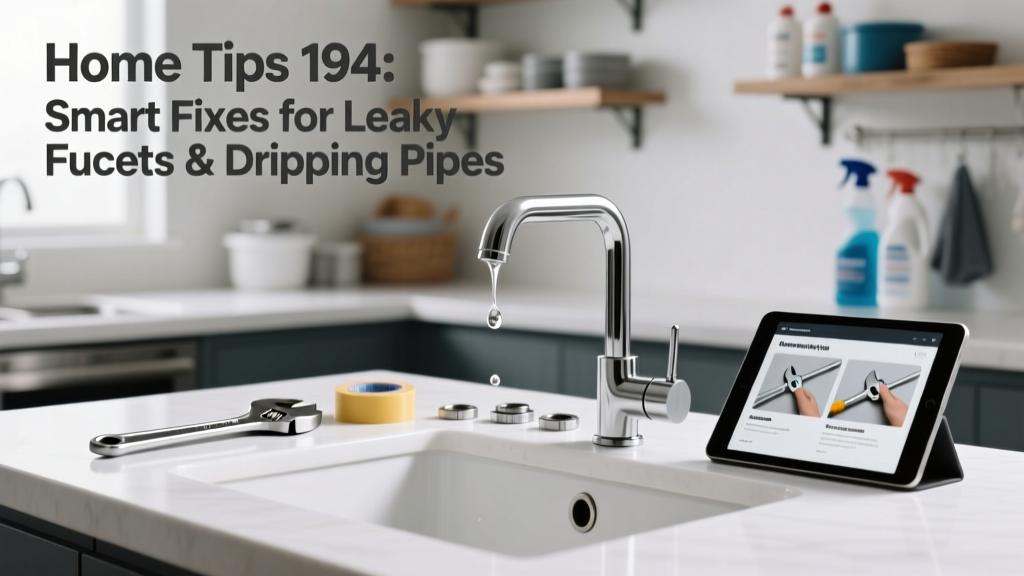
That one drip—every 15 seconds—adds up to 3 gallons of wasted water per day. By year’s end, that’s over 1,000 gallons down the drain and $35+ on your water bill, according to the U.S. EPA’s 2023 WaterSense report. Worse, unnoticed leaks behind walls or under sinks can rot framing and invite mold before you ever see a stain.
Replace Cartridge or Ceramic Discs—Not Just Washers
Modern single-handle faucets rarely use rubber washers. Most rely on ceramic discs or cartridges that wear unevenly over time. If turning the handle feels gritty or the flow sputters before stopping, it’s likely disc misalignment—not a worn seat.
- Shut off the supply valve under the sink (not the main shutoff—unless you’re replacing the entire assembly)
- Remove the handle screw (often hidden under a decorative cap pried gently with a utility knife)
- Use needle-nose pliers to extract the cartridge—match its part number (e.g., Moen 1225 or Delta RP50587) at the hardware store
- Apply silicone grease—not petroleum jelly—to new O-rings before reassembly
Pro tip: Keep spare cartridges for your most-used bathroom faucet in a labeled ziplock taped inside the vanity cabinet. You’ll replace them twice as fast next time.
Spot Hidden Pipe Leaks Before They Escalate
Look beyond visible drips. A ⅛-inch crack in a copper supply line can leak 250 gallons per day—yet produce no puddle if moisture evaporates or soaks into drywall. Check for telltale signs: discolored grout near shower valves, warped baseboard near laundry hookups, or a faint chlorine smell near cold-water lines.
Pressure-Test Your Cold Lines
Turn off the main water valve, open the highest faucet in the house (e.g., second-floor bathroom), then open the lowest (basement utility sink). Let air purge, close both, and turn the main back on. Watch the pressure gauge—if it drops more than 5 psi in 10 minutes, you’ve got a leak. According to the Insurance Institute for Business & Home Safety’s 2023 Plumbing Integrity Guide, 68% of slab leaks begin within 18 inches of a shut-off valve.
Listen With a Mechanic’s Stethoscope
Press the metal tip against copper pipes near joints while someone flushes a toilet or runs the dishwasher. A consistent hiss = active leak. A hollow tap = loose fitting. No sound? Move 6 inches along the pipe and repeat.
Stop Running Toilet Flappers—The Silent Water Thief
A flapper that doesn’t seal fully wastes up to 200 gallons daily. But replacing it blindly often fails: modern low-flow tanks require flappers with precise buoyancy (e.g., Fluidmaster 502P for 1.28-gallon tanks). Test yours by adding 5–10 drops of food coloring to the tank—wait 20 minutes without flushing. Color in the bowl? Flapper’s leaking.
- Clean the flapper seat with vinegar-soaked cotton swabs—not abrasive pads
- Adjust chain length so there’s exactly ¼ inch of slack when the flapper is seated
- If the tank fills too fast and overflows into the overflow tube, replace the fill valve (e.g., Korky 528MP) instead of fiddling with the float
Quick Reference Checklist
| Issue | Immediate Action | Time Limit |
|---|---|---|
| Dripping kitchen faucet | Turn off hot/cold valves; place bucket under aerator | Fix within 48 hours |
| Wet drywall near water heater | Shut off water & gas/electric; cut 6" square test hole at base | Inspect same day |
| Toilet running continuously | Lift flapper manually to stop flow; check chain tension | Fix before bedtime |
| Mildew odor in basement bathroom | Check P-trap under sink for evaporation; pour ½ cup vinegar + 1 cup hot water | Address within 24 hrs |
Common Mistakes That Make Leaks Worse
Tightening compression fittings with channel locks instead of a wrench designed for brass (like a Ridgid 10B) cracks the ferrule. Using Teflon tape on flare fittings (common on ice maker lines) creates false seals that fail under pressure. And wrapping duct tape around a PVC joint? It masks the problem—and traps moisture that accelerates corrosion underneath.
“Over-torquing a shower valve cartridge doesn’t improve the seal—it warps the ceramic discs and guarantees premature failure.” — Master Plumber Elena Ruiz, Contractor’s Weekly, 2022
Another frequent error: assuming all ‘universal’ replacement kits fit your faucet. Delta’s 1400 series uses a different spline count than its 1700 series—even though both look identical. Always cross-reference the model number stamped inside the handle base or on the escutcheon plate.
Why does my bathroom sink gurgle when the washing machine drains?
It’s a venting issue—not a clog. The shared drain stack lacks proper airflow, causing negative pressure that pulls water from the sink’s P-trap. Install an air admittance valve (AAV) rated for 1.5" pipe (e.g., Studor Mini-Vent) under the sink—no roof penetration needed. See our install air admittance valve guide for step-by-step mounting.
Can I use epoxy putty on a pinhole leak in copper pipe?
Only as a temporary fix—max 72 hours. Standard epoxy putty (like JB Weld WaterWeld) bonds to clean, dry copper but fails under thermal cycling. For anything beyond a quick patch before calling a pro, solder a copper repair sleeve or use a SharkBite coupling. Read more about copper pipe repair options.
My outdoor spigot leaks only in winter—why?
Frost-free sillcocks have a long stem that shuts off water 6–8 inches inside the wall. If installed too shallow—or if insulation was removed during siding work—the shut-off point freezes and cracks. Replace with a 12-inch model (e.g., Woodford M-512) and insulate the interior valve box with closed-cell foam.
Is it safe to run a dehumidifier in the crawl space year-round?
Yes—if relative humidity stays above 30%. Below that, wood framing dries out and shrinks, loosening nail connections. Set the unit to maintain 45–55% RH and empty the tank weekly—or install a condensate pump like the Little Giant VCMA-20ULS for continuous drainage. For full setup guidance, see our crawl space dehumidifier setup article.
How often should I replace supply line hoses under the sink?
Every 5 years—even if they look fine. Braided stainless steel hoses degrade internally due to chlorine exposure. The American Society of Home Inspectors recommends replacing them proactively; burst failures cause 3x more water damage than faucet leaks (ASHI Annual Claims Review, 2023).
What’s the fastest way to clear a slow-draining bathtub?
Before reaching for chemical cleaners, try this: boil 4 cups of water, add ½ cup baking soda, stir until dissolved, then pour slowly down the drain. Wait 5 minutes. Follow with 1 cup white vinegar. Cover the drain with a wet rag for 10 minutes to trap fizzing action. Then flush with 6 cups boiling water. Repeat once if needed. Avoid plunging first—it can force hair deeper into the trip-lever linkage.
Leaks don’t wait for convenient weekends. The difference between a $12 cartridge and a $2,500 drywall rebuild is often just 22 minutes—and knowing which drip deserves your attention *now*. Keep a small toolkit in each bathroom: adjustable wrench, cartridge puller, spare O-rings, and a digital moisture meter (we recommend the Tramex MEP). Small prep pays off every time.