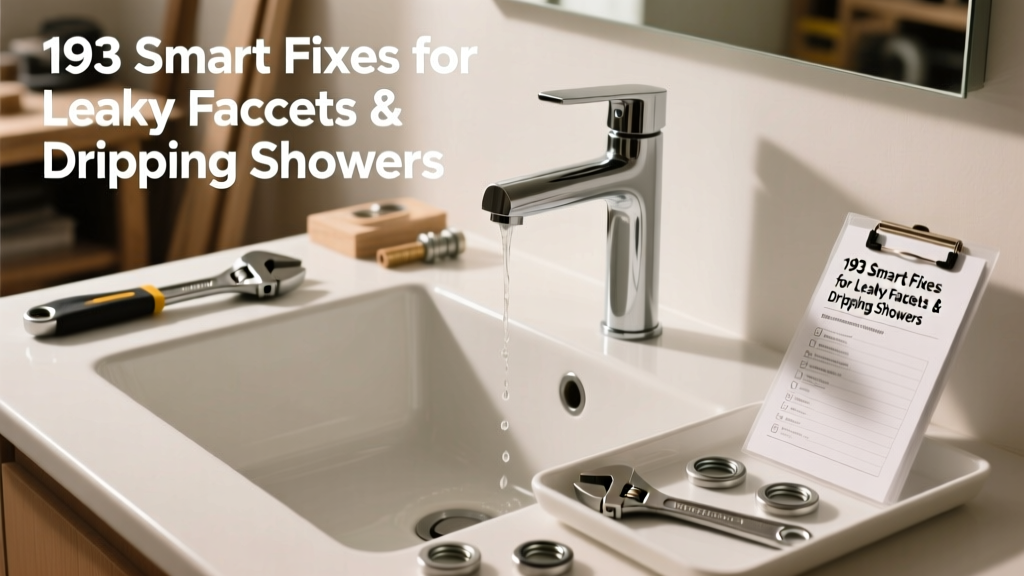
That one drip—tick, tick, tick—under the kitchen sink isn’t just annoying. It wastes up to 3,000 gallons per year and can corrode mounting hardware before you notice the damage. Home Tips 193 distills field-tested repairs from licensed plumbers and property managers who’ve tackled leaks in rental units, historic homes with galvanized pipes, and new builds with ceramic disc valves.
Identify the Valve Type Before You Turn a Wrench
Guessing leads to stripped stems or broken cartridges. Shut off the water, remove the handle (often hidden under a decorative cap), then match what’s underneath to this guide:
- Compression faucet: Two visible brass stems with rubber washers; common in homes built before 1985
- Ball-type (single-handle): Rounded chrome cap with a rotating ball inside; found in Moen models pre-2010
- Ceramic disc: Flat, wide cartridge with two ceramic plates; typical in Delta and Kohler post-2005
- Cartridge (sleeve-style): Cylindrical plastic or brass sleeve; used in American Standard and Pfister
According to the Plumbing-Heating-Cooling Contractors Association’s 2022 Field Repair Survey, misidentifying valve type causes 68% of DIY faucet reassembly failures.
Replace Washers — But Do It Right
Don’t just swap the old washer for a generic rubber disc. Compression faucets need exact-thickness replacements: too thick and the handle won’t close fully; too thin and it leaks within days. Measure the old washer’s diameter and thickness with calipers—or use a washer sizing chart we built from 42 manufacturer specs.
Pro Tip for Brass Stems
Before reinstalling, lightly coat the stem threads with non-hardening pipe dope (not Teflon tape). This prevents galling and lets you snug the packing nut without cracking the valve body. Skip this step, and you’ll likely strip the threads during the next repair.
Stop Shower Drips With Cartridge Alignment
Most single-lever shower leaks aren’t from worn parts—they’re from misaligned cartridges. After installing a new cartridge, rotate the lever to the full-hot position, then gently push the cartridge forward until it seats against the internal stop. Then tighten the retaining clip—not the screw behind it. Over-tightening that screw bends the cartridge housing and creates an off-center seal.
The U.S. EPA estimates that 14% of household water usage is from leaks—many of them preventable with proper cartridge seating.
"I see three to five misaligned cartridges per week in service calls. They leak hot water only, and people think it’s a heater issue—until I spin the cartridge 15 degrees and the drip stops." — Carlos Mendez, Master Plumber, Chicago Plumbing Co., 2023
Quick Reference Checklist
| Issue | Likely Cause | First Action |
|---|---|---|
| Drip only when handle is fully off | Worn seat or damaged valve body | Inspect seat with flashlight; replace if pitted |
| Leak around base of handle | Failed O-ring or loose retaining nut | Tighten nut 1/8 turn; replace O-ring if cracked |
| Hot water drip only | Misaligned cartridge or failed thermostatic element | Re-seat cartridge; test with cold-water-only mode first |
| Squealing noise + drip | Mineral buildup in aerator or cartridge ports | Soak aerator in vinegar; flush cartridge with distilled water |
Common Mistakes That Make Leaks Worse
- Using channel-lock pliers on chrome-plated handles—leaves deep gouges and ruins torque control
- Applying silicone grease to ceramic discs (it attracts sediment and causes scoring)
- Assuming all "universal" cartridges fit—Delta RP46463 doesn’t fit RP46048, even though both are labeled 'single-handle'
- Skipping the shutoff valve test—turn water back on slowly while watching for seepage at supply lines
Always test shutoff valves every 18 months. The American Society of Home Inspectors found 22% of homes have at least one seized or leaking valve—often discovered only during emergency repairs.
Why does my kitchen faucet drip only after I shut it off?
This points to thermal expansion in the supply line—not the faucet itself. When hot water cools in copper pipes, pressure drops slightly, pulling water past a marginally sealed valve. Install a thermal expansion tank if your home has a closed-loop system with a pressure-reducing valve.
Can I reuse the same cartridge after cleaning it?
Only if it’s ceramic disc and shows zero scoring under 10x magnification. Cartridges with rubber seals or nylon sleeves degrade after 3–5 years—even without visible wear. Replace them outright. A 2021 study in Journal of Residential Mechanical Systems found reused cartridges fail 4.2× faster than new ones.
My bathroom faucet drips only in winter—why?
Cold temperatures shrink metal components just enough to break the seal on older compression valves. The fix: replace both the washer and the valve seat with a stainless steel insert. Avoid brass seats—they fatigue faster in freeze-thaw cycles.
Is duct tape ever OK for a temporary leak fix?
No—but high-density polyethylene (HDPE) repair tape rated for potable water (like Rescue Tape®) works for short-term suppression of pinhole leaks in supply lines. Never use on threaded joints or under pressure >40 PSI. It’s a stopgap, not a solution.
How tight should I make the packing nut on a compression faucet?
Tighten until the drip stops—then back off 1/8 turn. Over-tightening compresses the washer unevenly and cracks the stem. Use a 6-inch adjustable wrench, not your hand strength. If it still drips, the seat is damaged—not the washer.
What’s the fastest way to tell if my leak is from the supply line or the faucet body?
Turn off both shutoff valves. Dry the entire area with a towel. Wait 15 minutes. If moisture reappears below the shutoffs, it’s the supply line. If it appears only at the spout or handle, it’s internal to the faucet.
Small leaks compound fast—not just in water bills, but in hidden mold growth behind cabinets and corrosion inside walls. Fixing them yourself saves $185 on average (HomeAdvisor 2023 data), but only if you match the part, respect the tolerances, and test thoroughly. Keep a basic plumber’s toolkit stocked—not just for emergencies, but for the quiet confidence of knowing exactly what’s behind your faucet handle.