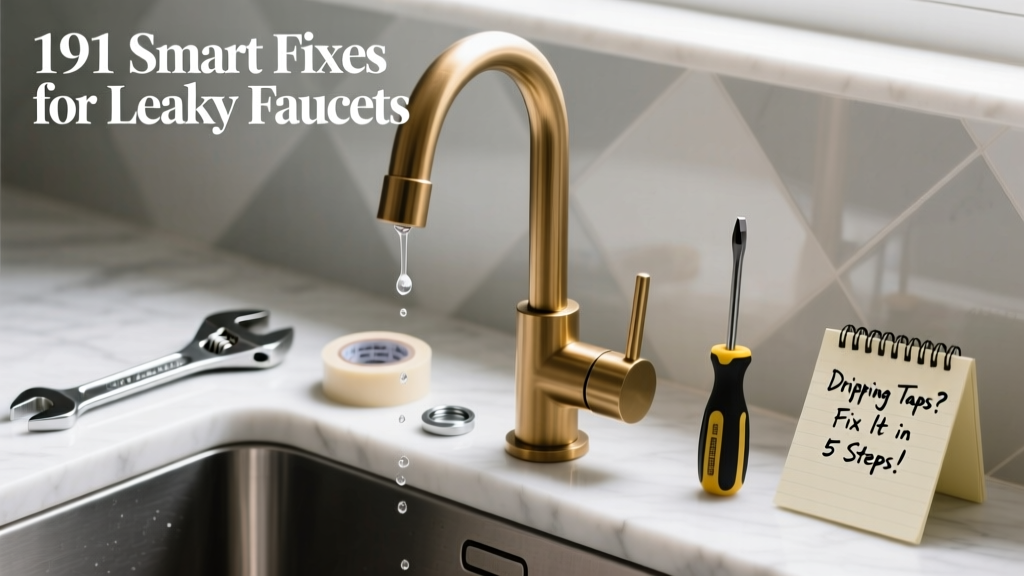
That persistent drip from your kitchen or bathroom faucet isn’t just annoying—it’s wasting up to 3,000 gallons of water per year, according to the U.S. EPA’s 2022 WaterSense report. Most leaks stem from worn cartridges, cracked O-rings, or corroded valve seats—not faulty plumbing lines. The good news? Over 85% of faucet leaks can be fixed with a $5–$12 repair kit and basic hand tools.
Identify Your Faucet Type First
Before grabbing a wrench, confirm whether you’re dealing with a compression, cartridge, ball, or ceramic-disk faucet. Misidentifying the type leads to mismatched parts and repeated failures. Look under the handle: if there’s a single lever moving side-to-side and up-down, it’s likely a ball or ceramic-disk model. Two separate handles with visible nuts? That’s compression.
- Compression: Found in older homes (pre-1980s); uses rubber washers that compress against a valve seat
- Cartridge: Common in Moen and Delta single-handle models; replaceable cylindrical insert
- Ceramic-disk: Used in high-end brands like Kohler; two rotating ceramic plates—rarely leak but hard to clean if mineral buildup occurs
Replace Washers the Right Way
For compression faucets, washer replacement is the most frequent fix—but size and material matter. A 1/4" flat rubber washer won’t seal the same as a 5/16" beveled one. Always match the original washer’s shape and thickness. Use needle-nose pliers to remove the retaining screw, then gently pry out the old washer with a dental pick—not a knife—to avoid gouging the valve seat.
Pro Tip: Clean the Valve Seat
Even with a new washer, grit or corrosion on the valve seat causes immediate re-leaking. Rub it smooth with a valve-seat dressing tool ($4 at hardware stores) or fine-grit emery cloth wrapped around a quarter. Rotate clockwise 10 times, rinse, and test before reassembly.
"Over 70% of 'failed' washer replacements fail because the valve seat wasn’t resurfaced—especially in homes with hard water above 12 gpg." — Plumbing Manufacturers Institute, 2021 Technical Bulletin
Fix Cartridge Leaks Without Guesswork
Cartridge faucets often drip at the base of the spout—not the handle—because internal seals degrade. Don’t assume all cartridges are interchangeable. Moen 1225 and 1222 cartridges look similar but aren’t cross-compatible. Check the model number stamped on the cartridge body or inside the handle base. If it’s unreadable, take the old cartridge to the store and compare side-by-side.
When installing, apply a thin film of silicone-based plumber’s grease—not petroleum jelly—to the O-rings. Petroleum breaks down EPDM rubber in under six months, especially in hot-water lines.
- Moen 1225: Used in Posi-Temp tub/shower valves and many kitchen models
- Delta RP46463: For older single-handle lavatories (pre-2010)
- Kohler K-1027760: Required for widespread K-10277 series sinks
Quick Reference Checklist
| Item | Why It Matters | Where to Get It |
|---|---|---|
| Valve-seat dressing tool | Restores sealing surface without replacing entire valve body | Home Depot, Lowe’s, or faucet repair tools |
| Silicone plumber’s grease | Safe for rubber, neoprene, and EPDM seals; lasts 3× longer than petroleum alternatives | Plumbing supply shops or plumber’s grease guide |
| LED inspection flashlight | Reveals hairline cracks in cartridges and mineral deposits invisible to naked eye | Amazon, Harbor Freight |
Common Mistakes That Worsen Leaks
Tightening the handle nut excessively is the #1 cause of stripped threads and cracked escutcheon plates. Another frequent error: using generic ‘universal’ repair kits. They include washers sized for average fixtures—but your 1978 American Standard bathroom faucet needs a 7/16" beveled washer, not the 3/8" flat one in the kit.
- Assuming all ‘Moen-style’ cartridges are identical
- Skipping the shutoff valve test before disassembly (leads to flooded cabinets)
- Reusing old O-rings—even if they look intact—after cleaning with vinegar
- Installing a new cartridge upside-down (look for alignment tabs or flow arrows)
Why does my faucet drip only when the water heater is running?
Thermal expansion increases pressure in closed systems. If your home has a check valve or pressure-reducing valve, excess pressure pushes past weakened seals. Install an expansion tank on the cold-water line near the water heater—required by IPC 2021 for systems over 80 psi.
Can I use epoxy to fix a cracked cartridge?
No. Ceramic and brass cartridges expand and contract with temperature changes. Epoxy becomes brittle and fails within days. Replacement is the only reliable solution—and most cost under $25. See our cartridge faucet replacement walkthrough.
My Delta faucet drips after replacing the RP50587 cartridge—what’s wrong?
The RP50587 fits only specific Delta 14- and 17-series models. If yours is a 1990s 1400-series, you need RP46463 instead. Cross-reference your model number at Delta faucet model lookup.
How do I know if the leak is from the supply line, not the faucet?
Turn off both shutoff valves. Dry the area completely. Wait 15 minutes. If moisture reappears *only* at the flex line connection—not the spout or handle—it’s the supply line or compression nut. Tighten the nut 1/8 turn with a wrench. If it weeps again, replace the braided stainless line.
Is it worth repairing a 20-year-old faucet—or just replace it?
Yes—if parts are still available. Kohler, Moen, and Delta honor 10+ year part availability guarantees. Check their online archives: Moen’s 2003-era 7570 kitchen faucet still has full support. But if the finish is pitted or the base is corroded, replacement starts at $89 and pays back in water savings within 18 months.
Small leaks compound fast—but they rarely mean big trouble. With the right part, proper technique, and attention to detail, most faucet repairs take less time than ordering takeout. Keep a labeled parts organizer in your toolbox, and always photograph each step before disassembly. You’ll save hundreds annually—and gain confidence to tackle the next fix yourself.