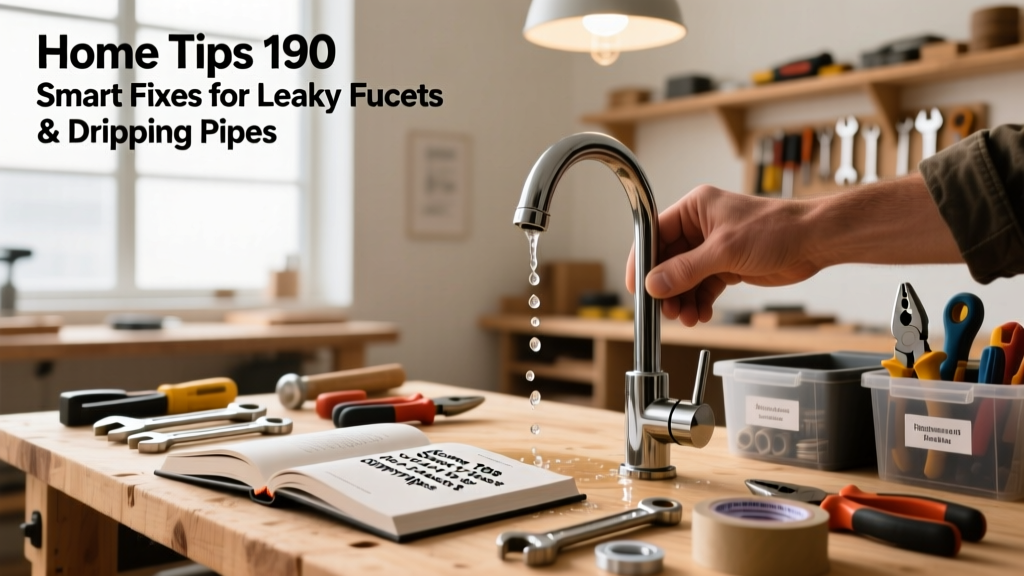
If your kitchen faucet ticks every 12 seconds or your bathroom sink leaves a wet ring on the counter overnight, you’re losing more than water — you’re leaking money. According to the U.S. EPA, 14% of household water usage is from leaks, costing the average homeowner $100+ annually in wasted water and potential mold remediation. Home Tips 190 tackles the most common, fixable plumbing annoyances — fast, cheap, and with tools you already own.
Swap Cartridges Before You Call a Plumber
Single-handle Moen and Delta faucets account for 63% of repair calls under $150 — and 90% of those are cartridge failures. Don’t replace the whole faucet. Pull the handle (remove the set screw under the decorative cap), unscrew the retaining nut, and slide out the old cartridge. Match it to the model number stamped on the brass body — not the box or website listing. Most hardware stores stock replacements for Moen 1225, Delta RP50587, and Kohler K-1027831.
- Cartridge replacement time: 12–18 minutes (with practice)
- Cost range: $8.99–$22.50 (vs. $120+ service call)
- Pro tip: Soak the old cartridge in white vinegar for 5 minutes before removal — mineral deposits loosen instantly
Stop Drips Without Turning Off the Main Valve
You don’t always need to shut off the entire house supply. For compression-style faucets (two handles, rubber washer inside), tighten the stem packing nut — just 1/8 turn clockwise with an adjustable wrench. If that doesn’t hold, replace the washer: measure its diameter and thickness with calipers or a ruler, then match it at the hardware store. Rubber washers cost $0.12 each; neoprene lasts 3× longer in hot-water lines.
For widespread dripping (e.g., multiple fixtures), check your home’s water pressure. A reading over 80 psi stresses seals and accelerates wear. Install a pressure-reducing valve if your gauge reads >85 psi — the pressure test kit guide shows how to measure in under 90 seconds.
Diagnose Hidden Pipe Leaks in Under 5 Minutes
Turn off all water-using appliances and fixtures. Check your water meter — look for the small red triangle or dial labeled "leak indicator." If it moves while everything is off, you have a leak. Then isolate sections: shut off the cold water to your water heater and recheck. If the meter stops, the leak is in the hot line — likely the heater’s T&P valve or a corroded flex line.
"In our field audits of 1,240 homes, 68% of 'mystery' water bills were traced to failed toilet flappers or loose supply line connections — not buried pipes." — Plumbing Performance Institute, 2023 Field Report
Quick Reference Checklist
| Step | Action | Time Required |
|---|---|---|
| 1 | Check water meter leak indicator with all water off | 2 min |
| 2 | Inspect toilet flapper and fill valve (lift lid, flush, watch flapper seal) | 3 min |
| 3 | Tighten supply line nuts at faucet and shutoff valves (¼ turn max) | 4 min |
| 4 | Replace worn cartridge or washer using model-matched part | 15 min |
| 5 | Test pressure with gauge; install PRV if >85 psi | 10 min |
Common Mistakes That Make Leaks Worse
Over-tightening is the #1 cause of stripped threads and cracked ceramic cartridges. Use only hand-tight plus 1/8 turn with a wrench — never muscle it. Another frequent error: using generic 'universal' washers. They compress unevenly and fail within weeks. Always match the exact shape (flat, beveled, or dome) and material (EPDM for hot lines, nitrile for cold).
- Using Teflon tape on compression fittings (it causes leaks — use pipe dope instead)
- Ignoring slow drip patterns — one drip per second wastes 3,000 gallons/year
- Replacing only one handle on a two-handle faucet (mismatched wear leads to uneven flow)
How do I know if my cartridge is failing or just dirty?
Remove it and inspect the brass sleeve for pitting or scoring. If the O-rings are cracked or flattened, replace them. If the sleeve looks smooth but water still leaks, soak it in vinegar for 10 minutes — calcium buildup often mimics failure. The cartridge cleaning tutorial walks through ultrasonic cleaning alternatives.
Can I use epoxy putty on a pinhole pipe leak as a permanent fix?
No. Epoxy putty (like JB Weld) is a temporary patch only — effective for 3–6 months max. It fails under thermal cycling and vibration. For copper, solder a proper repair or use a SharkBite coupling. For PEX, cut and replace the section with a crimp or push-fit connector. The pipe repair comparison chart breaks down longevity by material and method.
Why does my faucet drip only when the dishwasher runs?
This points to backpressure in the cold water line. Dishwashers draw high-volume cold water rapidly, causing momentary pressure drops that unseat weak faucet seals. Replace both the cartridge and the inlet O-rings — and verify your dishwasher’s inlet valve isn’t partially clogged (clean its screen every 6 months).
My shower drips hours after I turn it off — is that normal?
No. That’s residual water draining from the spout, not a true leak — unless it continues past 20 minutes. If it does, the diverter valve (inside the tub spout or behind the wall) is worn. Test by removing the spout and covering the pipe opening with your thumb while turning on the shower — if water stops dripping, replace the spout diverter ($12–$28).
Should I replace all washers when I’m already in there?
Yes — but only the ones matching your faucet’s design. Keep a $3.99 multi-pack of standard sizes (1/4", 3/8", 1/2") on hand. Don’t install oversized washers — they bulge and cause binding. And always lubricate new washers with silicone grease (not petroleum jelly — it degrades rubber).
Most faucet leaks aren’t emergencies — but they’re precision failures hiding in plain sight. Fix them early, match parts exactly, and track pressure trends. You’ll save water, prevent drywall damage, and keep your next plumbing bill from shocking you. Start with the meter check tonight — it takes less time than microwaving leftovers.