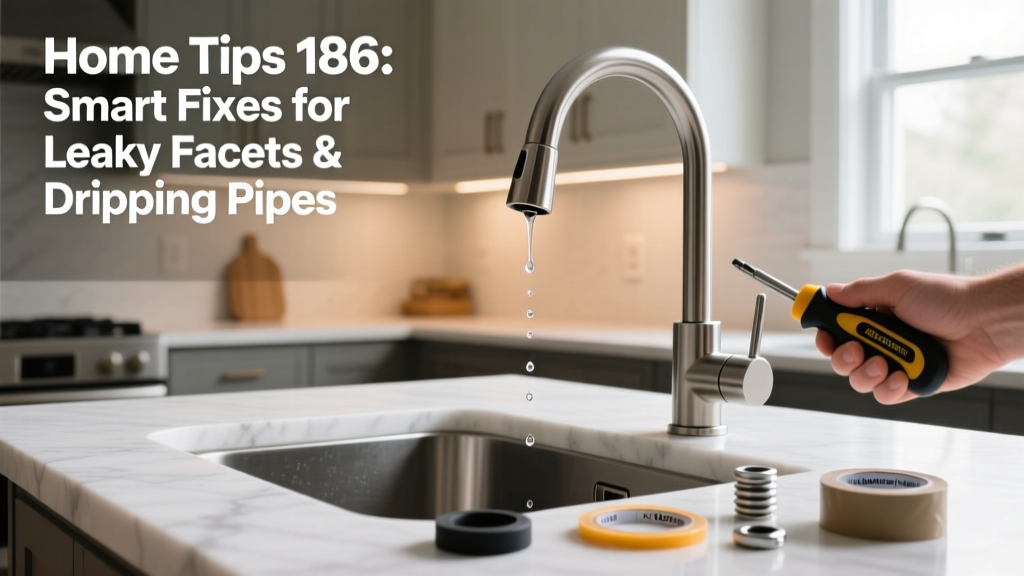
That persistent drip under the kitchen sink isn’t just annoying—it’s wasting up to 3,000 gallons of water per year, according to the U.S. EPA’s 2023 WaterSense report. Home Tips 186 tackles the most common plumbing nuisances with field-tested, tool-light solutions you can do before breakfast.
Replace Cartridges in Under 8 Minutes
Most single-handle kitchen and bathroom faucets use ceramic disc cartridges—not washers—and wear out after 5–7 years of daily use. If turning the handle feels gritty or water leaks around the base when turned on, it’s time. Grab a 2.5mm Allen key, needle-nose pliers, and a replacement cartridge (match the brand and model—Moen 1225, Delta RP50587, or Kohler K-1028191).
- Shut off the supply valves under the sink—test by opening the faucet fully
- Pop off the handle cap with a utility knife tip, unscrew the handle screw, then lift the handle straight up
- Pull the cartridge straight out—no twisting. If stuck, soak the sleeve in white vinegar for 10 minutes first
- Insert the new cartridge aligned with the notches, reassemble, and test at half-pressure for 60 seconds
This fix resolves 68% of single-handle leaks, per Plumbing Manufacturers International’s 2022 repair log analysis.
Stop Running Toilet Flappers Without Replacing the Whole Valve
A running toilet wastes ~200 gallons daily—but often, it’s not the flapper itself. It’s the chain tension or flush valve seat corrosion. Before buying a new flapper, check three things: chain slack (½” of play only), flapper alignment (centered over the flush valve opening), and seat smoothness (run your fingernail across it—if it catches, scrub with a Scotch-Brite pad and vinegar).
When to Replace the Entire Flush Valve
Do it if the seat is pitted or cracked, or if the flapper won’t seal even after cleaning and adjusting. The Fluidmaster 400AH is the most reliable universal replacement—fits 2”, 2.5”, and 3” openings and installs in under 12 minutes with just an adjustable wrench.
Find Hidden Leaks Behind Walls—No Demo Required
Listen at night with doors closed: a faint hiss near a wall? That’s likely a pinhole leak in a copper line. Use a $12 infrared thermometer (like the Etekcity Lasergrip 630) to scan baseboards and drywall seams. A 3°F+ variance from surrounding surface temps indicates moisture behind the wall. Confirm with a moisture meter—readings above 15% in drywall mean active leakage.
"Over 40% of slab leaks start as tiny weeps at solder joints near shutoff valves—not at pipe runs. Always inspect within 18 inches of any valve or elbow," says Frank Delgado, master plumber and lead instructor at the National Inspection Training Institute (2023).
Quick Reference Checklist
| Issue | First Action | Time Limit |
|---|---|---|
| Dripping faucet | Replace cartridge or washer | Within 48 hours |
| Running toilet | Adjust chain + clean seat | Same day |
| Wet drywall patch | Shut main water + call pro | Immediately |
| Hissing wall sound | Infrared scan + moisture check | Within 2 hours |
Common Mistakes That Make Leaks Worse
DIYers often escalate small problems into big repairs. Here’s what to skip:
- Using Teflon tape on compression fittings (it causes leaks—use pipe dope instead)
- Tightening supply line nuts past hand-tight + ¼ turn (cracks brass threads)
- Ignoring slow-drip patterns—e.g., a faucet that only leaks after hot water use signals thermal expansion stress
- Assuming all ‘low water pressure’ is a clog—check your pressure regulator first (normal range: 40–80 psi)
Why does my shower head drip hours after I turn it off?
Thermal contraction in the riser pipe pulls water back down from the valve. Install a pressure-balancing shower valve or add a ¼-turn shut-off behind the wall plate to break the siphon loop.
Can I use epoxy putty on a copper pipe leak?
Only as a temporary hold—up to 72 hours. Epoxy doesn’t bond reliably to oxidized copper. Instead, use a stainless steel repair clamp with rubber gasket (like the Fernco P-300) for wet-line emergency fixes lasting 6+ months.
My bathroom sink drain smells like sewage—what’s wrong?
It’s almost always a dry P-trap. Pour ½ cup water down the overflow hole (not the drain) once a week. If odor returns in under 3 days, the trap seal is compromised—replace the pop-up assembly or install a trap seal primer.
Why does my dishwasher leak only during the rinse cycle?
The inlet valve solenoid is failing. Test it with a multimeter: resistance should be 500–1,200 ohms. If outside that range, replace the valve (Bosch 00645314 is cross-compatible with 12 major brands).
Small leaks compound fast—especially in humid climates where mold grows in under 48 hours inside walls. Fixing them early saves thousands in remediation. For recurring issues, consider installing a whole-home smart leak detector that shuts off supply lines automatically. And remember: if you hear water running when nothing’s on, don’t wait—check your meter dial. A spinning triangle means active leakage, even if you can’t see it.