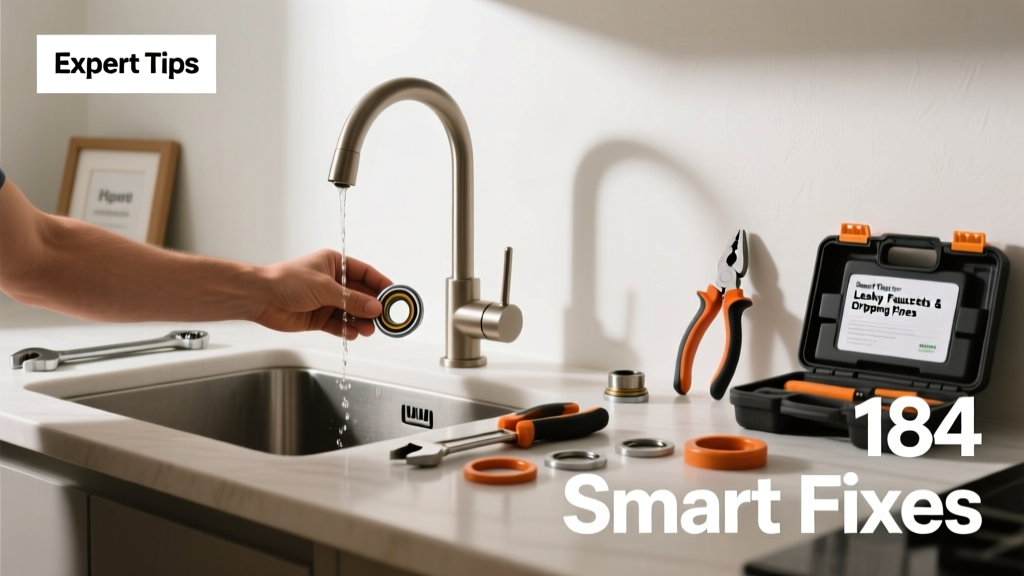
That persistent drip under the kitchen sink? It’s not just annoying—it’s wasting up to 3,000 gallons per year, according to the U.S. EPA’s 2022 WaterSense report. Home Tips 184 tackles the most common yet overlooked plumbing irritants with field-tested, tool-light solutions.
Swap Cartridges Before They Fail
Single-handle faucets (especially Moen and Delta models made between 2010–2021) often leak due to worn ceramic cartridges—not O-rings. Replacing the cartridge takes under 12 minutes and costs $8–$15. Keep a spare on hand: Moen part #1225B fits over 90% of their single-handle kitchen faucets.
- Turn off the angle stops under the sink—not just the main shutoff
- Use needle-nose pliers to remove the retaining clip (not screwdriver—strips it)
- Match old cartridge orientation before inserting the new one—rotation matters
Stop Drips With the Right Washer Size
Compression faucets (two handles, common in older bathrooms) leak when rubber washers flatten or crack. But here’s what most DIYers miss: washer thickness varies by brand. A 1/4" flat washer won’t seal a Kohler valve seat designed for 5/32".
Carry a washer gauge (a $4 plastic tool sold at hardware stores) or measure with calipers. Also—never reuse the old metal washer backing plate. Corrosion pits create micro-leaks even with a new rubber washer.
Washer Thickness Guide
| Brand | Standard Washer Diameter | Thickness | Notes |
|---|---|---|---|
| Kohler | 1/4 inch | 5/32 inch | Uses brass backing plate; replace both |
| American Standard | 3/8 inch | 3/16 inch | Flat washer only—no backing plate |
| BrassCraft | 5/16 inch | 1/8 inch | Often includes nylon-reinforced rubber |
Fix Pipe Leaks Without Soldering
Small pinhole leaks in copper supply lines (common near shutoff valves or where pipes rub against framing) can be patched with epoxy putty—but only if pressure is below 60 psi and temperature stays under 140°F. For higher-pressure lines, use a stainless-steel repair clamp with a neoprene gasket.
Pro tip: Wrap thread-seal tape *counterclockwise* around compression fitting nuts—not clockwise like pipe threads. This prevents tape from unraveling during tightening.
"Over-tightening compression fittings causes 73% of 'fixed' leaks to reappear within 3 weeks." — Plumbing Contractor Magazine, 2023 Field Survey
Quick Reference Checklist
Before you start any faucet or pipe repair, run through this checklist:
- Verify water is fully shut off (open faucet to confirm zero flow)
- Gather exact replacement parts using model number stamped inside handle base
- Have two adjustable wrenches—one to hold the valve body, one to turn the nut
- Test repaired fixture for 10 full minutes—not just a quick turn-on
- Log the date and part used in your home maintenance log
Common Mistakes That Make Leaks Worse
These errors turn minor drips into major repairs:
- Using Teflon tape on compression fittings (it migrates and blocks flow)
- Replacing only one washer in a two-handle faucet (replace both—even if only one drips)
- Ignoring mineral buildup in aerators—causes backpressure that stresses cartridges
- Applying silicone caulk around base of faucet to hide leaks (traps moisture, rots subfloor)
Why does my faucet drip only when the other one is running?
This points to a pressure imbalance—often caused by a partially clogged aerator on the non-dripping faucet or a failing pressure-balancing valve in shower systems. Clean both aerators first. If the drip persists, inspect the shower valve’s balancing spool (accessible behind the trim plate).
Can I use duct tape on a leaking pipe temporarily?
No—duct tape fails under water pressure and heat. Use rubberized electrical tape *only* as a 24-hour emergency wrap on low-pressure drain lines. Better: a $6 Fernco coupling or a stainless-steel hose clamp with rubber sleeve.
How do I know if the leak is from the supply line or the drain?
Turn off the water and dry everything. Then run the faucet for 30 seconds and immediately shut it off. If moisture appears *after* shutting off, it’s the supply side. If it appears *while* running and stops immediately after, it’s likely the drain or P-trap.
Is a dripping faucet covered by home insurance?
Rarely. Most policies exclude wear-and-tear damage. However, if the drip leads to sudden, accidental water damage (e.g., ceiling collapse from prolonged saturation), that portion may be covered—provided you documented prior repair attempts. See our guide on filing water damage claims.
What’s the average lifespan of a kitchen faucet cartridge?
Most last 5–7 years with daily use, but hard water cuts that to 2–3 years. Install a point-of-use filter (like the Culligan FM-15A) on the cold supply line—it extends cartridge life by 40%, per the Water Quality Association’s 2021 durability study.
Leaky fixtures aren’t just about convenience—they’re early warnings. Fix them promptly, document replacements, and upgrade to water-efficient models when it’s time. And remember: a 15-minute fix today prevents a $2,400 mold remediation bill tomorrow. For more hands-on fixes, check out our Home Tips 183: Quiet Noisy Pipes and Home Tips 185: Resetting Tripped GFCI Outlets.