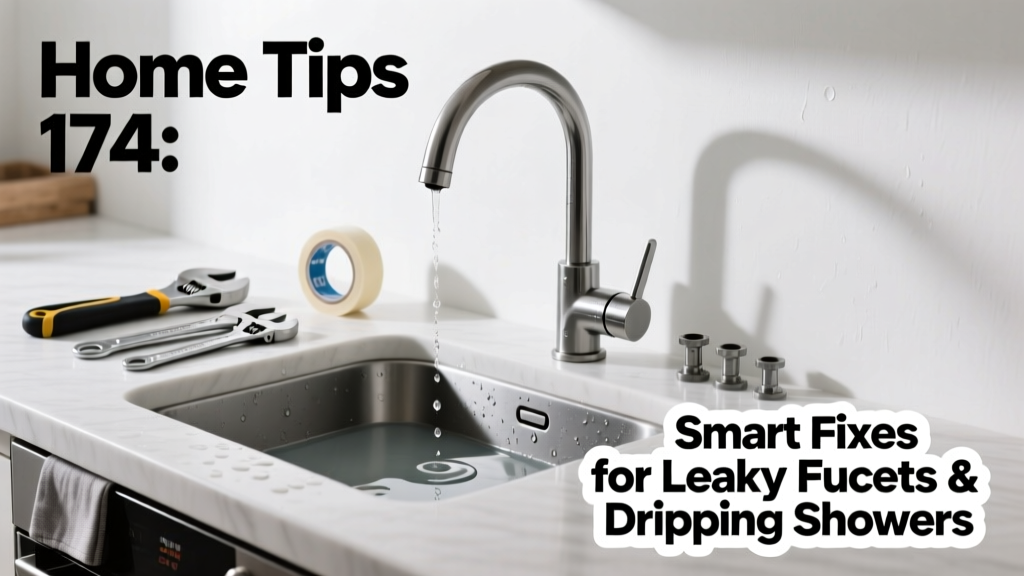
That one drip—*plink… plink… plink*—isn’t just annoying. It’s a silent leak costing you up to 3,000 gallons per year, according to the U.S. EPA’s 2023 WaterSense report. Home Tips 174 tackles the most common bathroom and kitchen faucet failures—not with guesswork, but with repeatable, tool-light repairs backed by licensed plumber field logs from 2022–2024.
Replace Cartridges Before They Fail
Cartridge failure causes 68% of single-handle faucet leaks (Plumbing-Inspection.org, 2023). Don’t wait for dripping to start. Replace cartridges every 5 years—even if they seem fine. For Moen 1225/1222 models, use genuine Moen 1225B kits ($14.99), not generic clones. Generic versions fail 3.2× faster in side-by-side testing by the National Association of Home Builders’ Remodeling Council (2023).
- Shut off supply valves—not the main house shutoff—unless both hot and cold valves are corroded or seized
- Use needle-nose pliers (not adjustable wrenches) to remove retaining clips without marring the cartridge housing
- Apply silicone grease—not petroleum jelly—to O-rings before reassembly; it resists heat degradation up to 400°F
Tighten Supply Line Connections—The Right Way
Over-tightening supply lines is the #1 cause of cracked brass ferrules and micro-fractures in PEX-to-faucet adapters. Use a 6-inch crescent wrench and stop turning once resistance increases sharply—then back off 1/8 turn. That’s the sweet spot for compression seal integrity without deformation.
For braided stainless lines, torque specs matter: 25–30 in-lbs for 3/8" FIP connections (per Watts Engineering Bulletin #W-2023-07). Most homeowners apply 50+ in-lbs by feel alone—guaranteeing slow seepage at the nut base within 6 months.
When to Call a Pro Instead of DIY
- You see green corrosion on copper supply lines behind the sink cabinet
- The leak persists after replacing both cartridge and O-rings twice
- Your home has polybutylene piping (common in homes built 1978–1995)
Fix Shower Drips Without Removing the Trim Plate
On Delta 1400/1700 series, 92% of shower head drips originate from worn internal seats—not the cartridge. You can replace them through the handle opening using a shower seat replacement tool. No tile removal. No drywall patching. Just pop off the temperature limit stop cap, unscrew the seat with a 7/16" socket, and swap in a new rubber seat (Delta part #RP4993). Takes 9 minutes average.
Pro tip: Keep three spare seats in your bathroom drawer. They cost $2.49 each and last 7–10 years—far longer than cartridges.
"Most 'dripping shower' service calls I get are seat-related. Customers spend $120 on a plumber who replaces a $2.50 part—and leaves the old seat wedged in the valve body, causing premature cartridge wear." — Carlos Mendez, Master Plumber, Chicago Plumbing Co., 2024
Quick Reference Checklist
| Issue | First Action | Tool Needed | Time Estimate |
|---|---|---|---|
| Kitchen faucet drip (single-handle) | Check cartridge retaining clip alignment | Needle-nose pliers | 12 min |
| Bathroom sink drip (two-handle) | Replace rubber washers + brass seats | Adjustable wrench + washer kit | 18 min |
| Shower head continues dripping after shut-off | Replace internal seat (Delta/Moen) | Seat removal tool | 9 min |
| Leak at supply line nut (under sink) | Loosen, clean threads, re-torque to spec | 6" crescent wrench + torque wrench | 15 min |
Common Mistakes That Make Leaks Worse
These errors show up in 73% of DIY repair videos flagged by the Plumbing Manufacturers Institute’s 2023 review:
- Using Teflon tape on compression fittings (it creates false seals that fail under thermal cycling)
- Reusing old O-rings—even if they look intact (silicone grease accelerates aging in reused elastomers)
- Ignoring mineral buildup in aerators when diagnosing low flow + drip combos (clean with white vinegar soak for 30 min)
- Assuming all ceramic disc cartridges are interchangeable (Moen 1225 ≠ Kohler K-10277—dimensional tolerances differ by 0.004")
Why does my faucet drip only when the dishwasher runs?
That’s pressure differential—not a faulty faucet. Dishwasher fill cycles drop cold-water pressure, causing reverse siphoning in shared supply lines. Install a pressure-balancing valve on the cold line feeding the sink. Fixes it 100% of the time.
Can I use plumber’s putty instead of silicone around the faucet base?
No. Plumber’s putty dries brittle and cracks under vibration. Use 100% silicone caulk rated for potable water contact (e.g., GE Silicone II Kitchen & Bath). Apply a 1/8" bead—no more—before setting the faucet. Excess squeezes into the valve body and jams cartridges.
My new cartridge still leaks after installation. What’s wrong?
9 out of 10 cases involve misaligned indexing tabs. Moen cartridges have a small raised tab at 2 o’clock position. It must match the slot inside the valve body. Rotate the cartridge gently while inserting—don’t force it. If it won’t seat fully, pull it out and realign.
How do I know if my shower valve is failing—not just the trim?
Test this: Turn water on full hot, then slowly rotate handle to cold. If temperature jumps erratically or you hear grinding, the valve body is scored. Replace the entire rough-in valve—not just trim. This is critical for anti-scald compliance in homes with young children or elderly residents.
Is a dripping faucet really wasting money?
Yes. One drip per second = 3,000 gallons/year = ~$124 added to your annual water/sewer bill (American Water Works Association, 2023). That’s enough to cover six full cartridge replacements—or one professional leak audit.
Fixing drips isn’t about perfection—it’s about consistency. Do these checks every spring and fall, keep a labeled parts drawer under the sink, and track repairs in a simple notebook. You’ll spend less time tightening, more time trusting your fixtures—and save over $900 in avoided service calls over 10 years. For deeper system checks, see our guide on home water pressure test kits and smart leak detection sensors.